28 May, 2026
Head count at large Nordic banks declines for 1st time since 2021
By Adrian Jimenea and Marissa Ramos
The total number of employees at the six largest banks in the Nordic region declined for the first time in at least five years as the integration of AI into the companies accelerates.
The aggregate number of employees, measured as full-time equivalents (FTEs), across the six largest banking groups in the region was 107,681 at the end of 2025, down from 108,984 a year earlier, according to S&P Global Market Intelligence data. This upended the growth in each year from 2021 until 2024.
The sampled banks were Nordea Bank Abp, DNB Bank ASA, Svenska Handelsbanken AB (publ), Skandinaviska Enskilda Banken AB (publ), Danske Bank A/S and Swedbank AB (publ).
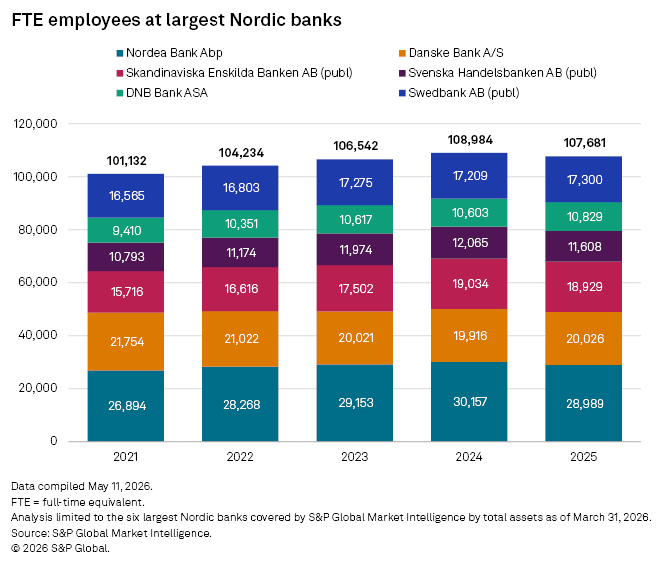
The head count reduction underscores increasing pressure for banks to protect their earnings as the profit boom from elevated interest rates in recent years diminishes. Experts have said the next few years will be a cost-management game for these banks.
Nordea's head count reduced by 1,168 in 2025, and Handelsbanken by 457, according to Market Intelligence data. SEB, which reduced its FTEs by 105, imposed a temporary hiring freeze in June 2025.
Though not all sampled banks reduced head count, those that increased have since announced layoff plans.
Swedbank, whose head count increased to 17,300 from 17,209, unveiled in April cost-cutting measures that would reduce its FTEs by around 500. Danske Bank's 2025-end head count rose to 20,026 from 19,916, but the company announced in February that it had made 420 positions redundant, mostly in its home country. Danske announced 262 additional redundancies on May 28.
Compensation-related payments typically account for the majority of a company's operating expenses. The share of such costs in the sampled bank's total operating expenses is poised to decline in 2027 versus 2025, according to Visible Alpha estimates.
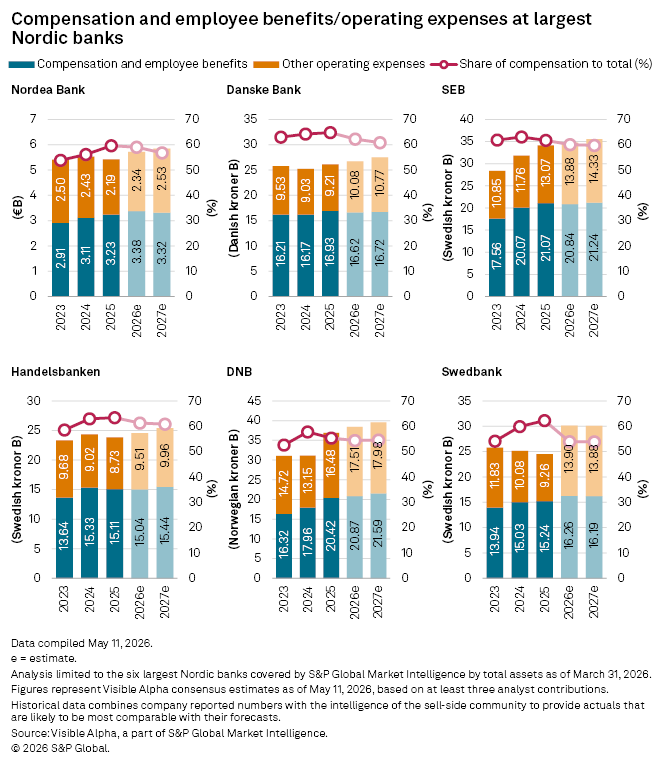
Swedbank is projected to record the largest decline, at 8.36%, followed by Danske Bank at a far second, with a projected reduction of 3.95%. The share of salaries to Nordea Bank's total expense pool is projected to decline by 2.83%.
Citi Research previously posited that Swedbank could actively pursue cost savings following an investigation by New York regulators into alleged historical participation in illicit transactions. Financial crime could be an area where the bank can automate manual processes, analysts said.
Danske Bank also cited automation for the redundancies it announced in late February. Nordea was more candid about the impact of technology, saying it expects fewer employees in the future due to AI and process optimization.
"We do think that IT investments, especially in AI, are going to be there to stay. We think we will see more of the efficiency gains going forward," Sonja Förster, senior vice president for European Financial Institution ratings at Morningstar DBRS, said in an interview.
Handelsbanken's salary-to-total expenses ratio in 2027 is projected to be around 60.80%. The bank operates under a decentralized business model, with branches having autonomy in decision-making. The bank has completed its cost-cutting push for efficiency and has no plans to implement another one soon, CEO Michael Green said during an earnings call.
Handelsbanken has the largest Nordic branch network in the sample, with 639 branches, most of which are in Sweden.
"We will not interfere with our home markets. We will not interfere with our branch office managers," Green said about head count and related costs. "Ultimately, they decide."
Visible Alpha is a part of S&P Global Market Intelligence.