06 May, 2026
Gulf banks brace for Middle East war impact with hefty Q1 loan loss provisions
By Deza Mones and Beenish Bashir
Banks in the Gulf are preparing for higher credit impairments as the fallout of the war in the Middle East begins to weigh on their loan books.
Loan loss provisions at First Abu Dhabi Bank PJSC
The loan books of banks in the United Arab Emirates are expected to face increasing pressure from their exposure to the real estate sector, which is a major lending line. Analysts anticipate a slowing of the real estate sector due to the war, along with potential deterioration of asset quality and an increase in loan loss provisions.
The United Arab Emirates' central bank was the first to roll out broad support measures for banks after hostilities broke out, targeting access to liquidity and funding, temporary relief from capital requirements, and loan classification flexibility. The proactive measures should provide banks with "some flexibility and additional resources to navigate through the stress," S&P Global Ratings said in a recent report.
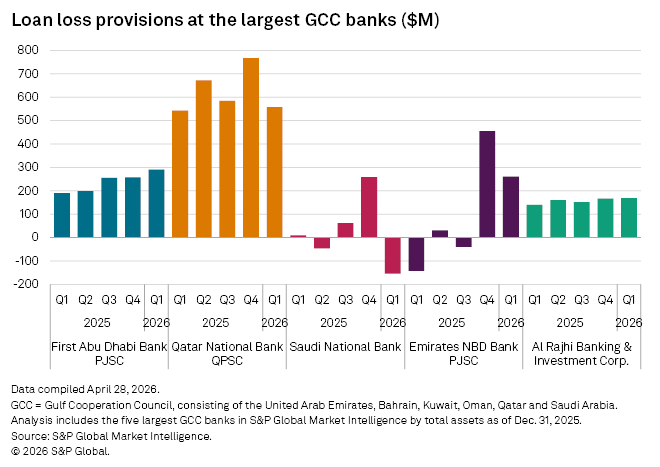
FAB said its provisions included 300 million dirhams of additional expected credit losses (ECL) to reflect "elevated short-term volatility." Emirates NBD, meanwhile, cited "prudent provisioning" across the bank and Turkish unit Denizbank AS as well as an additional ECL charge of 865 million dirhams "in light of the evolving geopolitical environment."
At Saudi Arabia's Al Rajhi Banking & Investment Corp., loan loss provisions rose to $168.2 million. This was somewhat offset by the securitization of nearly 1.4 billion riyals of customer loans in the first quarter to further boost its liquidity and capital profile, CFO Abdulrahman al-Fadda said during an April 28 earnings call.
Saudi National Bank
Banks across the region are projected to increase their provisions for loans and lease losses in the next two financial years. In aggregate, provisions are forecast to reach $11.59 billion in 2027, up from $7.63 billion in 2025, according to Visible Alpha estimates as of March 24.
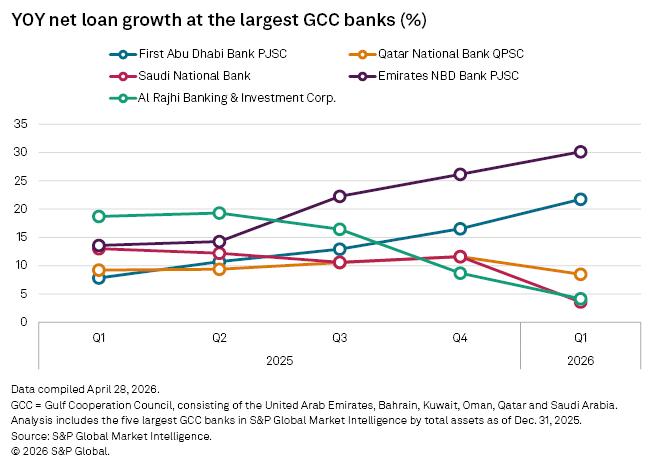
Loan growth set to slow
Net loans grew 4.2% at Al Rajhi and 8.5% at Qatar National Bank QPSC. UAE banks FNB and Emirates NBD registered double-digit net loan growth of 21.7% and 30.1%, respectively.
Loan growth in the region is now expected to be lower than initially projected, S&P Global Ratings said, adding that the war's impact on banks' asset quality should become apparent over the next few quarters.
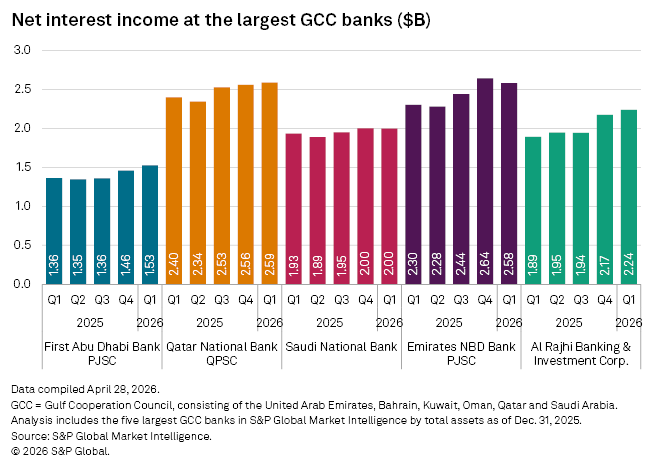
Lending income rose at all five banks in the first quarter, led by Al Rajhi Bank. Its net interest income (NII) — the difference between interest earned on loans and that paid out on deposits — climbed 18.4% on a yearly basis to $2.24 billion. NII growth at SNB was more muted.
FNB and Emirates NBD both recorded NII growth of more than 12%, while QNB logged an 8% uptick.
– Set up alerts for the Middle East & Africa Monitor, a weekly roundup of key financial news in the MEA region.
– Compare banks using the Peer Analysis template on S&P Capital IQ Pro.

A prolonged war will result in weaker economic growth and lower business activity and would likely translate into slower credit growth and lower non-interest income for Saudi banks, Fitch Ratings wrote in an April report.
"Higher inflation and higher-for-longer interest rates would pressure net interest margins, with increased competition for liquidity raising the cost of funding," Fitch analysts said.
Uncertainty regarding the war and its impact on energy prices and inflation more broadly has prompted major central banks around the world to pause rate-cutting cycles. As widely expected, the US Federal Reserve on April 29 held its key interest rate steady. Central banks in the Gulf including the UAE, Saudi Arabia and Qatar have moved in lockstep due to their currencies' peg to the US dollar.
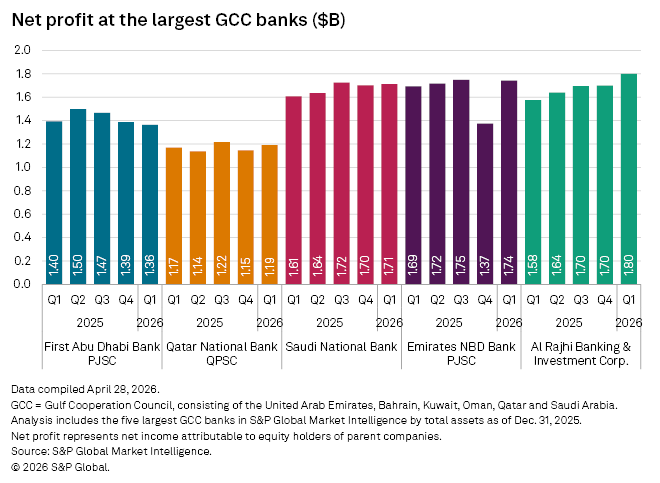
Overall, the five Gulf banks reported robust first-quarter results.
Al Rajhi Bank recorded a double-digit profit growth of 14.3% year over year to $1.80 billion, while SNB posted a 6.6% increase to $1.71 billion. FAB was the only one to record a decline, as its profit slipped 2.2% to $1.36 billion.
The results reflect a "decent quarter" for Gulf banks and indicate limited impact, so far, from the war, analysts at Citi Research said in a May 4 note.
As of May 4, US$1 was equivalent to 3.67 United Arab Emirates dirhams and 3.75 Saudi Arabian riyals.