27 May, 2026
Electric co-ops, states watch FEMA ahead of storm season as grants begin to flow

By Karin Rives
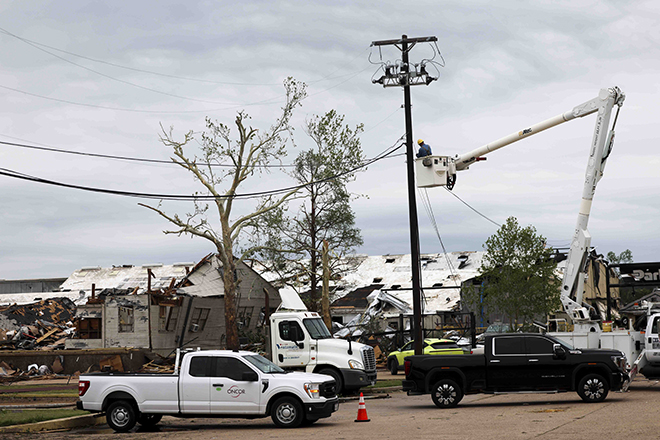
| Utility workers restore power after a major tornado tore through North Texas on April 29, 2026, killing two people. Source: Shafkat Anowar/The Dallas Morning News via Getty Images. |
Electric cooperatives, state floodplain managers and emergency preparedness officials in the US are heading into the 2026 hurricane and wildfire season with questions about what role the federal government will play if disaster strikes.
The Federal Emergency Management Agency is operating with nearly half of senior leadership positions unfilled and 5,000 fewer employees than it had in January 2025.
An agency review board appointed by the Trump administration did not propose to close the agency, as some had feared, but it recently called for shifting more responsibilities and disaster-related costs to states. Its May 7 report also proposed more FEMA staff cuts over the next several years.
"The loss of the institutional knowledge and memory of the senior leadership — it will take years to recover from that," Chad Berginnis, executive director of the Association of State Floodplain Managers, said in an interview. "I expect things will be even slower coming back online because there's simply not enough people to do the kind of behind-the-scenes work to review and approve contracts."
FEMA did not respond to questions about its staffing or preparedness for the 2026 summer season.
Years-old disaster requests approved
FEMA has in recent weeks begun to release previously frozen funding, in part due to court orders, making a dozen announcements that brought good news to several power providers.
On April 23, Midwest Energy Inc. was approved for $18.7 million in FEMA recovery funds for two storms in 2022 and 2023 that affected more than 251 miles of the electric cooperative's lines in Kansas.
Five days of heavy ice, snow and wind in March 2022 damaged electric transmission and distribution systems in nine Kansas counties, according to Mike Morley, the utility's director of corporate communications and government affairs. Then in July 2023, storms and tornadoes damaged poles, conductors, transformers and other hardware that had to be replaced, Morley said in an email.
Midwest Energy has 10 disaster declarations pending at FEMA, with seven stemming from events in 2024 and 2025 and the oldest going back to 2021, Morley said.
Secretary of Homeland Security Markwayne Mullin, who took office in late March, announced another batch of disaster funding approvals on April 23 that included nearly $27 million for the Satilla Rural Electric Membership Corp. in Georgia. The cooperative's grant covers emergency power restoration work needed after Hurricane Helene knocked out power for nearly all of its 58,000 members in 2024.
The French Broad Electric Membership Corp. in Western North Carolina was approved for a $7.3 million grant earlier that month. The money will be used to repair a hydropower dam that was damaged by Hurricane Helene.
"The movement of grants seems to be accelerating and probably represents some return to normalcy after Secretary Mullin took charge at DHS," Andrew Rumbach, a senior fellow with the Urban Institute and disaster recovery expert, said in an email. "I think it is too early to judge whether the staff reductions at FEMA and DHS will impact the overall administrative timeline for grants, but some of the barriers that were in have been removed and that is helping."
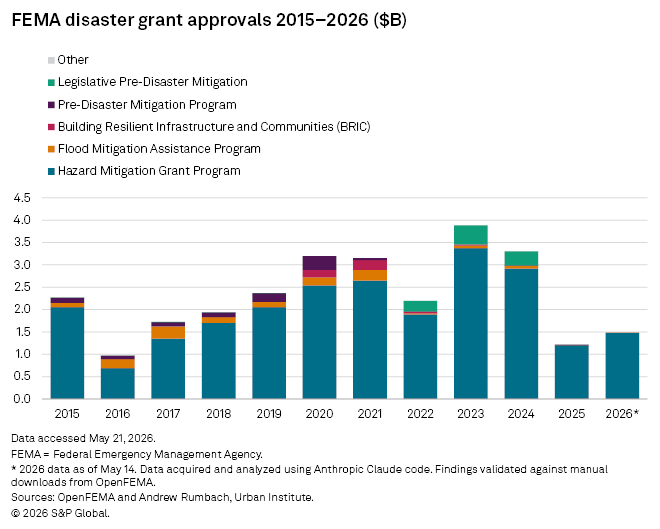
The longest government shutdown in US history added to grant delays, some electric co-ops reported.
On May 22, FEMA announced it had approved $175 million in post-disaster funding for communities across the country — including nearly $1 million in costs that Tennessee's Greeneville Energy Authority incurred from Hurricane Helene.
The utility lost 107 power poles, 44 transformers and nine miles of electric wires in that disaster, Paige Mengel, Greeneville's CFO, said in an interview. The federal money has yet to be paid out, but FEMA processes have always been slow, she added.
"I think, if anything, the government shutdown probably had more of an effect because they weren't able to work [at all] on these kinds of projects then," Mengel said in reference to the 43-day federal shutdown in the fall of 2025. "They were only doing emergency projects."
'Take on disaster recovery overnight'
Yet, even as FEMA appears determined to process backlogged grants, questions remain about who will provide resources in the coming months.
The agency's top official in charge of disaster response and recovery has been embroiled in controversy after he claimed he teleported to a Waffle House restaurant, and his deputy is expected to step down in the coming weeks. The agency's resilience office, tasked with managing the National Flood Insurance Program and training first responders, has no leadership.
In a May 14 letter to Mullin, Rep. Bennie Thompson (D-Miss.), ranking member of the House Committee on Homeland Security, and Rep. Timothy Kennedy (D-NY), another committee member, urged the secretary to immediately release any remaining grant funds and to reverse FEMA's workforce reductions.
They also told the agency to "depoliticize the disaster declaration process and provide Congress with a full and transparent accounting of the agency's current readiness posture." FEMA has so far approved nearly 84% of disaster declarations by states that supported Donald Trump in the 2020 election, compared with 40% from blue states, according to Rumbach's data.
Administration actions such as freezing grants and rescinding disaster preparedness programs and initiatives have left US communities less prepared for severe weather, said Shana Udvardy, senior climate resilience policy analyst with the Union for Concerned Scientists.
The Federal Flood Risk Management Standard was among programs that Trump rescinded on his first day in office in January 2025, she said. The standard required all FEMA-funded construction projects to be rebuilt to withstand future flooding and sea level rise.
"I think the question state and local and tribal folks are going to be wondering about is, what kind of help can they expect?" Udvardy said. "It takes time for local governments and states to get programs and activities up and running. They can't just take on disaster recovery overnight."
Fewer Atlantic hurricanes, more heat and wildfires
The El Niño weather pattern in 2026 is expected to bring fewer Atlantic hurricanes in the season that kicks off June 1, but weather experts warn against complacency.
"Just because you have fewer hurricanes, or the likelihood of hurricanes is less, you can always get that one hurricane that is absolutely catastrophic," said Erik Smith, technical leader of energy systems and climate analysis for the Electric Power Research Institute.
El Niño, which is triggered by warmer ocean temperatures in the Pacific, is also expected to contribute to extreme temperatures and drought. Many parts of the US had the hottest and driest spring months on record, which reduced reservoir levels and increased wildfire risks. Just like Western states, the Eastern US all the way down to Florida may be vulnerable to wildfires this summer, weather experts predict.
"If you don't get a lot of big, large-scale rains that can help bust these droughts, that really sets the way for a potential increase of wildfires," Smith said in an interview. "We've already had wildfires going off across the Southeast."
The US has logged five storm and weather disasters each costing more than $1 billion in damages so far in 2026 for a total of $12.4 billion, according to Climate Central. The nonprofit resurrected a federal site tracking such events in 2025 after the Trump administration shut it down.