27 May, 2026
Austrian banks ramp up M&A activity at home and abroad
By Beata Fojcik and Cheska Lozano
| Raiffeisen Bank International has already announced two takeover offers this year as it seeks to strengthen its regional presence. Source: NurPhoto/Getty Images News via Getty Images Europe. |
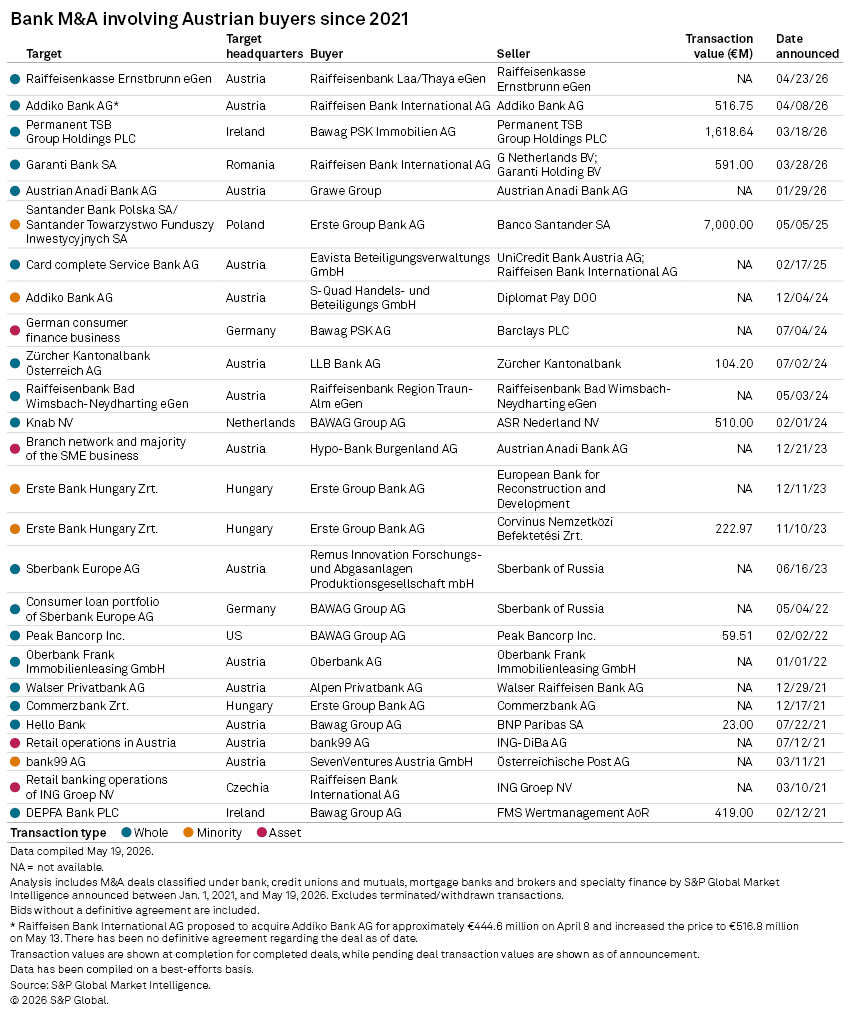
Austrian banks kicked off 2026 with a surge of M&A activity as they seek growth, diversification and stronger competitive positions across Europe.
Lenders in the country have initiated five deals so far this year, up from two in 2025 and matching the total for 2024, according to S&P Global Market Intelligence data.
Raiffeisen Bank International AG (RBI) announced plans to acquire Romania-based Garanti Bank SA and submitted an offer for Addiko Bank AG — an Austrian lender with a Balkan presence — at €26.50 per share, though the bid faces competition from Nova Ljubljanska Banka dd's higher offer.
BAWAG Group AG agreed to acquire Irish lender Permanent TSB Group Holdings PLC for €1.62 billion, expanding its reach in Ireland, where it already operates the mortgage franchise MoCo.
Domestically, The GRAWE Group, via its subsidiary Hypo-Bank Burgenland AG, acquired Austrian Anadi Bank AG in January, while Raiffeisenbank Laa/Thaya eGen agreed in April to acquire Raiffeisenkasse Ernstbrunn eGen.
Raiffeisenkasse Ernstbrunn and Raiffeisenbank Laa/Thaya are independent cooperative banks owned by their members. Along with other local Raiffeisen banks, they collectively own one of eight regional banks that are shareholders of RBI.
In 2025, Erste Group Bank AG agreed to acquire Banco Santander SA's Polish business for €7 billion, with the deal closing in January 2026. Erste Group regarded Poland as the "missing puzzle piece" in its positioning as a leading banking market player in central Europe, Erste Group's spokesperson told Market Intelligence.
Betting on central, southeast Europe
"The recent increase in European bank M&A activity, including by Austrian banks, reflects a convergence of strong internal financial capacity and favorable external conditions," said Andrea Costanzo, vice president of European financial institution ratings at Morningstar DBRS. "Robust capitalization coupled with sustained profitability have enabled banks to pursue sizable transactions without undermining capital buffers."
Domestic consolidation in Austria has historically been limited by fragmented institutional frameworks, strong regional ownership models and political sensitivities, Costanzo said. Austrian banks' significant operations in central Europe reduce the need for domestic deals, shifting their focus to building competitive positions abroad, Costanzo added.
RBI's recent acquisition in Romania reflects its commitment to central Europe, and the bank wants to play an active role in the region's further consolidation, an RBI spokesperson told Market Intelligence.
Bank profitability in central and southeast Europe is well above the euro area, with return on equity ratios of over 15% compared with about 10% in Austria and the eurozone, Raiffeisen Research head Gunter Deuber told Market Intelligence in a separate comment. Raiffeisen Research is the economic research arm of RBI.
Southeast Europe, in particular, has experienced strong gains and proven less sensitive to geopolitical risks than central Europe, with long-term prospects in this region driven by local economic growth and deepening EU integration, Deuber said.
Banking intermediation levels in central Europe remain relatively low, and the region still offers "an exceptional degree of catch-up potential and thus also better growth opportunities than the mature banking sectors in Western Europe," an Erste Group spokesperson said.
Erste's groupwide net interest margin (NIM) declined slightly in 2025, though its central European operations — which includes Romania, Croatia and Serbia — maintained a higher margin, Visible Alpha data shows. The 2025 data does not include the newly acquired Polish business.
RBI's groupwide NIM also declined, with central Europe below and southeast Europe above the group level. Both banks posted higher profitability and lower nonperforming loan (NPL) ratios in their central and southeast European operations than their groupwide metrics in 2025.
Austria's banking sector posted net profit of €11.8 billion in 2025, according to the Austrian central bank. Net interest income remained strong, while robust profitability and capital retention pushed the Austrian banking sector's CET1 ratio to 19.0% in 2025. Domestic lending picked up and overall credit quality stabilized, though NPL ratios rose for small business and commercial real estate loans, the central bank said in April.
The central bank noted that the Polish and Romanian acquisitions by Erste Group and RBI, respectively, are expected to dent capitalization levels in 2026, though strong profitability will continue to support lending and business expansion.
BAWAG looks west
While RBI and Erste Group have been pursuing opportunities in central and southeast Europe, BAWAG's strategy highlights a different approach.
"Western Europe's developed markets align closely with our strategy and risk appetite," BAWAG's spokesperson told Market Intelligence.
"We focus on countries with stable, high-quality economic fundamentals and predictable regulatory environments," the spokesperson said. "This provides a strong foundation for consistent, risk-adjusted returns, which is core to BAWAG's principle on how we manage the bank."
Western European banking markets offer attractive consolidation opportunities, as many are mature yet fragmented with low profitability and high cost-to-income ratios, allowing BAWAG to leverage its "efficient operating platform and retail and SME banking model" to create value and improve customer offerings, the spokesperson said.
BAWAG, at the group level, had a 20.6% return on equity, 3.3% NIM and 0.80% NPL ratio in 2025. A regional breakdown for the bank was not available.
– Access Visible Alpha estimates for Erste Group. (May require additional subscription.)
– Learn about Visible Alpha.
– Sign up for Earnings IQ alerts to get results as soon as they are released.

More to come
Current valuation levels across Austria and the wider central and southeast Europe region are broadly supportive of further M&A, particularly for well-capitalized banks pursuing transactions aligned with clear strategic objectives, Morningstar DBRS' Costanzo said.
Raiffeisen Research's Deuber sees scope for M&A activity in Slovakia, Slovenia, Croatia and Hungary.
Beyond conventional banking, there are also opportunities for growth and consolidation in asset management, Deuber said. In the current environment where IT integration and flexibility are crucial, smaller, more manageable acquisitions could be attractive, Deuber noted.
Despite their differing regional strategies, both BAWAG and Erste Group indicated they would consider domestic consolidation opportunities under the right conditions.
BAWAG's strategy is to grow into a pan-European and US banking group, and the company is comfortable with its position in Austria. It would assess compelling domestic opportunities that meet its strategic and financial criteria, though such opportunities are limited, BAWAG's spokesperson said. For any acquisition — domestic or international — BAWAG requires a strategic fit, scale or complementary capabilities, and disciplined return thresholds.
Erste Group, via its Austrian unit Erste Bank Oesterreich and the associated Sparkassen savings banks network, would also consider domestic consolidation opportunities as they arise, the spokesperson said.
Erste Group's CFO Stefan Dörfler said during an April 30 earnings call that the company routinely evaluates prospects for growth, "looking anywhere and anytime" for bolt-on local or domestic consolidation opportunities, but that the current priority is integrating the Polish business. "You cannot expect, or you should not expect, any crazy adventures from us," he said.
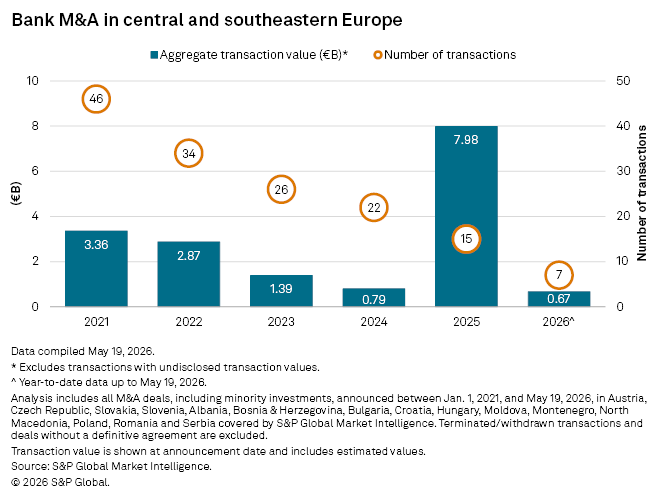
Aggregate transaction value of bank M&A in central and southeast Europe surged to €7.98 billion in 2025, driven largely by Erste Group's acquisition of Santander Bank Polska, though the number of deals declined to 15 from 22 in 2024. In 2026 to date, seven deals worth €670 million have been announced, S&P Global Market Intelligence data shows.
With Austrian banks expanding aggressively across Europe, other major regional lenders are also sharpening their strategies.
Poland's PKO Bank Polski SA, one of the largest lenders in central Europe, is actively building its international network to support Polish corporates abroad as part of its 2027 strategy. PKO plans to expand its foreign network of EU branches and representative offices to 12, having recently opened new representative offices in Sweden, Lithuania and Austria, it told Market Intelligence. PKO's foreign branches also operate in Germany, the Czech Republic, Slovakia and Romania.
Hungary's OTP Bank Nyrt., traditionally active in regional M&A, monitors opportunities both within and beyond the region. The bank's strategy is to grow organically by strengthening existing operations and through selective acquisitions where strategically and financially viable, both in current markets and new ones, the bank's spokesperson said.
Visible Alpha is a part of S&P Global Market Intelligence.