15 May, 2026
Appeals court wrestles with energy emergency claim in DOE plant order case

By Karin Rives
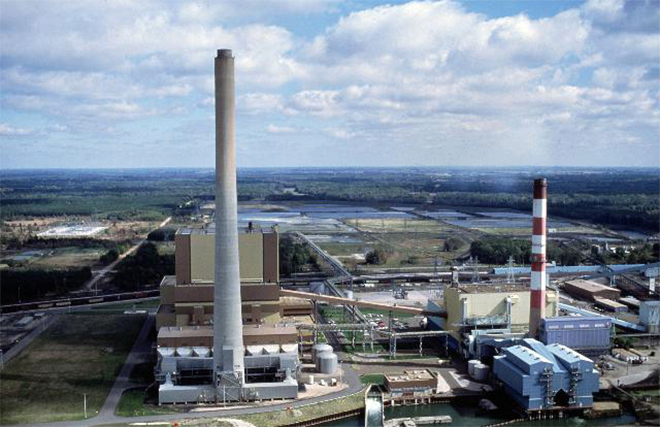
| The J.H. Campbell coal plant in Michigan, above, has continued to operate since May 2025 under four emergency orders issued by the US Energy Department. Source: CMS Energy Corp. |
US appeals court judges on May 15 pressed attorneys representing the Trump administration, the state of Michigan and public interest groups over how to define energy emergencies and what warrants federal intervention.
It was the first court hearing over the US Energy Department's use of emergency orders under Section 202(c) of the Federal Power Act of 1935 to keep coal-fired power plants from shutting down. The case before the US Court of Appeals for the District of Columbia Circuit focuses on the first such order, which was issued in late May 2025 and required CMS Energy Corp. to call off the planned retirement of its 1,331-MW J.H. Campbell power plant in Michigan.
The judges asked whether the US government has the right under the federal statute to override state and utility resource plans even if the emergency is not imminent. There were no warnings of blackouts in the region when the plant prepared to close.
Climate change, for example, is considered an emergency but will not cause devastation tomorrow, Judge Robert Wilkins said during the hearing. And yet we must take action today to avert that risk, he said.
"So if something that's foreseeable, that you have to take action now to avert, is that an emergency?" Wilkins asked Lucas Wollenzien, assistant attorney general for the state of Michigan.
In the case of the Campbell plant, there were already regulatory processes in place to address future emergencies, Wollenzien responded.
"We spent time in briefing talking about the role that the Public Service Commission and utilities play [in] integrated resource planning, as well as a system operator performing, studies to make sure that retirements are OK," Wollenzien said. "You also have to keep in mind that the MISO tariff is regulated by [the Federal Energy Regulatory Commission], and FERC has the ability to undertake efforts to steer resource planning if it so chooses."
The Campbell plant is in the Midcontinent Independent System Operator region.
Chief Judge Sri Srinivasan asked during the hearing whether the DOE should then only issue federal emergency orders as a last resort when all other efforts to stabilize the grid have failed.
"This case isn't about whether the grid faces challenges or whether they should be addressed," Benjamin Chagnon, an attorney with Earthjustice representing public interest groups, told the court. "The real question is who has authority to address those challenges, and how."
Robert Stander, deputy assistant general for the US Justice Department, said it is up to the head of the US DOE to determine whether an energy emergency exists and what to do about it.
"The secretary of energy is not required to wait for a blackout to happen before invoking Section 202(c) of the Federal Power Act," Stander told the court. "In the Campbell order, the secretary identified a shortage that called for immediate action. Congress delegated to the secretary sole discretion to determine how much risk is too much risk, how much shortage is too short."
Stakes are high
The case, People of the State of Michigan v. DOE, is being watched closely by operators of other power plants who also received DOE emergency orders over the past year. Several other lawsuits filed by states, environmental groups and ratepayer advocacy groups are pending.
Tri-State Generation and Transmission Association Inc., the only plant operator thus far to ask the DOE to reconsider its order, filed with the appeals court after the DOE denied its request.
The appeals court should affirm the DOE's May 2025 order for the Campbell plant because it was "supported by substantial evidence," Stander said. The key evidence, he said, was the North American Electric Reliability Corp.'s grid report for summer 2025 that warned of elevated reliability risks for the central US.
In a subsequent report for 2025–2026 issued in November 2025, NERC said risks were limited in the region even as reserve margins had declined. NERC plans to release its summer reliability assessment on May 19.
"The government makes a big deal about how the surplus has been reduced, but there's nothing magical about how much surplus one has," Chagnon told the court. "What the NERC assessment says ... when talking about the MISO region in particular, [is] ... using things like importing from neighbors, curtailing around exports and engaging in things like demand response."
The hearing in the DC appeals court was held as CMS Energy expected a fifth emergency order from the DOE extending operations for another 90 days past May 17, when the current emergency order expires. The utility said that as of March 31, it had incurred $180 million in losses from operating the plant past its retirement date, costs it expects to recover through a proceeding before the Federal Energy Regulatory Commission.
The attorney representing CMS Energy's regulated electric utility subsidiary, Consumers Energy Co., asked the court to ensure its final order will not undermine the company's efforts to recover such costs, even if judges declare the DOE's emergency order illegal.
"We'd urge you not to suggest that vacatur here would somehow entitle petitioners refunds," attorney Zachary Schauf with the law firm Jenner and Block told the court.