30 Apr, 2026
Wireless operators shift away from subsidies to focus on long-term savings

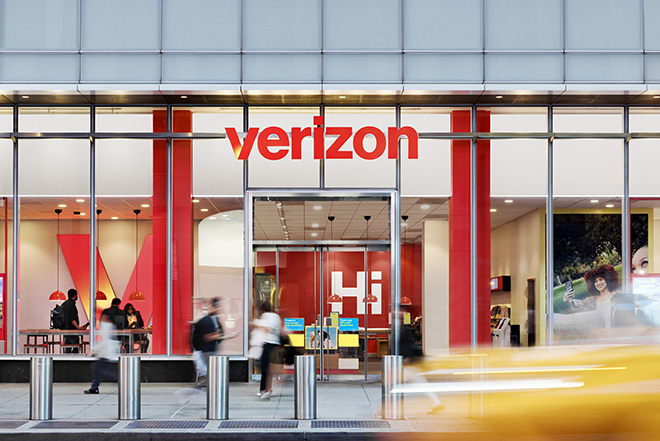
| Wireless carriers like Verizon say they are moving away from free handsets as their primary retention tool. Source: Verizon Communications Inc. |
As wireless operators compete for customers, they are telling a new story about savings — one that focuses less on immediate device subsidies and more on long-term value.
During recent earnings calls, executives from AT&T Inc., Verizon Communications Inc., T-Mobile US Inc. and Charter Communications Inc. all talked about the value their companies are providing to customers through converged wireless and broadband offerings. This value, they said, has less to do with one-time savings on new devices and more to do with recurring incremental savings for access to reliable networks. The shift in strategy comes as consumers are hanging onto their devices longer, stretching out upgrade cycles.
"The way that we think about this is customers — we're providing customers the most important technology in their lives that they use every single day ... not once every 1,000 days when they're replacing their phone," said T-Mobile Chief Business and Product Officer Mike Katz during the company's April 28 earnings call.
Long-term savings
Katz highlighted an estimate from HarrisX Billing Snapshots that found T-Mobile accounts with three or more voice lines saved over $3,700 compared to AT&T and Verizon over a roughly five-year period, a finding that has since been touted in T-Mobile's marketing.
"You saw a lot of our advertising, it was about savings you make every day rather than savings you simply make at the point you get a phone," T-Mobile CEO Srinivasan Gopalan said. "It was about our network. It was about that more rounded broad proposition."
T-Mobile is hardly alone in this strategy. Charter launched its own $1,000 savings guarantee in February. The offer promises customers who sign up for Spectrum Internet and switch two or more mobile lines from Verizon, AT&T or T-Mobile will save at least $1,000 in their first year, or Charter will cover the difference.
"We guarantee $1,000 of savings," said Charter CEO Chris Winfrey during the company's April 24 earnings call. "So we saw that kind of copied" by competitors, though he noted that Charter's guarantee specifically targets the three major wireless carriers and does not apply to other cable operators.
AT&T rebalances away from devices
AT&T CEO John Stankey outlined perhaps the most explicit shift away from subsidies during the company's April 22 earnings call, describing AT&T's portfolio as "over-indexed on device."
"It's not that devices aren't important to customers; and to certain segments of customers, they will continue and remain to be important, but I think we need a more balanced portfolio that makes sure that the customer understands the inherent value of the network underneath the relationship and the true amount that they're paying for that fantastic service that they depend on every day," Stankey said.
Stankey explained that device subsidies can obscure the true value of reliable and widely available network service. "There are other things besides devices that customers get value out of," Stankey said. "And putting that at the forefront to ensure that customers have choice about how they choose to allocate those perks and those benefits and things that are important to their loyalty over time, I think we can do a better job of balancing that relationship."
No such thing as a free iPhone
Verizon CEO Daniel Schulman described "structural changes" in how the company approaches customer retention and acquisition, moving away from a one-size-fits-all approach centered on device giveaways.
"Not every retention is going to be a free handset. In fact, quite the opposite. I mean, I think our industry has been too dependent on free handsets being the solution for everything," Schulman said.
In a specific example of how the old approach failed customers while wasting company resources, he described a hypothetical customer who was having trouble with service in their house and who was sent a free handset to prevent churn.
"So we just spent like $1,000 and did not solve the customers' issues. If we had listened and sent a femtocell to be installed at the house, we could have done that at 1/3 the cost and made the customer happy," the CEO said.
Schulman said the latter approach represents a fundamental shift in strategy, one that focuses on actually addressing customer needs while also reducing retention costs.
"The era of just the free handset, that's gone right now. We are looking at: What does the customer need? Can they have a handset that is last year's model that's been refurbished? Do they need a new handset? Many of them, because of the economy, are keeping their handsets longer right now," the CEO said.
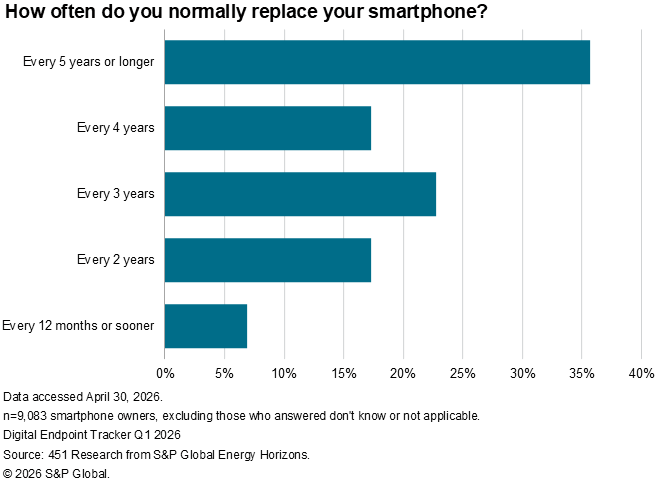
According to the Digital Endpoint Tracker Q1 2026 survey of smartphone owners by 451 Research from S&P Global Energy Horizons, more than a third of respondents (35.7%) replace their smartphone every 5 years or longer, while another 40% replace their phones every three to four years. Less than one-quarter of respondents said they replace their phone every one to two years.
Change over time
Other executives said the shift away from device subsidies will be a gradual change. "I think we will gradually work our way through this over time," AT&T's Stankey said. "I don't think this is throwing a switch."
Wave7 Research Principal Jeff Moore noted that AT&T continues to lead other carriers with a top "on us" offer for iPhones and Galaxy phones that requires a trade-in and 36 months of credits. "If this develops, that would be a future event," Moore told S&P Global Market Intelligence of the proposed move away from subsidies.
Charter, which added 368,000 mobile lines in the first quarter, said its net additions in the quarter were lower due to heavy device subsidy activity by the big telco competitors, especially around Apple Inc.'s iPhone 17.
T-Mobile's Gopalan agreed that "January was particularly competitive" in terms of subsidies, but he said that eased as the months went on. "I think Feb and March and going into April, we've seen some cooling down of that environment," Gopalan said.
For its part, T-Mobile has not abandoned device promotions entirely but instead is strategically linking its most aggressive device offers to premium service plans, creating a different kind of long-term value equation.
"And customers see that as a great trade-off, inclusive of all the other value that is incorporated in those premium rate plans," T-Mobile CFO Peter Osvaldik said during the company's earnings call.