


13 Apr, 2026
TotalEnergies' US offshore wind exit contrasts with global power-sector push
By Alex Blackburne and Gaurang Dholakia

|
TotalEnergies CEO Patrick Pouyanné, left, agreed to a deal with US Interior Secretary Doug Burgum in March that will see the Trump administration refund the French oil major for its US offshore wind leases, in exchange for TotalEnergies |
TotalEnergies SE's $1 billion exit from US offshore wind belies an expanding global power generation footprint that is tilting toward renewables even as gas-fired capacity remains the backbone of its portfolio for now, S&P Global Market Intelligence data shows.
Under a March 23 agreement with the Trump administration, the French oil major will surrender two offshore wind leases off New York and North Carolina and redirect the capital into US gas and LNG infrastructure, in exchange for a full refund of the fees it paid in 2022.
The deal underlines a view by TotalEnergies CEO Patrick Pouyanné that US offshore wind has become "uninvestable" amid policy reversals, yet it does little to knock the company's wider push into electricity markets off course.
TotalEnergies views power demand as one of the defining growth opportunities in the energy transition. The company's internal analysis sees global electricity consumption rising by an average of 2.5% annually through 2050, driven by electrification and new use cases such as data centers.
Against that backdrop, TotalEnergies aims to increase its electricity production by around 20% per year through 2030, reaching up to 120 terawatt-hours, with 70% from renewables and 30% from flexible gas.
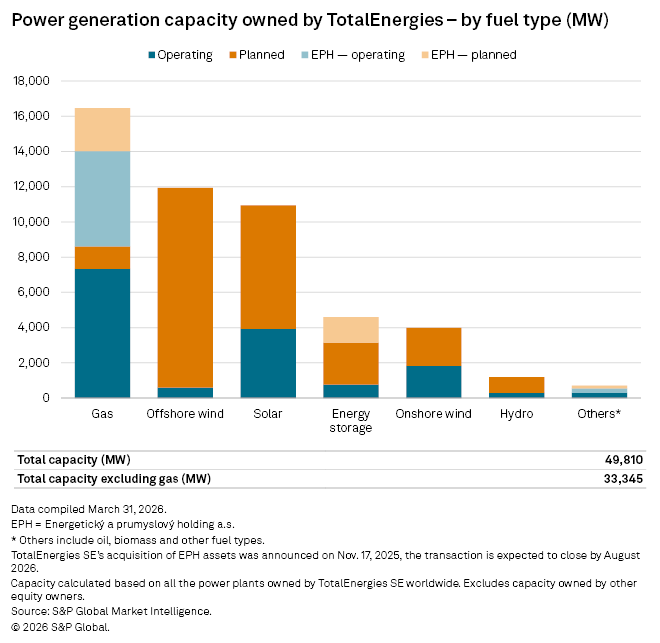
The Paris-headquartered oil major has around 40 gigawatts of net power generation capacity in operation or development across more than 60 countries globally, as well as a further 10 GW that will soon come under its ownership, according to an analysis of Market Intelligence data by Platts, part of S&P Global Energy.
Its power generation investments, particularly in renewables, make TotalEnergies something of an outlier compared to its European peers, many of which have scaled back their clean energy ambitions in recent years.
Shell PLC and BP PLC have refocused on their core oil and gas activities, while Equinor ASA has also cut its spending on power and renewables.
By contrast, TotalEnergies is accelerating its push into electricity through an "integrated power" strategy that is expected to command $3 billion to $4 billion of investment per year through 2030.
The ambition positions the company as the most bullish integrated energy major on clean energy, flexible generation and power demand growth.
Gas dominates today
While renewables are set to provide the bulk of TotalEnergies' growth in the power sector, the company's portfolio today is dominated by gas-fired capacity, with some 16.5 GW in operation and development, according to Market Intelligence data.
The figure includes a portfolio of gas-fired assets to be acquired by TotalEnergies from Czech energy group EPH as part of a €5.1 billion deal announced in November 2025.
Under the transaction, which is expected to close by August, TotalEnergies and EPH will create a 50/50 joint venture covering more than 14 GW of gross capacity in France, Ireland, Italy, the Netherlands and the UK.
The assets, which include gas plants, battery storage and biomass, will bolster TotalEnergies' flexible generation capacity and complement its growing renewables footprint.
In renewables, TotalEnergies has nearly 4 GW of net solar capacity in operation globally, as well as 1.8 GW of onshore wind and 761 megawatts of energy storage, Market Intelligence data shows. Its development pipeline across the three technologies stands at 11.6 GW, led by solar.
In offshore wind, while the US market may now be off the table, TotalEnergies continues to develop some 11.3 GW of net capacity in Europe and Asia. Offshore wind accounts for the largest share of the company's development pipeline by capacity, according to the data.
Most of its offshore wind assets are in Germany, where TotalEnergies is now the country's largest developer. The company is developing two German projects alongside local power giant RWE AG, with the partners also constructing the 795-MW OranjeWind project in the Netherlands.
In contrast to the US, offshore wind in Europe still makes "quite a lot of sense," Pouyanné said during an investor event in March, pointing to the region's relative lack of available land for renewables development and the greater economies of scale available for offshore wind developers.
Global footprint
Geographically, the US accounts for the largest share of TotalEnergies' sprawling global power generation portfolio, even after the company's offshore wind exit, Market Intelligence data shows.
TotalEnergies has 8.7 GW of onshore renewables in operation or under development in the US, technologies that Pouyanné cited as being much cheaper than offshore wind in a country with abundant land available.
The CEO told investors that TotalEnergies plans to build onshore renewables in the US at a rate of about 2 GW per year. "And the administration did not ask us to stop," Pouyanné added.
Beyond the US, TotalEnergies also has a significant power generation asset base in Germany, France, the UK and Spain, as well as further afield in places like Kazakhstan, Taiwan and Morocco.
The company on April 2 announced a binding agreement with Abu Dhabi renewable energy company Masdar to combine their onshore renewables activities in nine Asian countries into a 50/50 joint venture.
The partnership will have 3 GW of operational assets and 6 GW of projects to be completed by 2030, operating in Azerbaijan, Indonesia, Japan, Kazakhstan, Malaysia, the Philippines, Singapore, South Korea and Uzbekistan.
The Market Intelligence data does not include power generation capacity owned by TotalEnergies through certain shareholdings and joint ventures, such as its 17.25% stake in India's Adani Green Energy Ltd.
TotalEnergies' self-reported net installed power generation capacity, including renewables and gas-fired plants, stood at 26 GW at the end of 2025.
Separately, it reported 34 GW of gross installed renewables capacity, including projects held via JVs. It is targeting 80 GW of installed wind and solar by 2030 — a level that a TotalEnergies spokesperson said should make it one of the top five producers in the world outside China.