08 Apr, 2026
State Bank of India overtakes ICICI Bank in market cap ranking
By PRASOON PRIYE and Beenish Bashir
India's biggest lender by assets climbed one spot in the ranking of largest lenders by market capitalization in the January−March quarter, thanks to a relatively more stable outlook.
State-owned State Bank of India (SBI) overtook its smaller private sector rival, ICICI Bank Ltd., to be India's second-biggest lender by market cap, according to S&P Global Market Intelligence data. SBI's market cap contracted 0.3% from the previous quarter to 9,040.47 billion Indian rupees. In contrast, ICICI Bank shed more than 10%, according to data.
"SBI is projected to have more resilient net interest margins in the quarter ending March," Nomura said in an April 5 research note, describing SBI's net interest margin (NIM) performance as "most resilient among PSU peers." ICICI Bank is expected to see its NIM decline by approximately 2 basis points quarter over quarter in the fourth quarter of fiscal year 2026, it added.
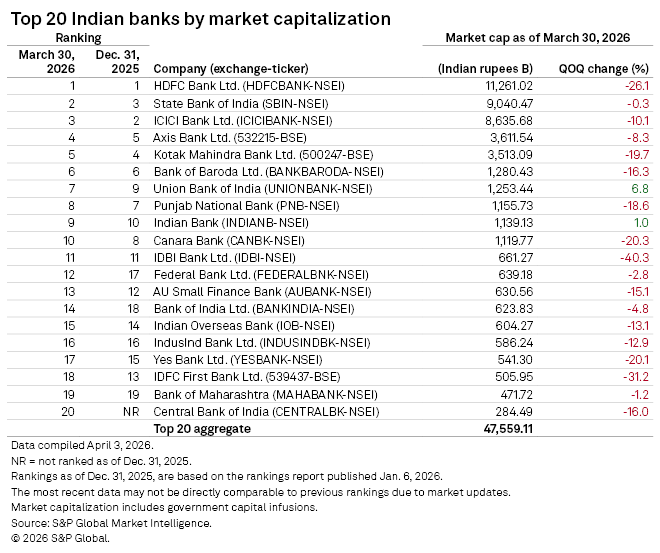
Eighteen of the 20 largest listed banks saw their market caps drop, driven primarily by a broad-based sell-off across sectors due to escalating geopolitical tensions in the Middle East. The US and Iran announced a two-week ceasefire on Feb. 8, easing tensions in global markets since the war began in February.
Foreign portfolio investors turned net sellers in March, driven by deteriorating global investor sentiment. After staging a comeback in February, foreign investors sold $10.8 billion of Indian equities through March 18, the Reserve Bank of India said in its monthly bulletin.
The Nifty Bank index, which tracks the most liquid and largest banks in India, was down 11.72% year to date as of April 7, nearly the same as the benchmark Nifty 50 index's 11.56% decline. Geopolitical concerns pushed most global bank indexes lower in the January−March quarter.
IDBI Bank Ltd. posted a 40.3% drop in its market cap to 661.27 billion rupees, the steepest percentage decline among peers in the quarter. IDFC First Bank Ltd. followed, losing 31.2% of its market cap, reversing a 43.8% surge in the October−December period.
HDFC Bank Ltd. lost 26.1% of its market cap but retained its top spot. The private sector lender closed the quarter with a market cap of about 11,261 billion rupees.
HDFC Bank's stock came under pressure following the sudden exit of its part-time Chairman Atanu Chakraborty, who resigned on March 18, saying: "Certain happenings and practices within the bank, that I have observed over the last two years, are not in congruence with my personal values and ethics."
Suresh Ganapathy, managing director and head of Financial Services Research at Macquarie Capital, said in an April 6 note that the fundamentals of HDFC Bank's stock remained strong and maintained an "outperform" recommendation.
"Robust deposit growth and a materially lower loan-to-deposit ratio should be viewed positively by investors," Ganapathy said. "HDFC's current deposit growth implies it could be around 200–300 bps ahead of system growth in fiscal 2026, which we see as a good outcome."
Only Union Bank of India and Indian Bank posted gains in their market cap in the January−March quarter. Union Bank of India saw a 6.8% gain, moving to seventh place from ninth in the previous quarter. Indian Bank's market cap increased 1% in the quarter.
As of April 8, US$1 was equivalent to 92.41 Indian rupees.