07 Apr, 2026
RARE EARTHS: Fledgling rare earths recycling sector offers non-China supply

|
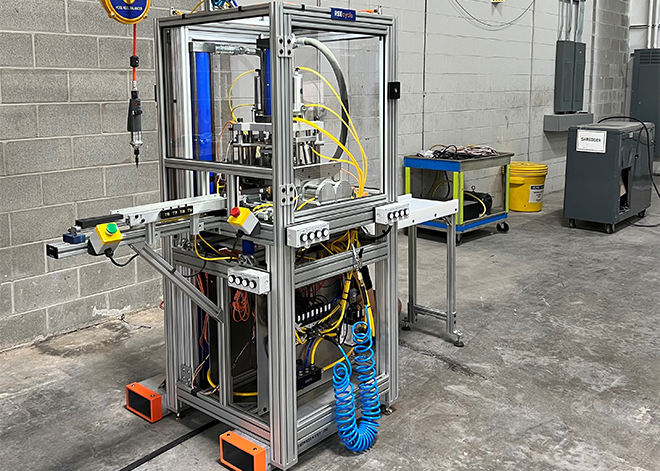
REEcycle's drive disassembly machine in Australia is designed to separate 3.5 inch hard drives into individual pieces |
Rare earth elements have come under increasing focus owing to their criticality to defense equipment manufacturing and clean technology. China has monopolized this supply chain for over two decades and has not shied away from using it for geopolitical leverage, forcing others to think of a diversification strategy. This is Part 3 of a 5-part series in which Platts News explores the strategies under play and the challenges they face. Read parts 1, 2, 4, and 5.
Western nations and their allies are making major investments in supply chains for recycled rare earths, but closing the gap with China comes with significant challenges.
China dominates global rare earth supply chains, which are essential for defense applications, electric vehicles and other advanced technologies. The country accounted for 60% of global mined production and 91% of global refining capacity for key rare earths in 2024, according to data from the International Energy Agency.
China has leveraged its dominance to develop a robust recycling supply chain that extracts more rare earths from production scrap and electronic waste. However, major investments from the US, EU and others aim to bolster rare earths recycling capacity and overcome economic challenges.
"Recycling is important for future supply [outside of China], but the key issue right now is setting up the logistics and establishing those feedstock networks," Chris Berry, founder and president of the House Mountain Partners advisory firm, told Platts, part of S&P Global Energy. "Without that, I don't see how you go through the process of building a large enough scalable plant to make it economically feasible."
China's lead
China's long-term position as the world's largest producer of rare earths has enabled the development of mature, efficient systems in which plants convert scrap into powder that can easily be recycled to extract more rare earth elements, said David Merriman, research director at critical materials consulting firm Project Blue.
Western nations, by comparison, lag far behind in their rare earth recycling capabilities.
"The capacity for rare earth recycling outside of China is minuscule compared to that within the Chinese market currently," Merriman told Platts.
"There's a number of reasons for that, including feedstock availability and accessing production scrap," Merriman said. "The industry outside of the Chinese market has had to focus on end-of-life material that is difficult to source, dismantle and process. It's made it difficult to make magnets recycling and recovery economic outside of China."
Berry highlighted tech giant Apple Inc.'s $500 million deal with California-based MP Materials Corp. as the most significant recycled rare earths supply partnership outside of China.
The companies expect the July 2025 deal to enable MP Materials to consume feedstock such as used electronics and industrial scrap and reprocess it into rare earths for use in Apple products.
"The challenge is you have to collect an awful lot of hard disk drives and AirPods to achieve the scale necessary to make rare earth recycling profitable in the US," said Berry.
Innovation to lower costs
To address profitability issues, companies are focusing on more efficient extraction technologies as compared to the traditional solvent extraction method.
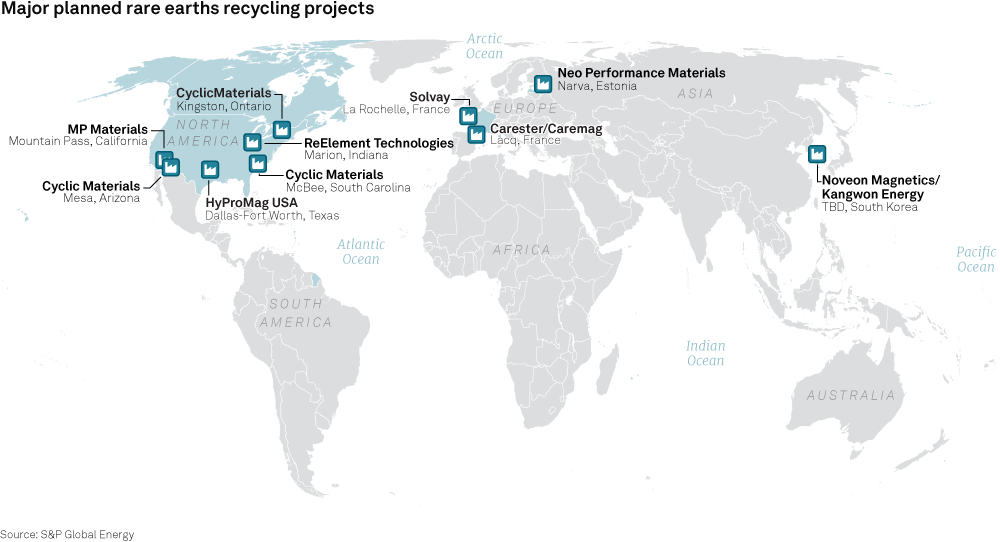
Indiana-based ReElement Technologies Corp. uses methods that leverage chromatography technology. The company received an $80 million loan from the US Department of Defense in November 2025.
"Conventional solvent extraction methods that are utilized and dominated by China are unviable outside of China," Mark LaVerghetta, cofounder and executive director of ReElement, told Platts.
"We partnered with Perdue University and acquired intellectual property from them," LaVerghetta said. "With chromatography, we can produce a variety of high-purity rare earth outputs at the low-end of the Chinese cost-curve."
ReElement Technologies also recently signed a deal with South Korea-based Posco International Corp. The companies will work together to develop a rare earths processing plant with annual capacity of 3,000 metric tons, targeting full capacity in the second half of 2027.
Government support necessary
The need to develop new technologies, build out supply chains and overcome economic hurdles underscores the importance of government support, experts said.
"Right now, the US and others are at such a disadvantage in terms of being so far behind China," Neal Dingmann, an analyst at investment bank William Blair, told Platts. "US customers have to pay three times more for domestic rare earths, so they're not going to do that."
"The only way to develop the sector is with government support. It's a necessity, at least in the medium term," Dingmann said.
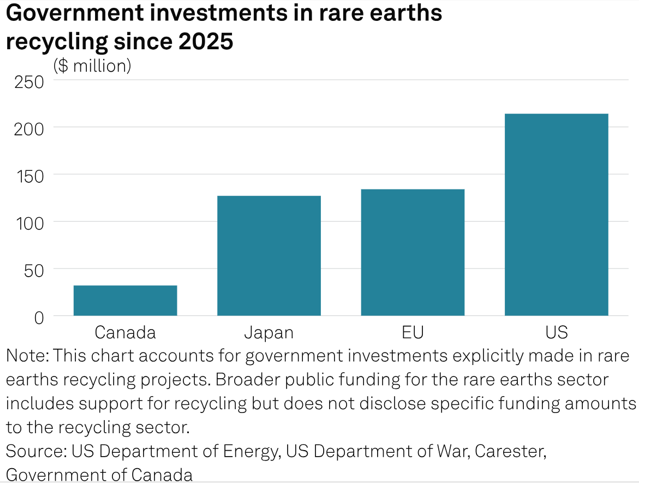
The US Energy Department in late 2025 offered $134 million in funding to support projects that recover and refine rare earths from "unconventional feedstocks, including mine tailings, e-waste, and other waste materials."
In the EU, the Critical Raw Materials Act took effect in 2024. The act includes a 2030 goal of being able to produce at least 25% of the EU's annual consumption of strategic raw materials, including rare earths, from recycling. In early 2025, the European Investment Bank committed to lending up to $2.3 billion to support the initiative.
Toronto-based Cyclic Materials Inc. has emerged as a major new player in rare earths recycling and has received over $31 million in support from the Canadian government in 2026.
The company has outlined plans to open commercial-scale facilities in Ontario, Canada, and in Arizona and South Carolina in the US.
"Whether it's the US, EU or other regions of the world, many countries and trading blocs are actively prioritizing domestic and independent supply of critical minerals," a Cyclic Materials spokesperson told Platts. "Given the long timelines, high capital intensity, and permitting challenges of rare earth mining, recycling is emerging as one of the only near-term, scalable pathways to build a resilient regional supply."
Rare earths learning curve
Business leaders say there is a learning curve for suppliers as well as end users as they seek to shift away from a rare earths industry that China has dominated for decades.
"I can tell you right now that, especially here in the US, these supply contracts or agreements are not tried and tested," Dan Bina, president and CEO of Iowa-based Critical Materials Recycling, told Platts. "Microsoft and others that we work with are all going through a complete reenvisioning of their rare earths supplies."
Investments are not likely to slow down any time soon, with rare earths becoming increasingly important as modern technology advances, and as a critical input in defense applications, experts said.
"With whatever geopolitical jitters might come down the line, you can see why countries want to invest in domestic supply chains for rare earths, given their military uses," Gernot Wagner, an economist at Columbia Business School, told Platts. "Governments will be willing to pay the necessary security premium."
Location
Products & Offerings
Segment
