23 Apr, 2026
Hungarian banks upbeat on outlook after Tisza election victory

By Beata Fojcik
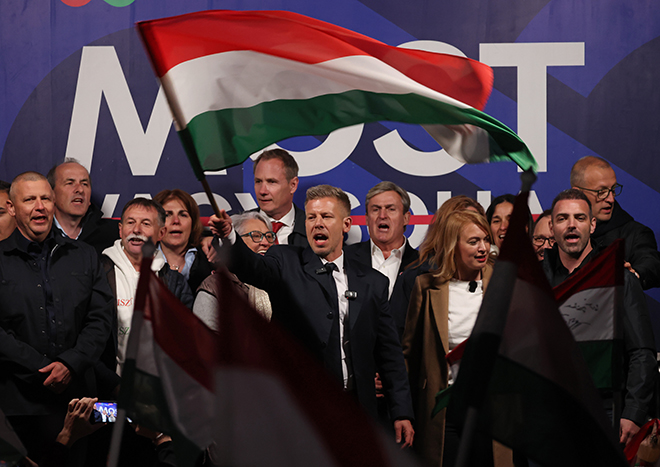
| Peter Magyar's center-right Tisza party won a constitutional majority, ending Prime Minister Viktor Orban's 16-year rule. |
Banks and analysts expect Hungary's new government to unlock EU funding, ease taxes on lenders and boost stability, signaling a positive shift for the financial sector and wider economy.
Peter Magyar's center-right Tisza party won nearly 71% of parliamentary seats in Hungary's April 12 election, ending Prime Minister Viktor Orban's 16-year tenure.
The result has been welcomed by the Hungarian Banking Association, which said it could open a new chapter for European integration and the Hungarian economic development.
"Cooperation between government, economic, and financial areas will result in sustainable development and growth, rooted in predictability," the association said in a statement on its website. It added that it was "committed and ready to cooperate for Hungary's stability and predictable growth." The association did not respond to S&P Global Market Intelligence's request for comments by the time of publication.
The constitutional majority grants the new government the power to amend the constitution and pursue reforms to strengthen the rule of law, potentially unlocking around €35 billion in EU funding that was frozen amid disputes with Brussels and Prime Minister Orban's resistance to implement reforms required by the EU. Investors also hope for reduced regulatory uncertainty under the new leadership and a rollback of some sectoral taxes.
The Tisza party's economic objectives involve significant fiscal restructuring and are expected to make the EU funds due to Hungary accessible again, a spokesperson for OTP Bank Nyrt. told Market Intelligence. "These factors could have a positive impact on the state of the economy, particularly in terms of investment," the bank said.
OTP, Hungary's largest lender, also said it hopes for the gradual phase-out of the special taxes affecting the banking sector.
Under Orban, the Hungarian government introduced several taxes on the banking sector, including a financial transaction tax, a special tax on financial institutions, and a windfall tax, which was extended in 2026.
OTP Bank said in March that its overall tax burden in 2025 rose 15% to 356 billion forints, primarily due to a 7.5-fold rise in the windfall tax. It anticipates a net tax rate of 53% for 2026, OTP CEO Peter Csanyi said in March.
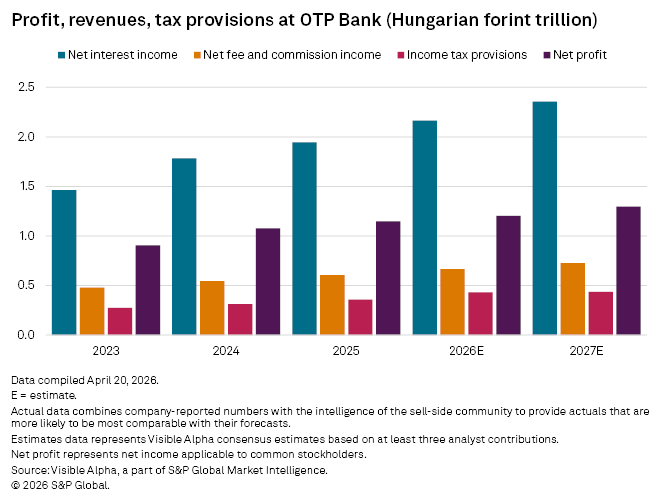
OTP Bank's income tax burden for the entire group is projected to rise 21% year over year to over 431 billion forints in 2026, according to Visible Alpha consensus estimates, while net profit is expected to grow 5% to 1.2 trillion forints. Analysts also forecast net interest income and net fee income to increase by 11.3% and 10%, respectively.
Other banks with a significant exposure to Hungary include KBC Group NV, Erste Group Bank AG, Raiffeisen Bank International AG and UniCredit SpA.
Positive catalyst
Morgan Stanley analysts said in April that they view the opposition victory as "a positive catalyst for the [OTP] stock, both from an investor and fundamental perspective."
Should the new government manage to unlock EU funds, market confidence could significantly strengthen, leading to a lower cost of equity and additional momentum for loan growth, especially in the corporate sector, the analysts said.
Enhancing the rule of law and the credibility of Hungary's legal system could foster the expansion of corporate lending by encouraging investment-led growth and positive effects from EU funding, according to Gunter Deuber, head of Raiffeisen Research. Such improvements would also support mortgage market growth, Deuber told Market Intelligence.
After two years of stagnation, OTP Bank experienced a strong uptick in domestic corporate lending in 2025. The bank is hopeful the positive trend will expand into the coming quarters and is also upbeat about mortgage lending, following a mortgage support scheme launched in the country last year.
"We count on the continuation of useful and successful state support programs," the bank told Market Intelligence.
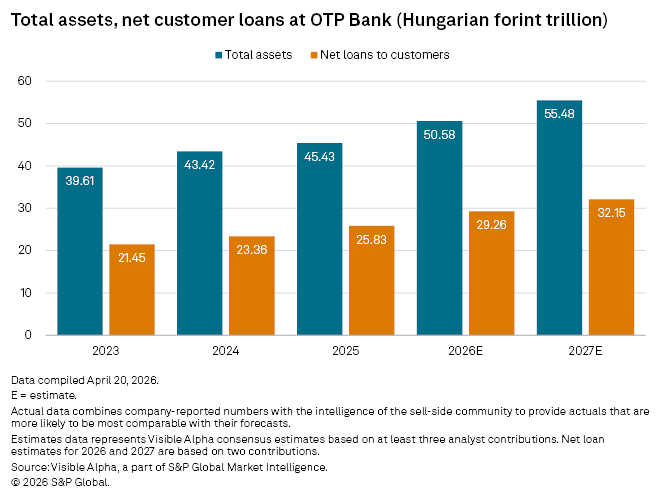
Net loans at OTP Bank are expected to grow 13% in 2026 and almost 10% in 2027, according to Visible Alpha consensus estimates.
Stock surge
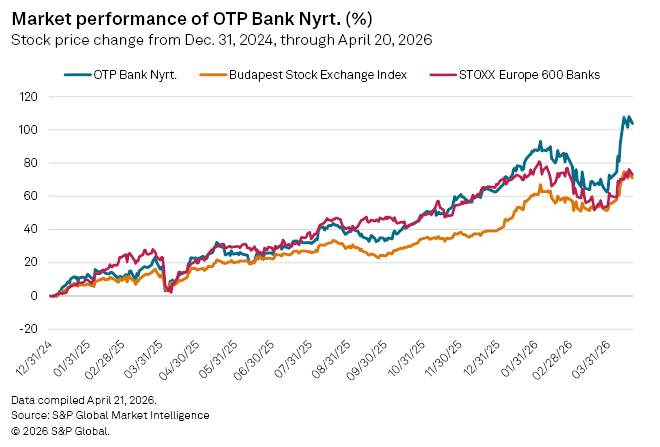
Hungarian stocks surged ahead of and following the elections. The rally was particularly strong for OTP, the largest constituent of the Budapest Stock Exchange Index. OTP's shares have risen more than 100% since the end of 2024 and almost 21% since the beginning of 2026, with most of the gains realized prior to the elections.
OTP's current stock price is not expensive compared to its future earnings and book value, given its strong expected returns, according to Morgan Stanley analysts. As a result, they kept their overweight rating on OTP and consider it one of their top investment picks.
Concorde Securities raised OTP's target price by 10% to 51,100 forints following the elections, while Autonomous Research increased its 12-month price target from 44,677 forints to 54,184 forints and maintained an outperform recommendation.
"In practice, this means there is room for higher valuation multiples, even if profit fundamentals remain unchanged," the analysts said.
The most favorable effects would be seen in sectors linked to economic recovery and infrastructure across the region. Banks would also gain, primarily through a reduced country risk premium and lower financing costs, though these advantages are expected to emerge gradually, the analysts added.
Macro challenges
While investors may hope for a swift release of the frozen EU funds, access will depend on meeting the EU's rule-of-law requirements.
"Poland's experience shows that it typically takes about eight months from implementing recommendations to receiving the first disbursement, but given Hungary's deeper institutional erosion, the process could take longer," VeloBank analysts said. In the base scenario, the first funds may arrive in the second half of 2027, with an optimistic outlook suggesting disbursement in the first half of that year, according to the analysts.
In 2026, the new government will likely focus on dismantling previous fiscal and economic policies, which could worsen short-term fiscal indicators, ING analysts said. However, potential long-term improvements may convince investors and rating agencies to give the government time to implement changes.
"We think that the first 100 days will be seen as a grace period," ING analysts said. "Hence, in our view, the first round of sovereign rating decisions in late May and early June won't result in any change."
Adopting the euro is also among the policy goals for the Tisza party, and with its majority, the new government has the power to pursue the necessary constitutional amendments if it decides the move is achievable, Deutsche Bank analysts said in April.
However, the country faces some formal hurdles regarding the adoption. Hungary's fiscal position and inflation rate still fall short of Maastricht criteria, meaning further improvements will be needed for euro adoption, the analysts said.
Other countries that have recently adopted the euro, such as Croatia and Bulgaria, have benefitted from enhanced liquidity under lower ECB reserve requirements, lower foreign exchange and funding risks, and expanded access to eurozone markets.
Although adopting the euro could reduce foreign exchange business for Hungarian banks, they are still expected to remain profitable, as higher loan volumes and significantly better refinancing conditions should compensate for these losses, Raiffeisen Research's Deuber said.
As of April 22, US$1 was equivalent to 310.93 Hungarian forints.
Visible Alpha is a part of S&P Global Market Intelligence.