30 Apr, 2026
European wind developers pursue repowering, hybridization in challenging market

|
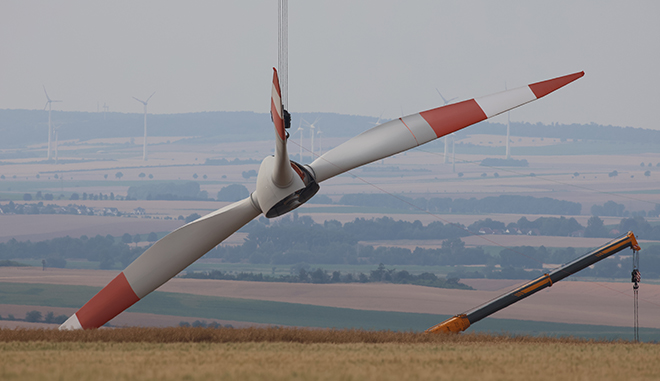
A wind farm in Germany being prepared for repowering. Germany accounted for 75% of the 2 GW of repowered wind capacity added in Europe in 2025. |
European onshore wind developers are increasingly turning to repowering existing wind farms and hybridizing assets as permitting delays and grid connection bottlenecks continue to hamper new project development.
Years of regulatory efforts at an EU level to accelerate renewables deployment since the energy crisis triggered by Russia's invasion of Ukraine have yet to resolve persistent permitting and grid access roadblocks, according to developers.
Executives at trade association WindEurope's annual conference in Madrid April 21–23 expressed frustration that Brussels' interventions have failed to translate into meaningful improvements on the ground, echoing complaints voiced at previous iterations of the event.
"Things have got worse [and] more complicated" in the last five years, according to Raimundo Fernández-Cuesta, chief financial and sustainability officer at Spain's Corporación Acciona Energías Renovables SA.
"Access to the grid, with this mass deployment of renewables, has become a bottleneck in many countries," the executive said in an interview with Platts, part of S&P Global Energy, after the conference. "Development has got a bit more lengthy or more uncertain."
Jorge Martínez, chief growth officer at Nadara Ltd., an onshore wind platform backed by JP Morgan Asset Management, said development timelines for onshore wind and solar projects have increased significantly in the last decade, in some cases doubling.
While Martínez acknowledged "very good intent" from Brussels and said several member states had folded regulations adequately into national law, authorities today are handling "10, 20 times more projects" than before — with fewer resources.
"We forget about the regional administration every country has and most importantly, the municipalities, the small counties, towns," the executive said on the sidelines of the WindEurope event. "They still hold those minor permits that are essential for deploying a project."
Repowering gains traction
Facing these headwinds, developers are turning to repowering and hybridization strategies that leverage existing infrastructure and grid connections.
Repowering accounted for 2 gigawatts of the 17 GW of new onshore wind capacity added in Europe in 2025, according to WindEurope data.
The trade association expects about 16 GW to be decommissioned between 2026 and 2030, with half of that to be repowered, resulting in 17 GW of new capacity.
Several countries are beginning to provide regulatory flexibility for repowering. Martínez cited Portugal, Spain and the UK as positive examples where permitting frameworks are "moving in the right direction."
However, the process still faces challenges. In Spain, developers can increase a project's capacity beyond 5%, but doing so requires going through the full permitting process again, including reobtaining grid access and connection permits — losing the streamlined procedures available for smaller increases.
"Why not 50%, 60%, 70% with battery storage?" Martínez said. "Why not maximize the use of the existing infrastructure?"
Germany leads the way
Germany is Europe's largest market for wind repowering, accounting for 1.5 GW of the 2 GW of repowered capacity added in 2025, according to WindEurope.
Spanish fund manager Qualitas Energy has a late-stage wind pipeline of more than 3 GW in Germany, with 513 megawatts under construction and 500 MW already operating.
Qualitas sees a "rolling market of repowering in Germany" as turbines get to the end of their useful life, according to Borja Caruana, head of operations and industry for Qualitas in Germany.
Yet, from a development perspective, repowering is "the same" as building new projects, requiring renewed land agreements and environmental studies, Caruana said in an interview with Platts in Madrid.
Fernández-Cuesta of Acciona Energía said repowering must also overcome financial hurdles. The company maintains its wind assets in near-new condition and believes in their "almost infinite life," meaning the decision to repower involves trade-offs.
"When you repower, you're also giving up the tail value, the terminal value," Fernández-Cuesta said. "You're dismantling a perfectly OK asset, which has got all of this cash generation ahead of it."
For repowering to make economic sense, developers in Spain need the ability to significantly increase capacity beyond the current 5% limit, according to the executive.
"We think the government should encourage or allow you to have a multiplier effect on this capacity," Fernández-Cuesta said.
Hybridization opportunity
Hybridization — combining wind farms with solar panels or batteries — presents another avenue for asset optimization, though its viability depends heavily on market conditions.
"The economics vary, and it's not always an opportunity in every market, but we think it helps to utilize the existing grid capacity and it's an efficient way for the system to increase the penetration of renewables," Fernández-Cuesta said.
The strategy's success hinges on whether power generation profiles are complementary. If a wind farm generates substantially during solar hours, adding panels may not make economic sense.
Developers also need to see how power prices and capital expenditure costs may evolve, Fernández-Cuesta said.
Long-term asset owners are particularly focused on maximizing the value of existing grid connections. Nadara, which is approaching 5 GW of installed renewables capacity globally, is exploring repowering and hybridization, as well as life extensions and overpowering.
"We don't stop at ready-to-build. We don't stop at [commercial operation]. We don't stop at five years [to do] asset rotation," Martínez said.
Developers who can execute these asset optimization strategies may find overcoming the barriers works in their favor.
"If [development is] more difficult, then there's hopefully a better return for those that can do it properly," Fernández-Cuesta said.