29 Apr, 2026
European bank execs talk up AI plans as focus on cost control intensifies
Pressure on European banks to enhance efficiency through greater AI adoption appears to have intensified in the early months of 2026, based on executive commentary during conference calls.
Mentions of "artificial intelligence" or "AI" by European bank executives during calls held in the first quarter of 2026 increased by about 40% on a sequential basis, to 514, and more than quadrupled from the 127 mentions during calls held in the first quarter of 2025, according to S&P Global Market Intelligence data. The analysis included
The surge in mentions of AI was accompanied by a more than 25% rise in mentions of "expenses" or "costs" to 2,123 in early 2026. This marked the highest frequency of references to expenses or costs since the first quarter of 2023, when European banks were faced with a spike in inflation.
"The CEOs and the CFOs of most of the banks are talking more and more about AI adoption," said Filippo Alloatti, head of financials and the credit team at global investment manager Federated Hermes, in an interview. "And, of course, the punchline is always about bringing down the cost base."
Some of Europe's largest lenders, including Banco Santander SA, UniCredit SpA, Intesa Sanpaolo SpA and Banca Monte dei Paschi di Siena SpA, made new strategy announcements related to AI adoption and deployment in the first three months of the year. Santander had the most mentions of both AI and expenses among European banks at events in the first quarter, while UniCredit came in second for AI mentions and sixth for references to expenses.
Spanish banking giant Santander's strategy targets at least €1.5 billion in cost savings by 2028, with AI accounting for 100 basis points of the bank's planned 930-bps improvement in its cost-to-income ratio — a key measure of efficiency — to 36%. UniCredit plans to use AI and other technology to cut costs by 1% annually through 2028.
Cost control has become one of the main aims for banks as tailwinds from higher interest rates fade, squeezing profitability, Nuria Álvarez, a bank equity analyst at Madrid-based investment firm Renta4Banco, said in an interview. Lenders' verbal and financial commitments to AI over recent quarters will only intensify that focus, Álvarez said.
"Banks have huge pressure on costs due to AI," Álvarez said. "They are using many resources to invest in AI to be more efficient in the future."
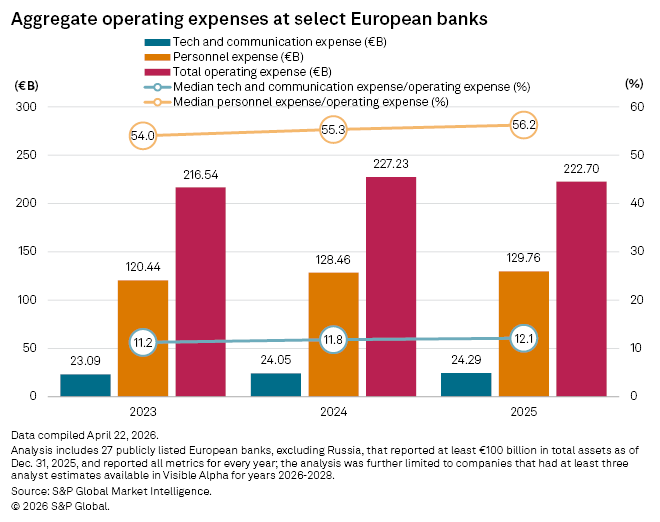
Aggregate costs among a selection of Europe's largest banks fell by almost 2% in 2025, compared with a 4.9% increase in 2024, based on lenders for which Market Intelligence data is available across cost categories and the relevant periods. Weaker growth in personnel expenses, which account for more than half of the banks' cost base, drove the slowdown in total expenses in 2025.
"Operating costs, despite banks' big investments in technology and artificial intelligence, have not increased that much because they are already getting efficiencies from those technologies that allow them to reduce operating cost in a significant manner," said Maria Parra, vice president, European financial institution ratings at Morningstar DBRS, in an interview.
Still, the impact on energy prices and inflation from the war in the Middle East could test European banks' plans for containing costs in the coming quarters, Parra said.
"Operating costs will be higher because of inflation," Parra said. "Although I don't think we are going to see a full pass-through of that inflation to operating costs because of the efficiencies that banks are starting to get from investment in technology."
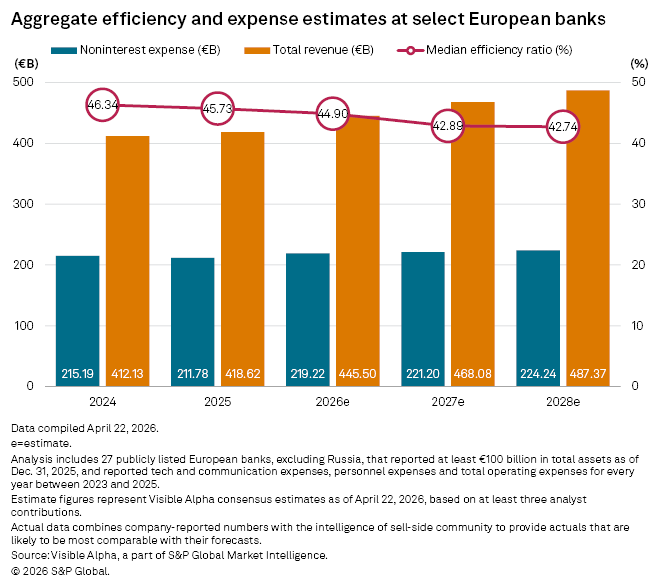
Gains from AI adoption are expected to contribute to an improvement in European banks' efficiency in the coming years. Analysts forecast aggregate costs at Europe's largest banks to increase at a significantly slower rate than revenues between 2026 and 2028, according to Market Intelligence estimates data.
A 9.4% jump in aggregate revenue among the lenders over the two years ending in 2028 is forecast to more than offset a 2.3% rise in average costs. The divergence, known in the industry as "positive jaws," will drive a 216-bps improvement in the median cost-to-income ratio at the banks, the data shows.
AI developments
European banks' discussion of AI is likely to intensify during first-quarter earnings calls, following a series of recent events that have heightened concerns about the technology's impact on the banking sector and the global economy.
A Feb. 22 report by Citrini Research, "The 2028 Global Intelligence Crisis," which hypothesized a global economy in turmoil in 2028 due to the impact of AI, caused a more than 1% decline in the S&P 500, driven by significant sell-offs in software stocks.
The next day, AI company Anthropic PBC announced the release of a new capability in its Claude platform designed to modernize common business-oriented language code, the decades-old legacy programming language many banks still use to run critical systems.
On April 7, Anthropic released a preview of its new Mythos model, warning that it could pose a significant cybersecurity risk to banks due to its ability to easily exploit vulnerabilities in legacy code. Anthropic has since begun working with bank regulators and supervisors, as well as a selection of lenders, to prepare the sector for the model's release.
The potentially disruptive impact of AI on society could force delays in banks' adoption of the technology, Unicredit CEO Andrea Orcel said during the bank's strategy presentation in February.
"I cannot judge how adoption [of AI and] dealing with the social impact is going to delay — and correctly so — the implementation of what we do," Orcel said. "Most CEOs cannot judge that because a lot of these changes are new and we are not accustomed to dealing with them."
Mentions of AI by European bank executives have increased significantly since early 2023, up from zero in 2022. OpenAI LLC released its first publicly available version of ChatGPT in late November 2022.