03 Mar, 2026
South Korea private equity deal activity falls in 2025
By Eleennae Ayson and Shambhavi Gupta
Global private equity and venture capital deal value in South Korea totaled $8.58 billion, down 38.8% from the prior year and the lowest annual figure since at least 2020.
The number of transactions fell to 446 from 582 in 2024, according to S&P Global Market Intelligence data.
South Korea's overall M&A activity slowed significantly from December 2024 through June 2025, Jin-Won Kim, a partner at KPMG in South Korea, told Market Intelligence. During the period, martial law was declared, the president was subsequently impeached and a period of leadership uncertainty affected the country's stability.
Since June 2025, transaction volumes have shown signs of recovery, Kim said, with global private equity firms and local investors now actively exploring M&A opportunities.
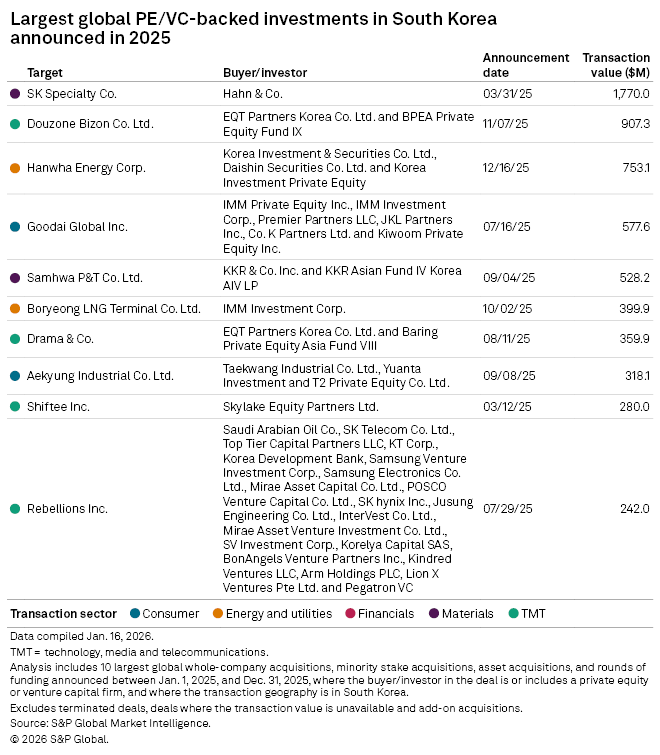
The second half of 2025 saw notable private equity investments in the country, led by large global managers, including The Carlyle Group Inc.'s pending purchase of KFC Korea Co. Ltd., KKR & Co. Inc.'s acquisition of Samhwa P&T Co.Ltd. and EQT AB (publ)'s acquisition of Drama & Co.
KPMG's Kim observed that local private equity players "have been a little bit slow because they are watching how government or regulators have tried to control local private equity over the last five or six months."
South Korea intends to tighten private equity rules after local firm MBK Partners was placed under investigation by government prosecutors over a debt issue involving its investment in supermarket chain Homeplus.
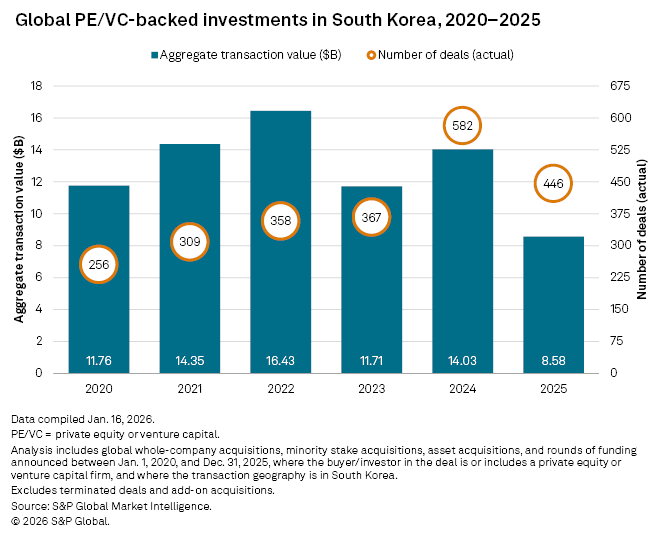
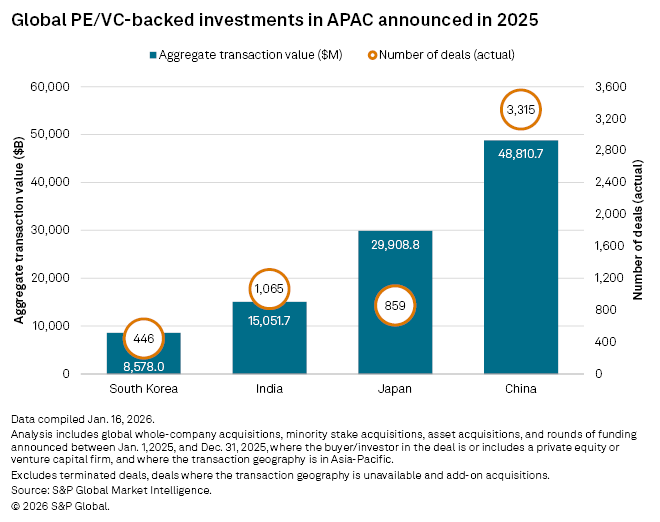
Even as deal activity declined in 2024, South Korea was among Asia-Pacific markets that have attracted the most private equity investment.
The country had the highest private equity penetration rate in the region, at 6.81% as of late November 2025. The measurement refers to the percentage of total private companies in a market that have private equity or venture capital investment.
– Download a spreadsheet with data featured in this story.
– Read about trends in global private equity-backed take-private transactions.
– Explore more private markets headlines.

Top sector
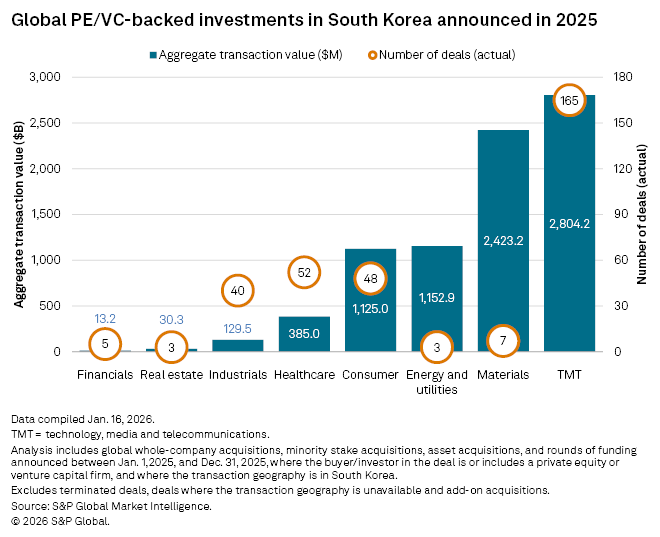
The technology, media and telecom sector led private equity transactions in 2025, attracting $2.80 billion in private equity investment. Deal count in TMT also led all sectors, at 165.
Notable TMT deals announced in 2025 include the pending $907.3 million acquisition of a 37.6% stake in AI infrastructure solutions company Douzone Bizon Co. Ltd. by EQT Partners Korea Co. Ltd. and BPEA Private Equity Fund IX. In February, less than four months later, EQT Partners Korea proposed to acquire an additional 57.69% stake in Douzone Bizon in a roughly $1.63 billion deal that would take the company private, according to Market Intelligence data.
"AI infrastructure is currently attracting substantial national interest and investment," said Jinyoung Kim, research fellow at the Korea Capital Market Institute. "AI-enabled SaaS is also widely viewed as a high-potential segment."
Top deals
In South Korea's largest private equity deal of 2025, Seoul-based Hahn & Co. completed the 2.6 trillion won acquisition of SK Specialty Co. Ltd., the specialty gases unit of industrial conglomerate SK Inc., The Korea Economic Daily reported. The SK Group retained a 15% stake in the business following the deal.
The South Korean government supports capital flows into sectors that enhance long-term economic competitiveness. "Startups and companies operating in advanced industries are therefore likely to benefit from this policy direction," Kim with Korea Capital said.
Outlook
In 2026, private equity funds are set to play a prominent role in South Korea's M&A market, with a strong focus on acquiring conglomerate carve-outs, according to Jihun Kim, executive director at DC Advisory.
As major conglomerates grapple with liquidity pressures and declining profitability — particularly in sectors such as chemicals — they are increasingly divesting noncore assets. This wave of divestments is creating attractive opportunities for both large and small private equity funds to acquire and restructure these businesses, DC Advisory's Kim said, adding that the trend is expected to drive significant deal activity.
Another potential sector for deals is the "K-beauty" sector, which shows outward expansion into markets like the US, marked by overseas interest in South Korean cosmetics and skincare products. A top deal in 2025 was Goodai Global Inc.'s proposed 600 billion-won acquisition of Seorin Co. Ltd.