03 Mar, 2026
Marine war insurance for Hormuz dries up as Middle East war intensifies

By Ben Dyson
|
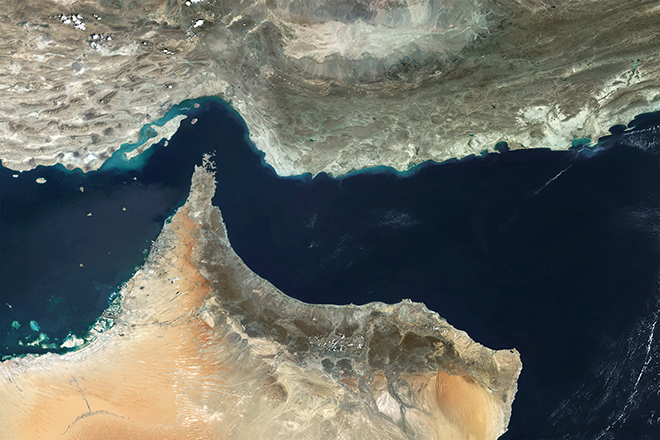
The Strait of Hormuz shipping lane has been a focal point for marine insurers in the early stage of the Middle East war. Source: Gallo Images/Orbital Horizon/Copernicus Sentinel Data via Getty Images. |
Ships wanting to pass through the Strait of Hormuz are finding it almost impossible to buy hull war cover after hostilities began between Iran and the US and Israel.
The Strait, a narrow stretch of water connecting the Persian Gulf and the Gulf of Oman, is a key shipping lane, though which roughly 20% of the world's seaborne oil and gas is transported.
"If you went to the hull market right now and said: 'I've got a tanker going through the Strait of Hormuz,' I think there is a possibility that you would struggle to find… underwriters looking to write that," David Smith, head of marine at insurance broker McGill & Partners, said in an interview.
The US and Israel on Feb. 28 began a sustained air campaign against on Iran, which has responded with missile and drone attacks against both military targets and energy infrastructure in the Persian Gulf.
Iran has also threatened to close the Strait and said it will attack ships attempting to traverse it. While Iran's naval capabilities have been seriously degraded and few ships have come under actual fire, the Strait is already "de-facto closed given that a lot of insurance companies have stopped insuring transiting vessels," Bilal Bassiouni, head of risk forecasting at risk advisory firm Pangea-Risk, said in an interview.
"No major carriers are transiting the Strait," he added.

Price spike
For vessels travelling to the Persian Gulf that are not planning to go through the Strait, the price of hull war cover has jumped. While noting that prices are "highly subjective" and based on criteria such as vessel size, flag, ownership and cargo, Smith is seeing "rates of up to 1% [of the ship's value] for seven days without breaching the Strait of Hormuz."
Hull war insurance prices for the Gulf were around 0.25% of a ship's value before the fighting broke out, according to several news reports.
Shipowners also face paying more for liability cover if their vessels are travelling to the Gulf. Protection and indemnity (P&I) clubs — mutual marine insurers that provide ships' liability cover — have been cancelling certain war cover. All 12 members of the International Group of P&I Clubs, a risk pool that covers 90% of the world's ocean-going tonnage, have given 72 hours' notice of cancellation of parts of their war cover in the Gulf.
The cancellations are for non-poolable war risks, which cannot be shared between the International Group members.
"In most cases the clubs will be offering to reinstate war coverage at terms to be agreed," Peter Hulyer, head of P&I for the UK at insurance broker Marsh LLC, said in a press statement. "Mutual P&I cover offered by the clubs is unaffected."
The cancelled cover is typically related to war risks included the clubs' charterers' coverage, a range of covers offered to those chartering vessels. The move brings the P&I war market into line with the hull war market, Smith said.
Waiting game
The situation in the Strait of Hormuz means that ships are now building up in the area and looking for alternative ports, Smith said.
"The underwriters are waiting to see what happens, and I think most sensible shipowners are waiting to see," he said. "No shipowner wants to put either his asset, and more importantly his crew, in danger. They'll look for every alternative other than do that."
Docking at ports in the Gulf could also be risky. There have been attacks on the Port of Duqm in Oman, which Bassiouni said signals "a higher risk of collateral damage around other vessels that may be anchored in ports close to what Iran may deem as legitimate military targets in those waters."
Obstructing the Strait of Hormuz could trap some ships in the Persian Gulf, which could trigger so-called blocking and trapping claims under war policies, Smith said. However, vessels would need to be stuck for six months, a year or longer for this coverage to come into play, Smith said, "so that concern at the moment will be right at the very back of most underwriters' thoughts."
Red Sea risks
While Hormuz has been a focal point for marine insurers in the early stages of the war, they are also alert to the potential for the Houthis, an Iran-backed group based in Yemen, to resume attacks on vessels in the Red Sea. "Everyone is keeping a very, very watchful eye also right now on the Red Sea," Smith said.
Trouble in the Red Sea does not cause the same level of disruption as Hormuz because there are alternative routes available. Even so, an underwriter being asked for a price to go through the Red Sea now would give it more careful consideration than they would a week ago, Smith said. "We all need to be very concerned about what's going on within the Persian Gulf," he said. "But I think also you still need to keep half an eye on the Red Sea as well."
The level of threat from the Houthis will depend on how long the war lasts, according to Bassiouni. Following the 2025 ceasefire deal between the Houthis and the US, the Houthis' calculations will be more based on domestic considerations and their relationship with the US than Iran, he said.
That said, as airstrikes against Iran continue, the Houthis may eventuallly decide to "reactivate the Red Sea attacks to shift pressure away from Iran and also increase leverage that they may have at the same time," Bassiouni said.