18 Mar, 2026

LA faces choice after 2025 wildfires: Rebuild all-electric or stay with gas?

SNL Image

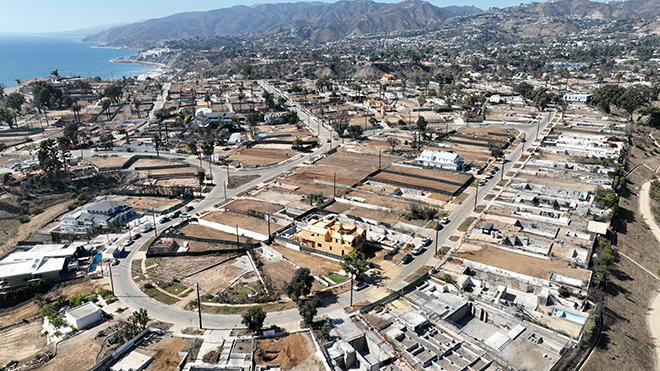
Thousands of homes have yet to be rebuilt in the Pacific Palisades neighborhood of Los Angeles, where wildfires devastated the community in January 2025.
Source: Allen J. Schaben/Contributor/Los Angeles Times via Getty Images.

Rebuilding Los Angeles County neighborhoods following devastating 2025 wildfires has raised a critical question for Southern California's energy future: Will the owners of more than 16,000 destroyed homes build back all-electric, or reconnect to the region's expansive natural gas distribution system?

California Gov. Gavin Newsom and Los Angeles Mayor Karen Bass have suspended building electrification policies, complicating the answer to that question. At the same time, the state, city and electric utilities have launched new incentives to build all-electric, while Southern California Gas Co. has offered enhanced rebates to install high-efficiency gas appliances.

Against this backdrop, building electrification advocates have mobilized to raise awareness about options to rebuild fossil fuel-free.

That has raised the specter of customer attrition for SoCalGas, which is already grappling with state policies designed to reduce investment in gas infrastructure, incentivize electrification and strategically decommission parts of the gas grid.

SNL Image

A host of factors have slowed the pace of LA County's rebuild, but the permitting process is getting underway. Los Angeles has received building applications for more than 1,654 addresses and issued permits for 984 as of March 17, according to a tally kept by the city.

"A lot of those decisions are happening right now, where people will be getting their insurance money and then hiring an architect and making these decisions around electrification," said Drew Shula, founder and CEO of sustainability and green building consulting firm Verdical Group Inc. "So now is the time to be doing this education and advocacy work."

Electrification policy suspended amid wildfires

For years, advocates have stressed that building fossil fuel-free is cheaper than electrifying homes through retrofits. While they roundly described the 2025 wildfires as a tragedy, advocates said rebuilding has opened the door to more cost-effectively electrifying for tens of thousands of Californians.

"You have a real opportunity when you have to start from scratch as terrible as that is to not only take advantage of some cost savings in construction, but also to make sure that your home is resilient, not contributing to the climate crisis and really prepared for the future of California," Beckie Menten, California director at the Building Decarbonization Coalition, told Platts, part of S&P Global Energy.

In the lead-up to 2025, California adopted building codes that increasingly encouraged developers to build all-electric, while Los Angeles joined dozens of Golden State communities in restricting gas use in new construction.

However, as wildfires ripped through Altadena and the Pacific Palisades neighborhood of Los Angeles, decision-makers started the process of rolling back those policies in an effort to streamline reconstruction.

On Jan. 13, 2025, Bass waived LA's gas ban for new construction in affected areas. Newsom issued executive orders in February and July allowing wildfire-destroyed buildings to comply with prior building codes. This meant they would not be bound to the strong incentive for electric space and water heating in the state's 2025 building code.

"For an environmentalist like me, it's really painful that that happened," Shula told Platts. "Because it was such an opportunity to make all of these buildings all-electric."

Policymakers continue to support electrification

Yet Los Angeles and California are seeking to encourage electrification. In August 2025, the city and its municipal electric utility, the Los Angeles Department of Water and Power (LADWP), announced a program to subsidize the cost of rebuilding all-electric for wildfire-damaged homes. The High-performance, Optimized, Modern Electrification for Los Angeles (HOME LA) program offered incentives of up to $10,000 to install electric heating systems and appliances in residences.

As of late January, LADWP had received 19 HOME LA applications, though it expected participation to increase as more residents secure financing and enter the home design phase. The program is funded at $10 million per year for the next four years.

SNL Image

Southern California Edison Co. on March 6 proposed a roughly $20 million program to incentivize all-electric rebuilds for its residential customers in wildfire-affected areas. The program would leverage the hardening and upsizing of SCE's distribution system, which could facilitate incremental building electrification, the company said.

On March 9, the California Public Utilities Commission (CPUC) announced it would advance a long-planned $50 million program to subsidize all-electric rebuilds for homes damaged by wildfires and other natural disasters since 2017. The CPUC approved the Rebuilding Incentives for Sustainable Electric (RISE) Homes program in November 2021 and will begin taking applications on April 6.

It is unclear how much electrification the programs will drive, but past efforts offer some clues. Incentives launched by Sonoma Clean Power Authority and Pacific Gas and Electric Co. following the 2017 Tubbs Fire prompted about 6% of rebuilds to go all-electric in the first 13 months of the program, according to a 2019 case study.

After the 2021 Marshall Fire in Boulder County, Colorado, about 70% of rebuilds took advantage of incentives from Xcel Energy Inc. and the state, with at least 21% choosing all-electric construction as of October 2025, according to a report by The Urban Institute.

Awareness of electrification is growing

The new programs added to preexisting building electrification incentives offered by the CPUC, LADWP and the California Energy Commission. Getting out the word about these incentives has been a major focus for national, state and local advocates over the past year.

Some groups had already laid the groundwork before wildfires swept through LA. After the Thomas and Woolsey fires in the 2010s, the US Green Building Council (USGBC) developed several resources, including a green rebuilding guide, a workshop series for affected residents and a rebuild certificate program for contractors, USGBC California Executive Director Ben Stapleton said.

Seven years of building electrification campaigning in California has also aided advocates.

According to Stapleton, prior USGBC California surveys showed that about 70% of respondents were aware of the potential health impacts of indoor gas use, which advocates have highlighted since 2020 and the gas industry has disputed. In a workshop with senior citizens after the LA fires, Stapleton said a majority of questions were about rebuilding all-electric.

"The questions blew me away because I didn't think anyone would ask about electrification," he said.

While more Californians are aware of electrification these days, advocates cautioned that the transition to broader market awareness is still nascent.

"This is not the kind of tragedy that chose to only impact early adopters or customers who are a little more informed or savvy," Menten said.

SoCalGas launches new incentives

Meanwhile, more than 90% of homes in Southern California use gas for space and water heating or cooking, according to SoCalGas. The company said it is seeing strong demand for reconnections following the wildfires.

The company has reconnected more than 16,000 customers who were able to return to their homes. It had also received more than 800 reconnection requests for rebuild projects as of early February.

"SoCalGas recognizes the emotional and financial impact the catastrophic 2025 Los Angeles wildfires have had on our communities and has worked to make the natural gas restoration process as seamless as possible so customers can rebuild their lives affordably," SoCalGas spokesperson Erica Berardi told Platts.

SNL Image

As part of its building decarbonization agenda, the CPUC in 2023 ended ratepayer-funded incentives to install high-efficiency gas appliances in most new home construction. However, the CPUC exempted homes rebuilt after wildfires, citing CEC analysis that showed restoring service would not meaningfully increase gas consumption.

Following the 2025 wildfires, SoCalGas increased existing incentives by up to 50% for houses, apartment buildings and businesses. It additionally launched the Residential Energy Efficient Fire Rebuild program, which offers up to $10,000 in incentives to single- and multifamily buildings that exceed the state's building energy efficiency standards.

The company also launched a new financing mechanism, GoGreen Financing, for high-efficiency gas equipment and other energy conservation measures. Like electrification advocates, SoCalGas expected program adoption to accelerate as owners enter the mechanical and appliance planning stages of rebuilding.

Some all-electric rebuilds face cost premium

Electrification advocates and the gas industry have long debated the cost advantage of heat pumps versus gas furnaces. A rebuild on the scale of LA County's presents unique considerations.

Shula, the Verdical Group CEO, acknowledged that one of electrification's cost advantages results from not extending gas infrastructure to new homes. The existence of SoCalGas' sprawling gas system diminishes that cost advantage, he said.

SoCalGas serves more than 21 million consumers through 5.9 million meters, underpinned by 101,000 miles of pipeline. The CPUC is currently exploring how to strategically retire sections of that network, a process known as zonal decarbonization. However, that work will take time, and the CPUC did not identify LA County as a major priority for zonal decarbonization.

SNL Image

Candidacy for zonal decarbonization depends on the status of the underlying infrastructure, Menten said. In wildfire-affected areas, that includes how much damage the gas grid sustained and the scale of ratepayer-funded investment needed for repair, she said.

After inspecting and surveying roughly 200 miles of pipelines in the Palisades and Eaton fire areas, SoCalGas has found that distribution mains were undamaged and can safely serve customers as they rebuild, the company told Platts.

According to Stapleton, the data suggest that the cost of rebuilding with gas or all-electric should be roughly the same. However, he has heard of building owners being quoted $20,000-$30,000 more to rebuild all-electric.

After looking into the issue, Stapleton believes that some contractors built a premium into the quotes due to a shortage of workers trained to install heat pumps. He said it was critical for the green building sector to grapple honestly with these challenges.

"We rarely have the opportunity to build this many homes in a community in any community this way," he said. "And to me, that's kind of the opportunity to prove out that this is possible."