12 Mar, 2026

'Boom time': US battery storage sector bullish after another record year

SNL Image

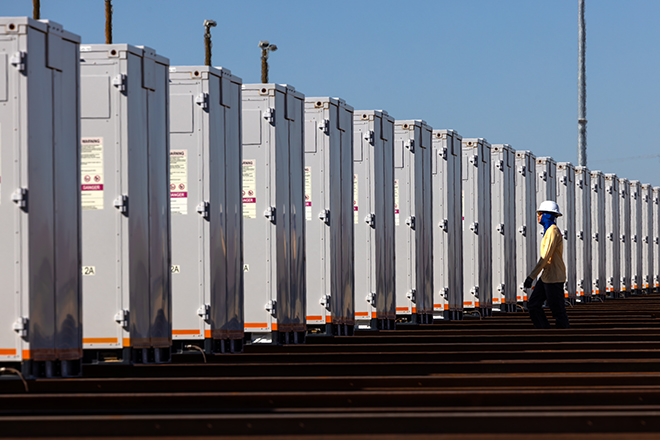
A technician checks battery equipment at Clearway Energy's Daggett 3 solar-plus-storage project in California.
Source: Irfan Khan/Los Angeles Times via Getty Images.

Momentum continues to build for big battery power plants in the US following another record year in 2025, in which the technology repeated its position as the country's second-largest source of new capacity after solar.

US utilities and independent developers added 17.75 gigawatts of large-scale battery power storage capacity last year, 52% more than the previous record in 2024, according to S&P Global Market Intelligence data. Companies completed nearly 6 GW in the fourth quarter alone, marking a new quarterly high and pushing cumulative non-hydroelectric storage capacity to roughly 48 GW — almost all of which was built this decade.

The data underscores the rapid ascent of lithium-ion battery systems, most of which are designed to store energy for up to four hours from colocated solar farms or renewables-rich grids to help meet rising US peak power demand.

"I've never seen an industry move so fast," said Chris Taylor, CEO of Portland, Oregon-based developer GridStor LLC, which is backed by Goldman Sachs Asset Management LP. "I don't know if there's ever been a technology in the history of mankind for energy that's been deployed at such a massive scale in such a short period of time."

The industry easily surpassed its target of adding 35 GW by 2025, a seemingly ambitious goal set in 2017 when the US had less than 1 GW of battery storage in operation. Since 2020, battery storage capacity has skyrocketed, overtaking cumulative pumped hydroelectric storage in 2024 and topping annual natural gas-fired capacity additions in each of the past two years.

Backed by long-term federal tax credits, an improving supply chain and surging demand from hyperscale technology giants, Taylor and many of his peers believe battery storage has only just begun to hit its stride as critical infrastructure to facilitate data centers, electric vehicles, factories and other sources of escalating power demand.

"From now to 2030 is going to be a boom time for our sector, because if you have well-positioned assets, you can quickly use those to support data center growth, and I see that as becoming a huge driver," Taylor told Platts, part of S&P Global Energy.

'All around the grid'

Developers have plans for nearly 185 GW of new large-scale battery storage capacity through 2030, implying 37 GW of planned annual additions, on average, over the next five years, according to Market Intelligence data. That includes about 24 GW under construction or in advanced development and over 150 GW of early-stage projects.

Such raw ambitions exceed the expectations of industry observers. Benchmark Mineral Intelligence, for instance, projects 104 GW of utility-scale battery additions between 2026 and 2030, while S&P Global Energy Horizons forecasts 93.3 GW over the same time period, including both front-of-the-meter and behind-the-meter resources.

This year, Benchmark expects 20.2 GW of utility-scale battery additions, compared with Horizons' forecast of approximately 16 GW. The US Energy Information Administration in February said it was tracking 24.3 GW of new utility-scale battery storage capacity planned for 2026, based on its preliminary monthly generator inventory, again trailing only solar.

Wherever the final numbers land over the next several years, the battery storage industry is bullish on its prospects.

"We are now at a point where people understand the role we play, and they are seeing how this technology is going to change the way the grid works," Julian Nebreda, president and CEO of energy storage technology integrator Fluence Energy Inc., told Platts. "This technology is going to be all around the grid. It's going to make the consumption of electricity a lot more efficient."

Fluence, Gridstor and other battery storage companies tout their ability to build capacity faster than competing technologies.

"Most of my customers care about speed to power more than anything," Nebreda said in an interview.

Storage hotspots

Texas and California continue to lead US demand for energy storage, according to Market Intelligence data, followed by Arizona, Nevada, Oregon and New York.

As of Feb. 26, Texas had 17.6 GW in operation, recently surpassing California, with 15.7 GW. Arizona has 5.1 GW in operation, and Nevada has 1.9 GW.

The largest pipeline of planned capacity additions tracked by Market Intelligence is also in Texas, totaling 74.6 GW. Developers have plans for 34.5 GW of additions in California, 16.1 GW in Nevada and 13.7 GW in Arizona.

But demand is diversifying across the US, with hotspots emerging in all corners of the country, often in places where data centers are proliferating.

One such region is the Pacific Northwest, where developers have about 8 GW planned in Oregon and 4.2 GW in Washington.

Portland General Electric Co. (PGE), Oregon's largest investor-owned utility, is at the forefront of battery storage development in the region, with 522 megawatts in operation and more in the works.

In February, the utility announced agreements to build two hybrid solar/battery projects, combining for 615 MW, and two standalone storage facilities totaling 400 MW. The projects stem from a 2023 request for proposals.

In addition, PGE is reviewing a shortlist of 5 GW of proposals resulting from its 2025 all-source solicitation, which includes over 2.1 GW of battery storage, according to a Feb. 17 state regulatory filing.

Battery storage offers a "trifecta" for PGE, supporting its reliability, affordability and decarbonization targets, Brett Greene, the utility's senior director of commercial initiatives, said in an interview. "This is a resource that actually checks many boxes."

As the region sees rising demand from data centers and electrification, PGE is finding that batteries can help address shortfalls in available capacity or transmission affecting "a couple hundred hours a year," Greene said. "The batteries are perfect for that because we can fill them and charge them during non-peak hours, and it's sitting there ready to address that congestion."

Hydroelectric power, the backbone of the region's power system, can also address such congestion.

"But what we're seeing is the data centers are locating near those hydro resources [and] they're starting to consume that hydro themselves," Greene said. "So the availability of hydro is shrinking, which means we need to offset that with new technology, which is the batteries."

Market Intelligence considers a project as announced when it has a listing in an interconnection queue with an accompanying public announcement or permitting action. A project is considered in early development after permitting begins. For a project to be considered in advanced development, it must meet two out of five criteria: financing is in place, power purchase agreements are signed, equipment is secured, required permits are approved or a contractor has signed on to the project. A project is under construction when building activity begins; site preparation does not qualify a project for this status.