Featured Topics
Featured Products
Events
S&P Global Offerings
Featured Topics
Featured Products
Events
S&P Global Offerings
Featured Topics
Featured Products
Events
S&P Global Offerings
Featured Topics
Featured Products
Events
Financial and Market intelligence
Fundamental & Alternative Datasets
Government & Defense
Professional Services
Banking & Capital Markets
Economy & Finance
Energy & Commodities
Technology & Innovation
Podcasts & Newsletters
Financial and Market intelligence
Fundamental & Alternative Datasets
Government & Defense
Professional Services
Banking & Capital Markets
Economy & Finance
Energy & Commodities
Technology & Innovation
Podcasts & Newsletters
24 Mar, 2026

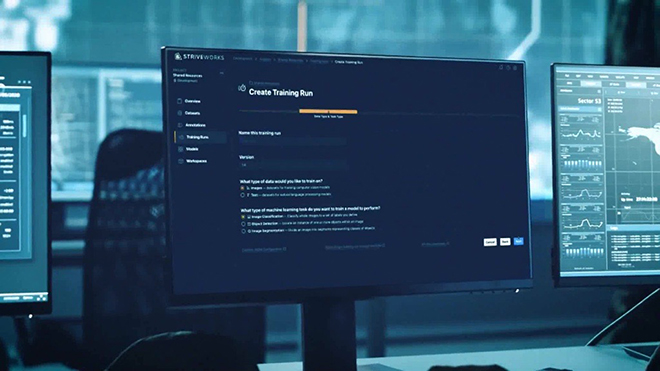
| Striveworks' Chariot platform functions as an operational layer beneath better-known defense applications, aggregating data from disparate sources and deploying AI agents to generate actionable insight in real time. Source: Striveworks Inc. |
➤ Striveworks sees agentic warfare dramatically altering how data is used and processed in national security situations.
➤ The company designs its systems around adaptability rather than point-in-time performance.
➤ Striveworks kept its Series B funding round small to command a premium valuation ahead of expected additional business from the Department of Defense
Striveworks Inc, which provides AI operations (AIOps) for defense and national security missions, announced a Series B growth investment from Washington Harbour Partners LP as demand for operational AI accelerates across the US government and allied defense communities. The Austin, Texas-based company's Chariot platform powers AI operations across several defense programs, including the Army's Next Generation Command and Control initiative, and has grown 497% in recent years.
S&P Global Market Intelligence spoke with co-founder and CEO James Rebesco to discuss what sets Striveworks apart in an increasingly crowded defense AI market, how its platform handles the complexity of classified environments, and why he thinks agentic warfare will define the next era of national security technology.
|
|
S&P Global Market Intelligence: Your platform sits below applications like Palantir Technologies Inc. in the stack. Can you explain what that means in practice?
James Rebesco:
You've said Chariot can deploy AI models in hours rather than months. How do you stress-test that durability before it matters in the field?
If people aren't thinking about adaptability as a constant, not an afterthought, those systems just aren't going to work. That's a pattern that's been tried and it doesn't hold. I spent the first decade of my career in electronic trading, and the core lesson from that was that market conditions change in minutes to hours. What made us good wasn't building the single best algorithm, it was building the fastest system at adapting. Out of that came the best system, because we were never optimizing for one point in time. We were optimizing for the ability to optimize. That same philosophy is now central to how we build for defense. And what's exciting is that customers are starting to evaluate AI systems the same way. Five years ago, you might evaluate an AI system based on a PowerPoint or the strength of your handshake. Three years ago, you'd test it against one gold-standard dataset. Today, customers are running evaluations over three days, five days, changing what you've got to find and make sense of each day. They're measuring to a tee your ability to adapt to the unknown. That's a clear demonstration of really smart, informed customers — and that's how we think about durability.
How does Striveworks handle AI systems operating across different classification levels?
The general pattern is to keep everything at the level it was trained on. If you train a model on top-secret data, you keep it there. What you do see in the other direction, and it's a very common and effective pattern, is building models on controlled but lower-classification data, then moving them up and fine-tuning with more exquisite, mission-specific data at the appropriate classification level. I don't think you're going to see a lot of declassification of trained models in the near future.
You've completed a Series B round with Washington Harbour Partners, whose founder and CIO, Mina Faltas, said Striveworks has "operationalized AI in some of the world's most demanding national security environments." How do you think about the growth path from here?
I think focusing on the end state — IPO, acquisition, whatever — is a distraction. If you focus on that, it poisons how you think about your customers, your team, your growth. The only thing that really matters is whether you're building a product that has genuine value to users and whether you can sell it in a way that's economically effective for everyone involved. If the answer to those questions is "yes," you've got something enduring, and the capital markets stuff sorts itself out. We were just focused on building the best business possible.
Where do you see this technology going over the next few years?
The pattern that's transforming enterprise SaaS — a nice front end, a database, automation connecting the two — that same pattern describes a lot of core software in the defense space. Those systems are going to go through radical change. I'll say it provocatively. Agentic warfare is going to fundamentally transform how people process data to fight in national security and intelligence applications. The pace of change in the underlying technology is moving faster than procurement cycles have historically moved, and I think what you're going to see is a compression of that gap. That's the opportunity we're positioned for.