


09 Feb, 2026
With planning, large US power customers can drive retail cost reductions – panel

By Zack Hale
Utility regulators must use a mix of near- and long-term strategies to address rising electricity prices as new sources of demand such as data centers and industrial manufacturing facilities are connected to the US grid, a panel of experts said Feb. 9.
Customers are currently experiencing a "whiplash effect" as a range of factors drives rate hikes nationwide, Christopher Namovicz, a modeler with the US Energy Information Administration, said during an annual policy summit hosted by the National Association of Regulatory Utility Commissioners in Washington, DC.
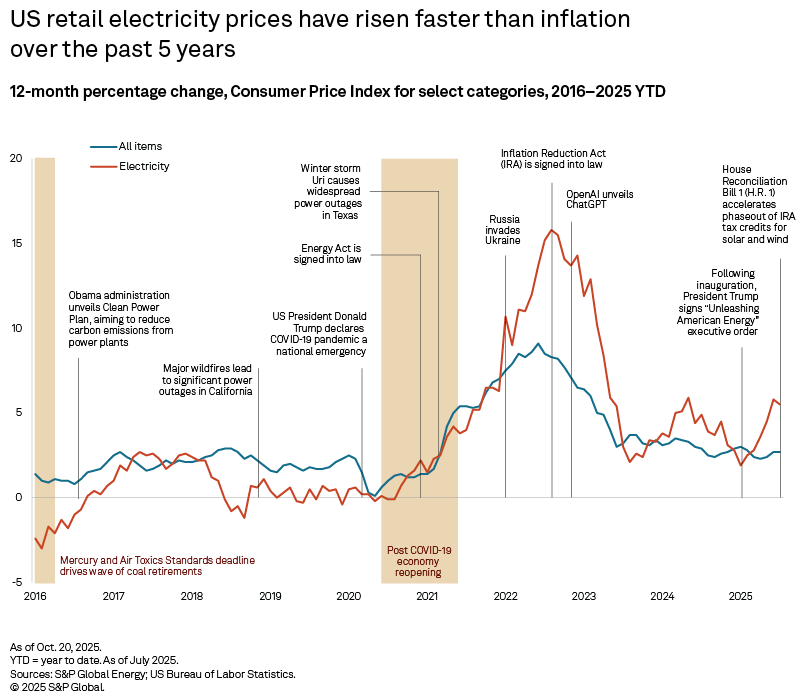
Consumer Price Index data for January shows a 6.7% year-over-year jump in US electricity prices, significantly outpacing inflation. A broader five-year increase in average US electricity prices — largely driven by the need to replace aging local transmission infrastructure, extreme weather and wildfire impacts, and demand growth — comes after more than a decade of "remarkably stable" prices, Namovicz said.
Jeff Dennis, executive director of the Electricity Customer Alliance, acknowledged that "it's tempting to kind of pin this on data centers and other large loads." But Dennis said the relationship between data centers and power prices is more nuanced. The trade group, whose membership includes hyperscalers like Google LLC, Microsoft Corp. and Meta Platforms Inc., promotes affordable solutions to expand the US power system and support economic growth.
A recent study by researchers at the Lawrence Berkeley National Laboratory on cost trends from 2019 to 2024 found that state-level load growth tended to reduce average retail electricity prices, Dennis noted.
In fact, the study found that states with the highest load growth over that period experienced price reductions, while states with contracting demand generally saw price increases. The findings align with the notion that spreading the fixed costs of transmission and distribution system investments over a broader customer base naturally exerts downward price pressure, the study said. However, the Berkeley researchers cautioned that those historical trends may not extend into the future.
"The tie between data centers and large loads in terms of cost increases is really a factor of how is the region, or the state, looking at that?" Dennis said during the Feb. 9 discussion. "Are they planning ahead for that large load? Are they putting measures in place to accommodate that load growth, or are they chasing it?"
Customer-identified generation
Nidhi Thakar, senior vice president of policy at the Clean Energy Buyers Association (CEBA), said utility regulators will need to "thread the needle" to address affordability while maintaining US leadership on artificial intelligence amid a resurgence in industrial manufacturing. The trade group's membership, which also includes major hyperscalers, has collectively procured or contracted for nearly 130 GW of carbon-free electricity over the last 10 years.
Expanding programs that allow large customers to bring their own generation resources to the grid is crucial, Thakar said. As an example, Thakar cited a new program being implemented as part of Southern Co. subsidiary Georgia Power Co.'s 2025 integrated resource plan that will enable CEBA members to purchase up to 3,000 megawatts of customer-identified resources through 2035.
Thakar said that adding large loads to the system can help "bring forward" already-planned utility system upgrades that would have otherwise occurred five to seven years in the future. From there, utility regulators can experiment with innovative tariff designs that compensate large customers for reliability contributions, such as the ability to ramp up or down in response to changing grid conditions.
"It provides a lot of optionality and creativity, and fundamentally helps build a more reliable and resilient grid," Thakar said.
Rob Threlkeld, director of global energy strategy for General Motors Co., said state regulators can also work with large customers to harness excess grid capacity that has been freed up by gains in manufacturing efficiency. "Frankly speaking, we are sitting on it, but we have no way to really activate that capacity — to be able to utilize it for a data center, or utilize it for whatever it could be — because of how some of the utility tariffs are done," he said.
Regional grid planning
Over the longer term, ensuring full compliance with the Federal Energy Regulatory Commission's landmark regional transmission planning rule — Order 1920 — will be essential, Dennis said. The rule, finalized in May 2024, requires regional grid plans to account for seven key economic and reliability benefits across a minimum 20-year planning horizon.
FERC's regulation is expected to help address the issue of piecemeal local transmission planning, which is broadly failing to address high grid congestion costs, Dennis said. A study by the consulting firm Grid Strategies found that nationwide annual grid congestion costs remained well above $10 billion from 2021 to 2024, while before 2021 those costs never exceeded $8 billion per year.
"Compliance with FERC's Order 1920 is going to provide more input into that process, and the opportunity to ask hard questions about how are projects that we're seeing in the regional plan helping to address this problem we have of piecemeal local projects," Dennis said.