20 Feb, 2026

US imports from China plummet, accelerating global supply chain realignment

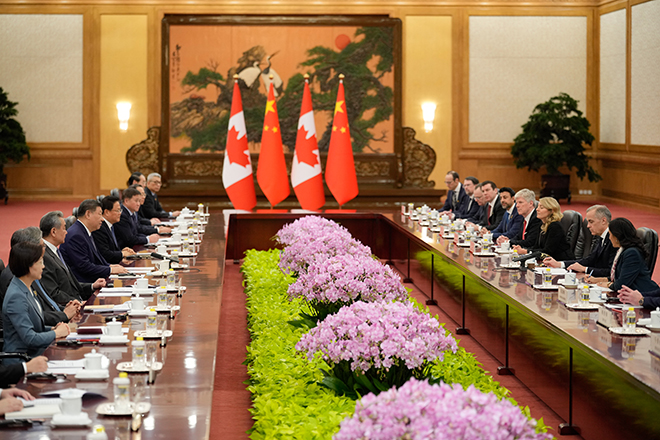
SNL ImageChina President Xi Jinping and Canadian Prime Minister Mark Carney, along with other government officials from the two nations, attend a meeting at the Great Hall of the People in Beijing on Jan. 16, 2026. China and Canada announced a strategic partnership in January to improve trade diversification.
Source: Vincent Thian/AFP via Getty Images.

Trade flows from China to the US declined sharply in 2025 amid tariff escalation and other geopolitical developments, indicating an acceleration of supply chain realignment and worldwide trade diversification.

US imports from China by value fell nearly 30% year over year in 2025, compared to a 9% drop from 2015 to 2024, according to S&P Global Market Intelligence and US Census Bureau data. US import volume from China totaled $308.38 billion in 2025, the lowest in at least the past 10 years.

Global supply chains have steadily diversified over the last decade, driven by China's expanding manufacturing footprint, tariffs introduced during US President Donald Trump's first term, the Russia-Ukraine war and trade disruptions caused by the COVID-19 pandemic. A new round of US tariffs enacted in 2025 and related geopolitical tensions likely accelerated this diversification trend, with the most drastic change seen in trade between the US and China, the world's largest bilateral flow in goods.

"China is definitely trying to diversify away from its dependence on America as far as a consumer of its exports," Scott Tillman, senior vice president of innovation at supply chain management provider Logility, said in an interview. "China is trying to diversify away from that flow as much as the US is trying to diversify away from that flow."

SNL Image

This trade diversification has largely been focused on supply chain realignment that prioritizes regionalization or vertical integration.

"There's this idea, especially within the Trump administration, to run the country more like a business that needs to be vertically integrated from controlling a certain amount of raw materials and down through the production chain," Tillman said. "Companies are having the same type of thought process to bring their supply chains closer to home as much as possible to cut down on risks."

The urgency to realign supply chains has expanded beyond the US and China after the US repeatedly signaled it was willing to escalate tariffs to achieve broader policy goals during the first year of Trump's second term. This has included multiple tariff proposals against Canada and the EU.

"Countries around the world are changing and establishing different free trade agreements, and they're doing that because they're realizing that what they've relied on in prior years can't necessarily be counted on going forward," John Lash, group vice president of product strategy at supply chain platform e2open, said in an interview.

Newly announced trade partnerships in early 2026 have included deals between the EU and India and between China and Canada.

China exports rise despite less trade with US

China still increased its total goods exports by more than 5% year over year in 2025 and raised its total goods trade surplus by 20% to a record $1.19 trillion, according to Market Intelligence and China Customs data.

"This shows that China is not a manufacturer for America but is a manufacturer for the world," Lash said. "This status provides an inherent defense to buffer against aggressive trade actions by other parties."

SNL Image

The US remained China's largest export destination in 2025, accounting for 11% of China's exports. However, that was down from a recent peak of 19% in 2018. China increased shipments to Vietnam by nearly 23%, the largest gain among its top 10 export markets. This was followed by exports to Thailand, which rose more than 20%.

US imports rise, deficit fluctuates

Even with higher tariffs and lower trade with China, total US goods imports in 2025 increased nearly 5% year over year to $3.416 trillion, according to Census Bureau and Market Intelligence data. The overall US trade deficit for goods expanded to a record $1.231 trillion in 2025.

SNL Image

While tariffs may trigger supply chain diversification and target long-term goals, they will not necessarily alter overarching trends in import volume or trade deficits in the near term.

"The tariffs are more about longer-term changes in the structure of the supply chain, like getting more strategic control of things like rare earths and rebuilding core components of the US industrial base that relate to the defense industry and creating more self-reliance," Matt Lekstutis, director at procurement and supply chain consulting firm Efficio, said in an interview. "Looking forward, there will be more volatility, but I don't see the tariffs on their own substantially shifting the direction that the deficit is moving."