26 Feb, 2026
US banks' NDFI lending pace reaccelerates in Q4 2025
By Claire Lawson and Gaby Villaluz
The US banking industry again accelerated its nondepository financial institution lending pace after tapping the brakes in the third quarter of 2025.
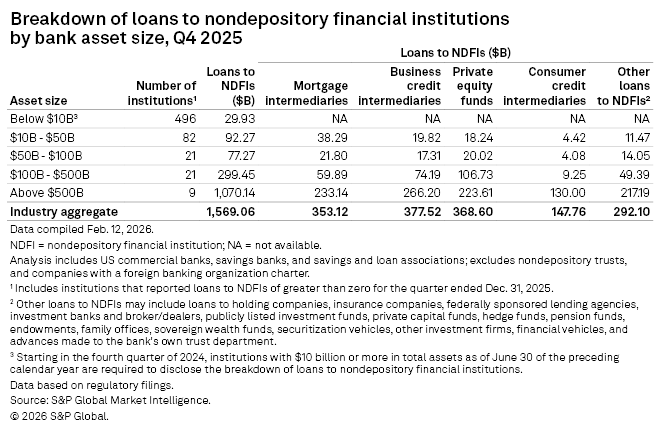
After growth slowed and investor pressure ratcheted up in the 2025 third quarter, growth in loans to nondepository financial institutions (NDFIs) ticked up again to an industrywide 7.3% increase for the fourth quarter of 2025. All the top 20 banks by exposure to NDFI loans increased the loans quarter over quarter, and of those, seven grew their exposure by over 10%.
In total, loans to NDFIs grew $129.66 billion in the fourth quarter, compared with all other loans growing $31.38 billion, or just 24.2% of the growth in NDFI loans.
Huntington National Bank, which acquired
Wells Fargo Bank NA, with the second-largest NDFI loan portfolio totaling $212.13 billion, recorded the next-highest increase in loans to NDFIs quarter over quarter, up 14.2%. The company is primarily exposed to business credit intermediaries (BCIs), with a $71.01 billion portfolio, accounting for 7.45%
That category is also the largest for the rest of the industry, with $377.52 billion in loans, or about 24% of NDFI loans out of the five categories. BCIs include direct lenders, real estate investment trusts and business development companies.
EverBank NA was the only private company to rank among the top 20 NDFI lenders in the fourth quarter, and the smallest company by asset size to rank with just $46.03 billion in assets. The group's median asset size was $307.01 billion, over six times the company's size. Loans to NDFIs accounted for 41.9% of EverBank's $35.90 billion loan portfolio and increased 12.5% quarter over quarter.
JPMorgan Chase Bank NA held the most loans to NDFIs among US banks, with $237.85 billion in exposure, growing 5.2% quarter over quarter.
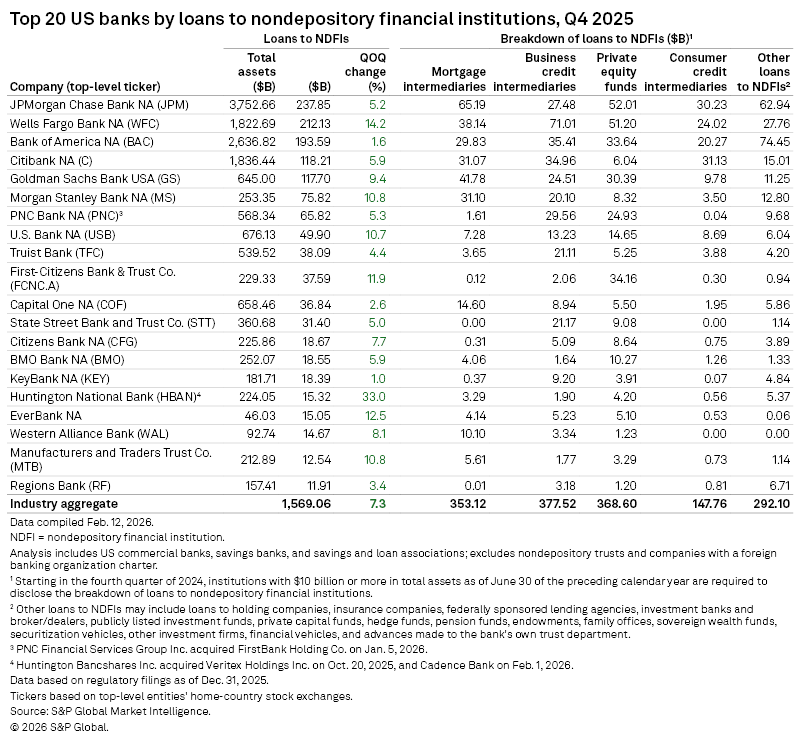
The industry's aggregate proportion of loans to BCIs out of gross loans and leases was 2.80% for the fourth quarter, up 14 basis points from the prior quarter. Of the top 15 banks by proportion, six banks have a proportion higher than 10%, and 11 increased that proportion quarter over quarter.
State Street Bank and Trust Co. held the highest proportion of loans to BCIs, accounting for 45.08% of the company's gross loans and leases, a stat that rose 265 basis points from the prior quarter.
Morgan Stanley Bank NA, with the second-highest proportion of loans to BCIs at 19.73% of its loans and leases, increased that proportion 316 basis points quarter over quarter.
While both State Street and Morgan Stanley are larger banks, with over $250 billion in assets, Apple Bank, with the third-highest proportion of BCI loans, had just $19.22 billion in assets in the fourth quarter. Its 15.68% proportion increased 66 basis points quarterly, with its BCI loans reaching $2.09 billion.
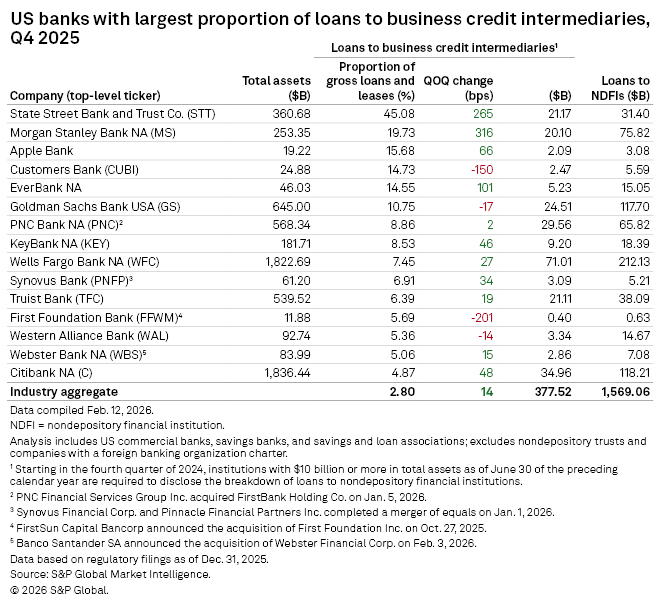
The smallest banks required to report NDFI lending, with assets between $10 billion and $50 billion, primarily lend to mortgage credit intermediaries, accounting for 41.5% of NDFI loan exposure for those entities. Banks with less than $10 billion in assets are not required to break down loans to NDFIs in regulatory reporting.
Overall, the largest banks dominate this space, as institutions with over $500 billion in assets accounted for 68.20% of NDFI loans held.
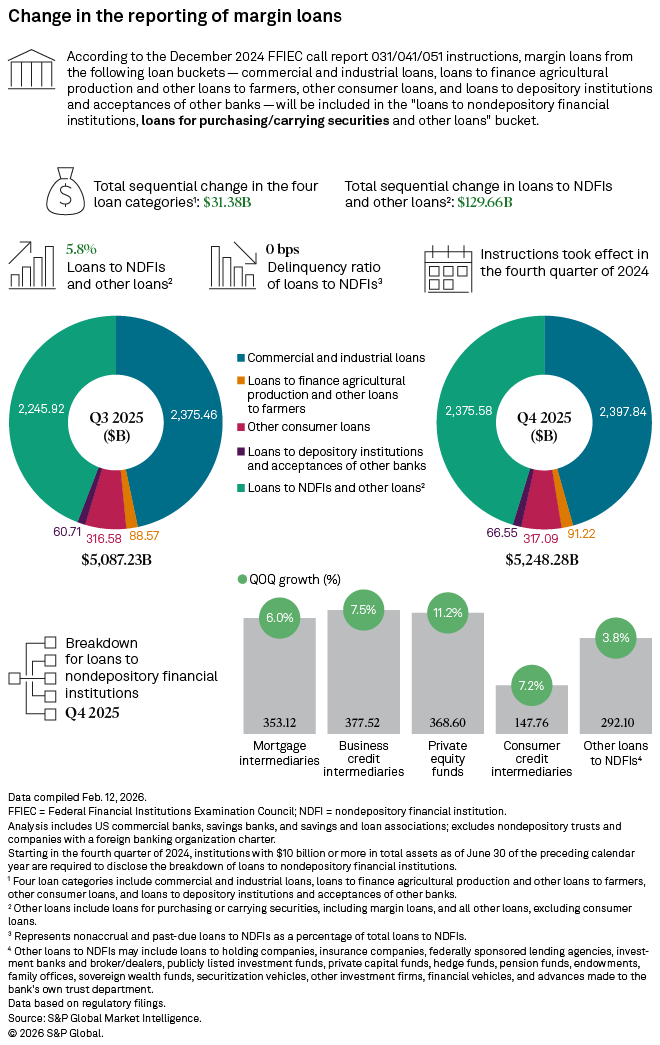
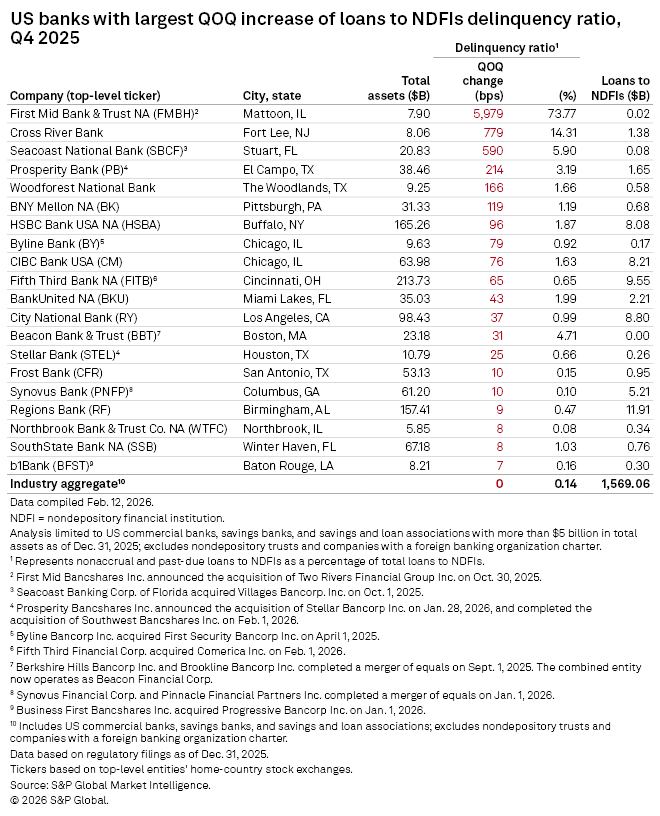
Credit worsened slightly for the asset class quarter over quarter, as the industry's aggregate NDFI loan delinquency ratio rose by less than 1 basis point to 0.14%.
First Mid Bank & Trust NA's NDFI portfolio delinquency ratio increased the most among US banks, up 5,979 basis points to 73.77% of its $15.2 million in NDFI loans. Fort Lee, New Jersey-based Cross River Bank's NDFI loan delinquency ratio rose 779 basis points quarterly to 14.31% of its $1.38 billion NDFI loan portfolio, the second-most among US banks with assets over $5 billion.
– Set email alerts for future Data Dispatch articles.
– Read some of the day's top news and insights from S&P Global Market Intelligence.

Regions Bank's NDFI delinquency ratio rose 9 basis points quarter over quarter from none, but executives remained positive about the portfolio after derisking the company's leveraged lending book in the years prior.
"We don't feel like there's any big potential clouds forming for us as we look at our portfolio," Regions Head of Corporate Banking Brian Willman said in a February conference presentation, calling the portfolio "stagnant."
Hovde analyst David Bishop echoed the sentiment for the industry broadly, calling NDFI credit quality "largely a nonissue" but acknowledging the risk that could stem from the category's prior accelerated growth.
"The rapid growth over the last several quarters continues to warrant monitoring especially as selected institutions have relatively large exposures as a percent of total risk-based capital," Bishop wrote in a Feb. 20 note.