11 Feb, 2026

Shell's Sonnen, Solrite target 'solar orphans' in Texas home battery rollout

SNL Image

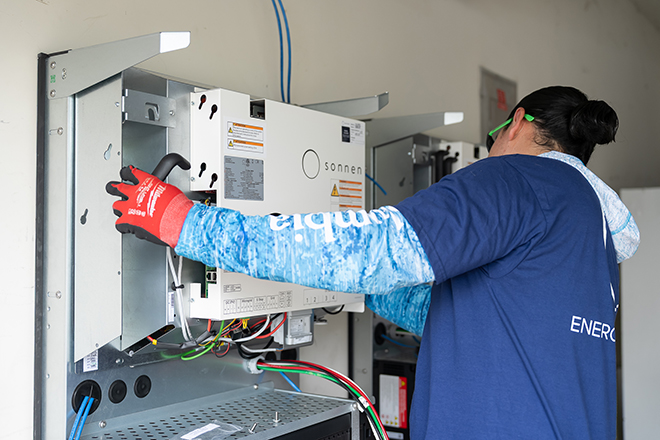
A technician installs a Sonnen battery storage system at a house in Houston.
Source: Sonnen Inc.

Sonnen Inc., an energy storage affiliate of oil major Shell PLC, is working with Solrite Electric LLC to accelerate its rollout of home battery systems in the Electric Reliability Council of Texas market.

Building on a collaboration launched in 2025, Sonnen and its project financing and installation partner are targeting an additional 600 megawatt-hours of dispatchable residential energy storage capacity in the ERCOT market in 2026 through Solrite's expanded battery-based virtual power plant purchase agreements, the companies announced Feb. 11.

Working with Sonnen and Lubbock, Texas-based retail electric provider Quext Energy LLC, which does business as Abundance Energy, Solrite's offer includes an "all-in" retail rate of 12 cents per kilowatt-hour — undercutting average rates in the state — along with 60 kWh of battery backup power for $20 per month.

The offering reflects efforts to expand the reach of behind-the-meter batteries that provide backup power during outages and grid services when combined with software into portfolios of distributed energy resources, sometimes referred to as virtual power plants (VPPs).

"Our goal here is to prove a model," Solrite CEO and founder Regan George told Platts, part of S&P Global Energy.

The companies are pitching the VPP deal to customers who either do not have solar or who have become "solar orphans" in the deregulated Texas market, where retail electric providers are not obligated to continue compensating customers for excess solar generation once their short-term contracts expire, George said in an interview.

"A lot of homeowners put solar on two years ago and found a good buyback program at that time, and now ... they need to re-up with another buyback program, and there isn't a good one," he added, noting that many Texas homeowners with solar but without batteries face eroding economics and stranded investments.

Different than in California, which reformed its net energy metering rules for customers of regulated utilities on a statewide basis, Texas is changing its rules for excess solar compensation "little by little," depending on each retail electric provider, "and all these people are orphaned," Sonnen Chairman and CEO Blake Richetta told Platts.

With Solrite's offer, "you're not going to lose money anymore," he added.

'Such a disruptor'

Solrite and Sonnen say they expect to add up to 10,000 new customers in Texas this year.

"I see this as such a disruptor," Richetta said, highlighting Sonnen's vision for VPPs, which starts with load shaping, including charging and discharging multiple times per day.

"It is withdrawing energy during the times when the grid is cleaner and cheaper and less congested, and it is harnessing solar and obviously harmonizing it with the rhythm of the grid, but offsetting specific peak periods," the Sonnen CEO said. "So it is first about load shape."

As their VPP collaboration expands, including outside of Texas, Sonnen and Solrite are beginning to offer additional grid services.

VPPs generate revenue by supporting the grid in various ways, such as through capacity, ancillary services or frequency regulation, but compensation for VPP operators and participating assets depends on specific business models and market designs, according to a December 2025 report from S&P Global Energy Horizons.

"While VPPs initially emerged as demand response programs, the increasing penetration of distributed generation and storage has enabled them to evolve into multi-asset portfolios, now active in major markets such as the US, Germany and the UK," the report said.

By 2030, Horizons projects the US to have 16.2 million electric vehicles, 25.2 gigawatts of behind-the-meter storage and 42.6 GW of demand response.

"If integrated into VPPs, this capacity could cover up to 9% of peak demand," the report said.

The Federal Energy Regulatory Commission's Order 2222 in 2020 laid a "regulatory foundation" for VPPs by mandating that distributed energy aggregators be allowed to participate in wholesale markets, the report added.

The US also supports VPP deployments through federal tax credits for solar and storage, in addition to multiple state-level rebate programs, it said.