27 Feb, 2026
Shares in US insurers make light of Supreme Court tariff ruling

By Tyler Hammel
Shares in US insurers were less impacted by the broader market's volatility that came in the wake of a US Supreme Court decision striking down President Donald Trump's sweeping tariffs.
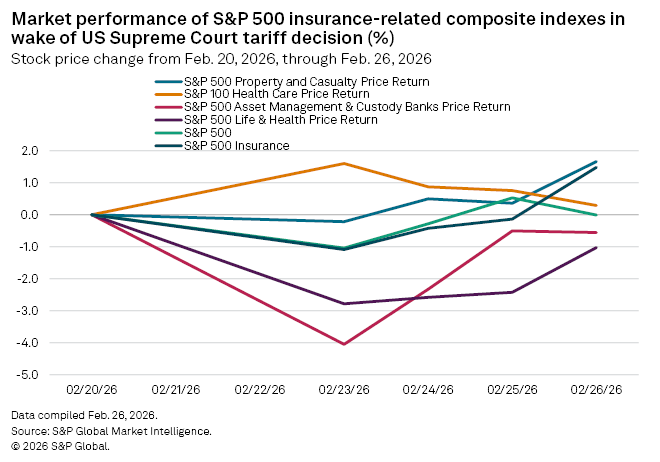
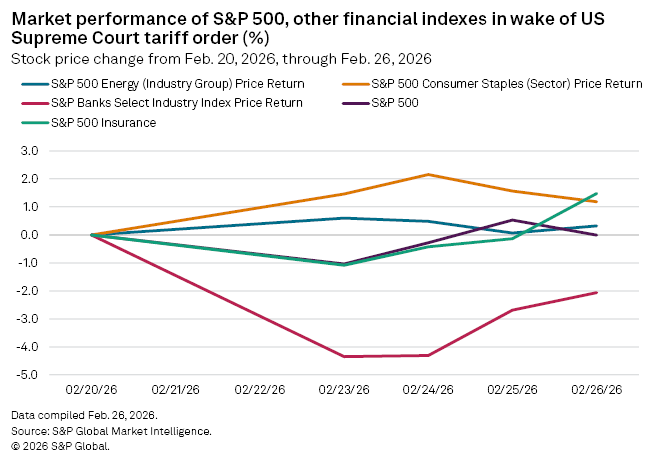
Apart from some specific managed care and insurance technology players, most listed US insurers shrugged off the Supreme Court decision with the S&P Global insurance index rising 0.62% from Feb. 20 through Feb. 26. Insurance performed slightly better than the S&P 500 index, which, after an initial rise, remained largely steady, and better than the banking and energy indexes, as the stock market reacted to investor uncertainty.
In the near year since Trump announced his escalating series of global tariffs, the insurance sector has remained well insulated against any direct impacts from the tariffs, according to Piper Sandler analyst Paul Newsome. While some insurers may have worked inflationary concerns into their revised rates post-tariffs, consumers are unlikely to see related rate lowered now, Newsome said.
"I don't think any insurer really changed prices because of the tariff, and I don't think if [the tariffs] go away, you'll see much of an impact as well," Newsome said. "I think the insurance industry will just kind of keep trucking along and you won't see much of an impact either way."
Tariff ruling
In a 6-3 ruling released Feb. 20, the Supreme Court held that the Trump administration exceeded its authority by using the International Emergency Economic Powers Act to impose wide-ranging global tariffs, calling much of the administration's economic policy into question.
Since the ruling, Trump has doubled down on the tariffs, signing Feb. 20 an executive order that imposes the 10% tariffs under Section 122 of the Trade Act of 1974. Those went into effect Feb. 24 and Trump has subsequently threatened to raise the tariffs to 15%.
Some companies in the retail and imports sectors have filed lawsuits seeking reimbursements for tariffs paid to the US government. While those lawsuits remain ongoing, if refunds materialize, insurers are unlikely to be recipients, according to Newsome.
"Companies have to show how they were directly impacted, and because insurers are not actually importing or exporting anything I would be surprised if any saw refunds," Newsome said.
Impacts vary by sector
Insurance and insurance-adjacent sectors such as healthcare and asset management reacted differently to the Supreme Court decision but after a few days there were only a couple of percentage points differences in terms of overall performance.
While the insurance sector has been largely insulated against the tariffs, the property and casualty sector has some more exposure due to its reliance on imported parts for home and vehicle repairs, among other things susceptible to inflationary pressures, Newsome said.
"When you start looking at where tariffs would potentially create inflation, it's there but it's just proportionally not as big as other [financial sectors]," Newsome said.
Even with the unpredictable ups and downs, Newsome expects insurers to emerge from this period of volatility in a good position.