19 Feb, 2026
Restaurant inflation stays hot, forcing shift in American dining

By Brian Scheid
Soaring labor, food, insurance and tax costs have kept restaurant inflation at highs typically seen around recessions. This has pushed operators to hike menu prices and triggered a shift in where and how often millions of Americans dine out.
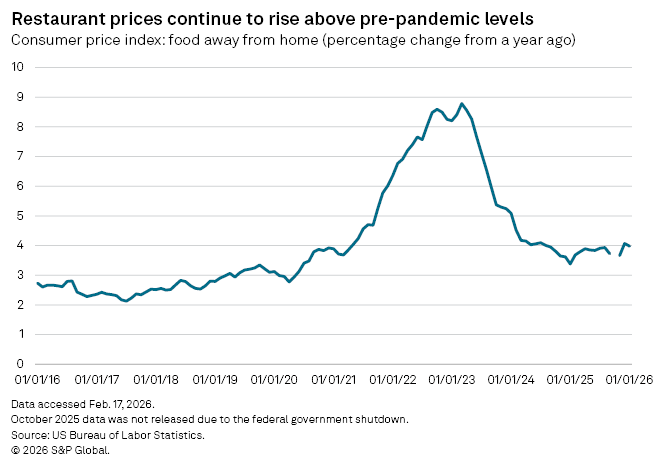
The consumer price index's measure of food away from home, a category that includes restaurants, rose 4% from January 2025 to January 2026, according to the latest government data. Food away from home prices have seen annual growth on average of about 3.9% each month since the start of 2025, only a slight cooling from 2024, when annual inflation growth averaged nearly 4.1% each month.
The overall consumer price index — the market's preferred inflation measure — climbed 2.4% from January 2025 to January 2026, its smallest annual increase since May 2025 and a more than 60-basis-point drop in four months. While overall inflation has moderated and is now showing signs of cooling, restaurant inflation continues to accelerate. Consumer prices for food away from home increased 39.3% from January 2019 to January 2026. By comparison, the index increased 19.2% across the previous seven years, from January 2012 to January 2019.
These higher prices have caused customer traffic to US restaurants to decline for two straight years, with only modest growth projected for 2026, said Rich Shank, senior principal and vice president of innovation with Technomic.
"Growth is really challenging, and consumers are definitely changing their behavior," Shank said in an interview.
After years of elevated inflation, many American consumers have cut back on restaurant spending. Roughly four in 10 US consumers cut their restaurant frequency in 2025, including 44% who said they have cut down on going to full-service restaurants, according to the National Restaurant Association's annual state of the industry report, released this month.
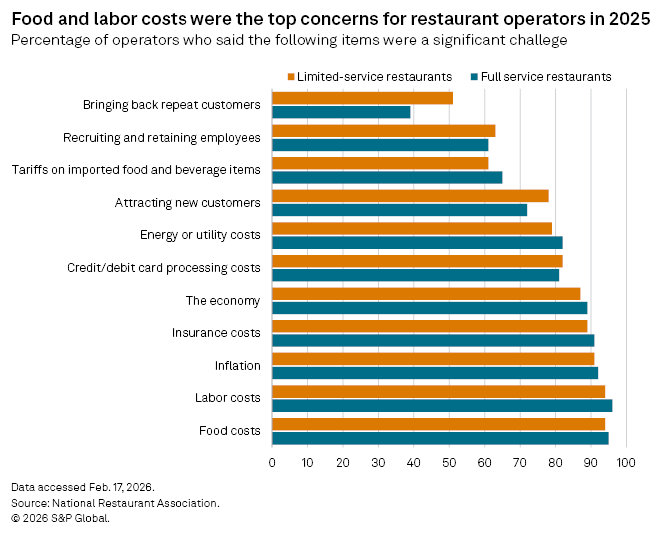
More than 60% of operators reported that customer traffic to their restaurants declined in 2025 compared with 2024. In 2025, 42% of restaurant operators reported that their businesses were not profitable, according to the report.
"The math is difficult," said Chad Moutray, chief economist with the National Restaurant Association. "Restaurant operators face an enormous number of costs that are going up ... and at the same time, they face a consumer that is very stressed."
Picky eaters
These consumers, faced with a sluggish labor market and higher costs in all corners of the economy, continue to dine out but have become more deliberate about where and how often they spend on dining.
"Consumers are still going out to eat, they've just become a lot more selective when they do," said Taylor Bowley, an economist at Bank of America Institute.
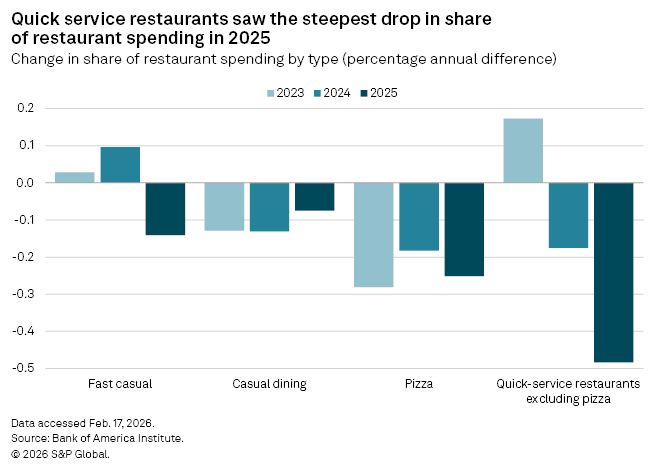
Average monthly spending per household on restaurants and bars was $371 in 2025, a 30% increase from 2019, according to card data from Bank of America.
This rise in spending has come with a change in preferences as spending at casual dining and pizza restaurants has declined for three straight years. Quick-service restaurants saw the most substantial drop in 2025, the data shows.
"Even the places that are supposed to have these cheap meals aren't even feeling cheap enough anymore," Bowley said. "We're definitely seeing higher menu prices, and consumers are adjusting their spending because of it."
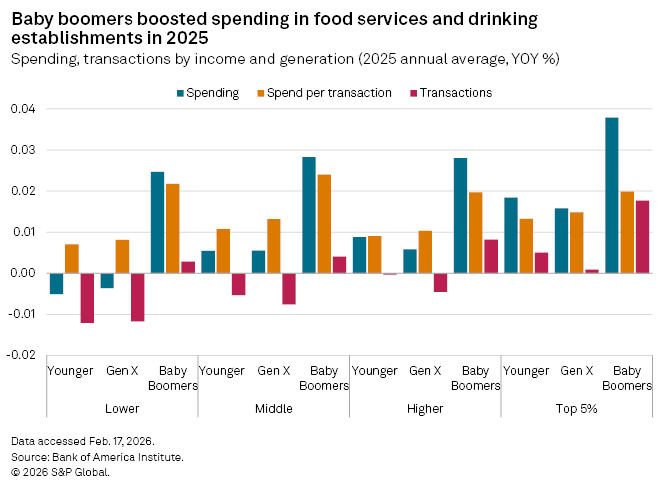
The changes in preferences vary, however, based on consumers' age and income as older, more-affluent Americans appear to be driving growth at the moment.
Generation X and younger consumers in lower- and middle-income groups, for example, had fewer restaurant transactions in 2025 yet higher spending per transaction, the Bank of America data shows.
Baby boomers of all income levels increased restaurant spending, spending per transaction and total transactions. Consumers of all ages in the top 5% of income spent more and had more transactions.
Quick-service restaurants, which lost traffic from lower income consumers due to price increases, are trying to attract more middle-income consumers with promotions focused on value and limited-time offers, said Shank with Technomic.
Higher-income consumers are spending more on dining out because they are less price sensitive, while quick-service or value-focused chains could be benefiting from higher prices as consumers trade down to compensate, said Michael Zdinak, who leads the US consumer markets service at S&P Global Market Intelligence.
"The middle is always at risk of getting carved out in this scenario," Zdinak said. "Any restaurant that relies on convenience more than value, or has high labor and fixed costs, is going to be more vulnerable when consumers don't show up as often."
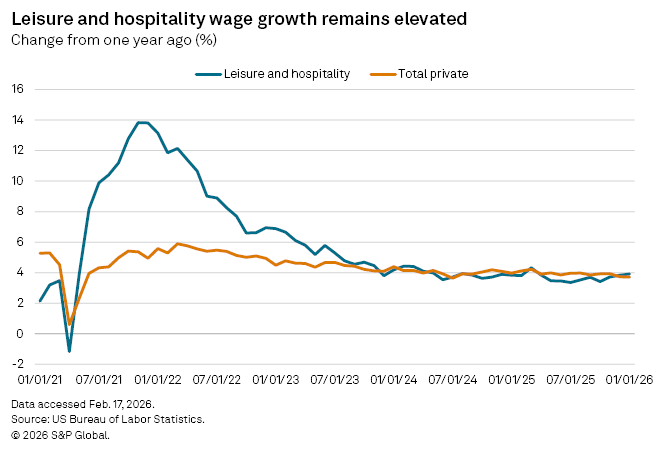
For now, wages and salaries are decelerating but "holding up," Zdinak said, and while prices are likely to continue to rise, a gap remains between what consumers say and what they do.
"No one likes higher prices, but spending on dining out is holding its own, largely because consumers value convenience," Zdinak said.
If job losses start mounting in the labor market, dining-out behaviors shift more considerably, but that is not expected in the current "low hire/low fire" atmosphere.
"We expect consumers to muddle through the slowdown in hiring and for spending on food away from home to continue growing this year," Zdinak said.