09 Feb, 2026

Magnetite miners see green steel demand boost from EU carbon tax

SNL Image

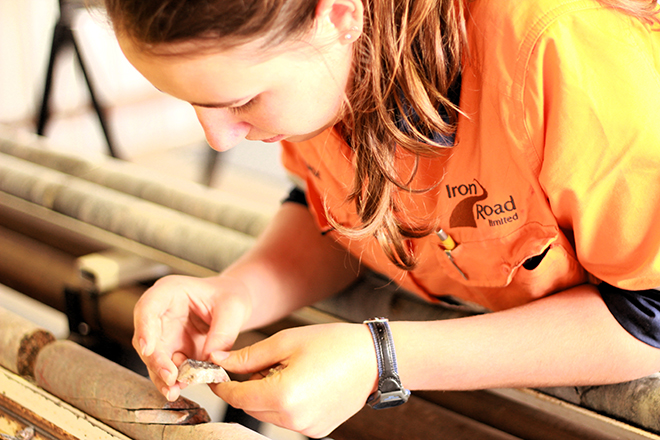
Core inspection at Iron Road's Central Eyre iron project in South Australia, one of several costly projects seeking investments to meet green steel demand.
Source: Iron Road Ltd.

Australia-listed magnetite miners are concerned over tepid global green steel markets, but they see a better future due to renewed demand signals from the EU's Carbon Border Adjustment Mechanism.

Australia is the world's largest iron ore producer due to its vast hematite deposits, which are now seeing declining grades. It also has an estimated 66 billion metric tons of magnetite resources and about 10.5 billion mt of reserves, of which nearly 99% is concentrated in South Australia and Western Australia, according to the Institute for Energy Economics and Financial Analysis (IEEFA).

Magnetite is suitable for low-emissions steelmaking via hydrogen-based direct reduction and electric arc furnaces routes.

Most of these magnetite resources are in the hands of junior companies that need billions of dollars in investments. These projects still need port and road/rail access, as well as energy and water needed to process ore into magnetite concentrate.

The dream of feeding emerging green steel markets has kept magnetite explorers' hopes alive over the past decade.

SNL Image
Larry Ingle, CEO of Iron Road.
Source: Iron Road Ltd.

However, "although strong interest in direct-reduction-grade concentrate remains, there has been a distinct softening over the last 12 months relating to global green iron/steel ambitions," Larry Ingle, CEO of Iron Road Ltd., told Platts, part of S&P Global Energy.

"Investors and potential strategic partners, including steelmakers, are taking a more cautious long-term view in this regard," Ingle said.

"There's less discussion today about decarbonization of the steel industry, which was very hot a few years ago," David Cataford, CEO of Champion Iron Ltd., told Platts.

Hydrogen doubts

Green hydrogen, which is essential for low-emissions production of iron and steel, has lost momentum both globally and in Australia. This is linked to cooling sentiment in green steel investments, Ingle said.

"There's challenges around anything using renewable energy and hydrogen as a reductant, so the most likely proponents will be using natural gas rather than straight hydrogen and then developing the technology as they go," Peter Jones, managing director of Athena Resources Ltd., told Platts.

While there has been talk of hydrogen displacing everything in steelmaking, there are blast furnaces in Asia that are very modern and well engineered, Gordon Toll, chairman of Lodestone Mines Ltd., told Platts.

"They will run for 18 to 20 years on their first lining, another 18 to 20 years on the reline, and then unless obsolescence dictates otherwise, will do a third campaign. So you've got a 60-year life. No one's going to walk away from that capital," Toll said.

Signs of hope in CBAM

"After a couple of years of slower progress, the steel technology transition away from fossil fuels could gain renewed momentum in 2026," the IEEFA said in a Jan. 19 report.

Economies across Asia and Europe are still pushing ahead with decarbonization initiatives, including China's carbon tax on steel manufacturing and Japan's subsidies for lower CO2-intensive steel in car manufacturing, Cataford said.

These trends give Cataford confidence that markets "will be able to pay significant premiums" for Champion Iron's high-grade 69%-Fe product, which is set to come online from Bloom Lake in Quebec within the half-year. The product targets Europe, North Africa and the Middle East, the CEO said.

Champion Iron, which has a product portfolio comprising different blends of high-grade iron ore concentrate and magnetite ore, completed a $100 million private placement on Feb. 4 to acquire Norwegian magnetite concentrate producer Rana Gruber ASA.

"There is a move. We've seen the introduction of everything from penalties and tariffs and taxes to encourage people to move towards the greener steel market, which bodes well for what Hawsons Iron Ltd. is doing strategically to ultimately develop the Hawsons Iron project," Tom Revy, the company's managing director, told Platts.

There are "definitely challenges there [in green steel] that are now being addressed," Jones said.

Some uncertainty remains over the EU's CBAM, but it will drive price premiums for low-emissions products, which in turn will be positive for Australia's magnetite hopefuls, Jones said.

While there is "no doubt that funding new low-carbon steel projects will be enormously challenging, particularly in a slow demand environment globally, we think European steelmakers will find price support as a result of CBAM making imports less competitive," Paul Bartholomew, a senior analyst at S&P Global Energy CERA, said in an interview.

"Asia's approach is more piecemeal and much less developed and coherent compared with Europe, [but] we expect a lot more activity from Asian countries, with many looking to implement their own versions of CBAM, among other approaches," Bartholomew said.

Though there is a lack of higher-grade iron ore in the market, low Chinese mill margins and steel prices mean "high-grade ores are not receiving much of a premium. In fact, lump prices have fallen to a four-year low," Bartholomew said.

The Platts-assessed iron ore lump outright price was $103.4 per dry metric ton unit CFR China on Feb. 6, down from $115.55/dmtu a year prior, while the Platts-assessed iron ore spot lump premium was 4.5 cents/dmtu CFR China, down from 15.4 cents/dmtu a year earlier.