13 Feb, 2026
Insurify CEO flags 'overreaction' to new AI app as brokers take a hit

By Hailey Ross
Insurance brokers took a tumble on Wall St. following the release of an AI-driven price comparison app by an online insurance agent platform.
Insurify Inc. announced prior to market open on Monday that it had launched what it referred to as "the insurance industry's first ChatGPT app," which enables users to directly "browse, research and compare" car insurance within ChatGPT's new app library.
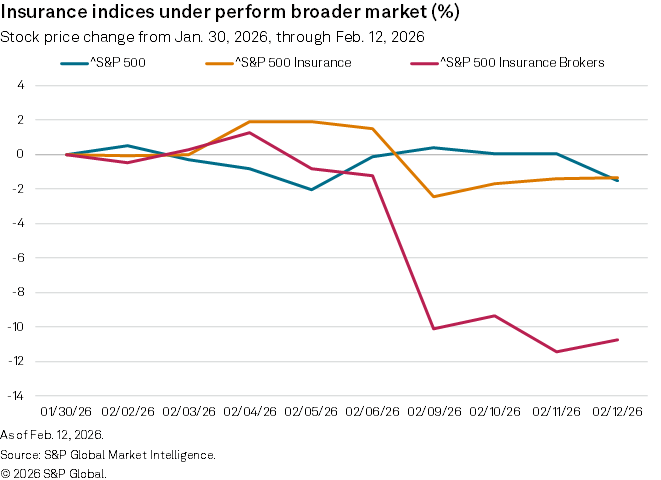
Shares in listed insurance brokers reacted quickly; the S&P 500 US Insurance Brokers Index fell 10.7% for the week. The S&P 500 and the S&P 500 US Insurance Index were down 1.5% and 1.3%, respectively, as of the market close on Feb. 12.
The market reaction to the app's release is possibly an "overreaction," Insurify co-CEO and co-founder Giorgos Zacharia told S&P Global Market Intelligence in an interview.
"It's not going to be just us that are thinking this way," Zacharia said. "We expect many other brokers will come out with their own version; we just happen to be the first ones."
AI fears hit the market
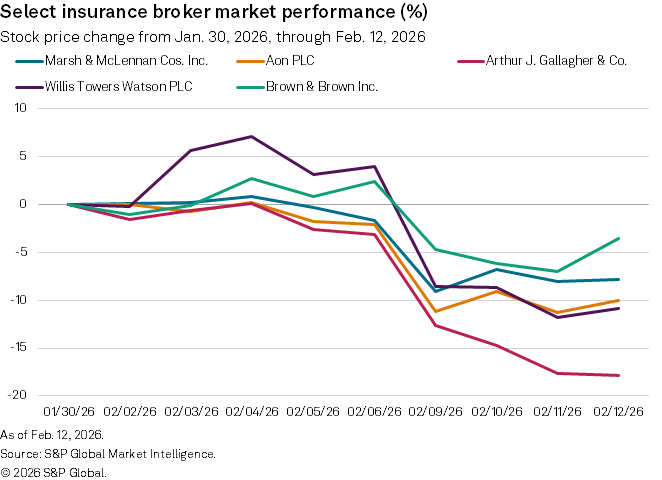
As of Thursday's market close, all five major insurance brokers were down this week. Aon PLC shares fell 10.1%, Marsh & McLennan Companies Inc.'s stock dipped 7.9% and Arthur J. Gallagher & Co. shares dropped 17.9%. Brown & Brown Inc. ended the week down 3.6% while Willis Towers Watson PLC's shares decreased 10.9%.
The short-term impact should be "relatively limited" for the major brokers, CreditSights analyst Cindy Chen said in an interview.
The Insurify app targets retail car insurance, Chen said, whereas many large-scale brokers focus on a different customer base. In her view, the sell-off was more representative of the "long-term potential impact of AI solutions that might unseat the brokers" in their core business lines.
"That concern is probably overdone because the national accounts and middle-market account customers that the leading brokers serve require a substantially greater level of understanding of the complex and nuanced risks that often translate to custom solutions," Chen said. "AI, I don't think, is able to do that at this point."
Insurify's price comparison website (PCW) app "brings actionable price discovery in a meaningful way to the US for the first time," RBC Capital Markets analyst Ross Broadfoot said in a Feb. 10 note. This type of actionable price discovery has existed in the UK from the start of the PCW market, he added.
"Thus, Insurify at the headline level represents a change to a domestic market, not a global phenomenon," Broadfoot said. "The interesting part is the use of AI tools and surfacing through ChatGPT as top of the funnel, but this is something that UK PCWs are and could develop."
Broadfoot said that Insurify "will only have its own way" until US competitors are able to launch competing products.
"There may be other challenges, but we believe this one is overstated and perhaps this news will accelerate existing plans," Broadfoot said.
Impact of AI advancements
Investor anxiety over AI advancements has spilled over into other sectors, including software companies. Almost every public US life insurer fielded analyst questions about exposure to software companies in its investment portfolio during its fourth-quarter call.
It's likely that more AI products are on the horizon that will mirror what Insurify has done in the auto space, CreditSights analyst Josh Esterov said in an interview.
"Where we are with AI now is the worst it'll ever be," Esterov said. "So the only direction it can go is that there's going to be more penetration of AI solutions across insurance and across other sectors."
While some insurance products tend to be bought online now, such as auto, home and some small business insurance coverage, the insurance industry has had "almost no success" in selling more complex products online, Esterov said.
A product like universal life insurance with secondary guarantee is difficult to explain, for example, so it would be hard for an AI solution to create something that can customize and compare offerings across different insurers.
There will likely still have to be a "human touch" there, Esterov said.