Featured Topics
Featured Products
Events
S&P Global Offerings
Featured Topics
Featured Products
Events
S&P Global Offerings
Featured Topics
Featured Products
Events
S&P Global Offerings
Featured Topics
Featured Products
Events
Financial and Market intelligence
Fundamental & Alternative Datasets
Government & Defense
Professional Services
Banking & Capital Markets
Economy & Finance
Energy & Commodities
Technology & Innovation
Podcasts & Newsletters
Financial and Market intelligence
Fundamental & Alternative Datasets
Government & Defense
Professional Services
Banking & Capital Markets
Economy & Finance
Energy & Commodities
Technology & Innovation
Podcasts & Newsletters
04 Feb, 2026

|
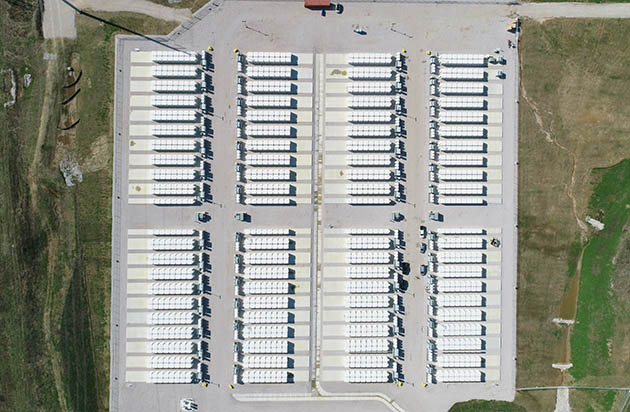
AES Corp.'s 800-megawatt-hour battery project in Pike County, Indiana, above, relies on Fluence technology. |
In his previous leadership roles at Qualcomm Inc. and Apple Inc., Jeff Monday had an inside view of the technology sector's struggles to secure sufficient electricity for increasingly large AI data centers.
Now over 100 days into his new post as chief growth officer at battery storage hardware and software supplier Fluence Energy Inc., Monday is positioned to help hyperscalers and other digital infrastructure developers plug their growing power gaps.
"It doesn't take long to realize that the race to lead in AI is really hard to disaggregate from the race to modernize and expand our energy delivery system," Monday told Platts, part of S&P Global Energy. "As you step back and look at it, battery storage plays an absolute critical role. ... It's going to be central to the way that people think about powering AI data centers."
Data center operators, including some of the world's largest companies, have emerged as a massive new sales opportunity for Fluence and other battery storage specialists. That opportunity builds on already strong demand from electric utilities and independent power producers (IPPs), which in recent years have made large-scale lithium-ion battery power plants into one of the leading new resources on the US grid.
|
Fluence Chief Growth Officer Jeff Monday. |
"To be clear, we're talking to the hyperscalers directly ... but then we're also talking to all of our IPP and utility customers about how we can support them for their hyperscaler and data center needs," Monday said. "It's a quickly evolving ecosystem."
Data centers can use batteries in various ways, according to Monday.
"Battery storage is unique in its ability to help the data center customers lower their firm power commitment to the grid operator," Monday said. "It helps them speed through the interconnection queue."
Having on-site batteries can also provide "backup and bridging power," replacing diesel generators, the executive added.
In addition, batteries can perform "AI load smoothing" and can "act as a shock absorber between the grid and the data center," Monday said.
Fluence is working on "a couple of data center projects" where the developers are overbuilding batteries relative to the needs of the data center to provide flexibility for the "incredibly spiky" power demand of today's graphics processing units (GPUs). Breakthroughs in GPU technology, however, could give data centers supporting AI a more levelized load, freeing up batteries for other revenue opportunities, according to Monday.
"If you overbuild your [battery storage system] now, particularly if you're in CAISO or ERCOT markets, you could actually be building out a revenue generation asset," Monday said. "You could start to trade that excess energy back into the market."
Data center pipeline
Several major battery storage projects designed to support data centers have emerged over the past year, highlighting the potentially powerful pairing.
Oracle Corp. and Google LLC, for instance, announced big battery-backed data centers in Michigan and Texas, respectively, while X.AI LLC installed Tesla Inc. Megapack batteries at its data center in Memphis, Tennessee.
Google parent Alphabet Inc. in December 2025 agreed to acquire Intersect Power LLC, a developer of solar and battery storage projects, for $4.75 billion in cash, marking the first time a hyperscaler has purchased an entire power company.
Fluence has not yet disclosed a major data center deal. But the company was in discussions with data center companies for over 30 gigawatt-hours of battery storage capacity, Fluence President and CEO Julian Nebreda told analysts on the company's fiscal fourth-quarter 2025 earnings call in November 2025.
That pipeline of data center opportunities has continued to grow, according to Monday.
"A large majority of it is still very much front of the meter, but our behind-the-meter pipeline is growing at a faster rate," Monday said.

Supporting its expansion, the battery storage industry scored a big win in the sweeping budget bill that President Donald Trump signed into law in July 2025.
The law accelerated the phaseout of valuable tax credits for wind and solar projects, but left in place tax credits for battery storage projects into the mid-2030s — as long as they comply with new restrictions on supply chains linked to China and other foreign entities of concern (FEOC).
Fluence is offering its customers a fully domestic supply chain, going beyond the FEOC restrictions, as well as products sourced from its global supply chains.
Because of their urgent need for power, some data center customers "are willing to forgo domestic content and tax credits just to take whatever is in our supply chain and available today," Monday said.
'Will it be sustainable?'
"Long-term, [the] data center opportunity is promising, but how large is the opportunity and will it be sustainable?" Jefferies analysts said in a Jan. 26 note to clients.
Fluence's Nasdaq-listed share price has surged more than 145% over the past year, which analysts attribute largely to investor optimism about data center demand.
"We continue to see [Fluence] as a data center beneficiary given its advantage as a domestic [lithium-iron-phosphate] battery supplier, but don't expect an order to be announced until late 2026 at the earliest and 2027+ more realistically," Jefferies analysts said.
Fluence ended its 2025 fiscal year with roughly $2.3 billion in revenue, about $300 million below its expectations, but also with a record order backlog totaling $5.3 billion.
The company expects to increase revenue in fiscal year 2026 to between $3.2 billion and $3.6 billion.
A December 2025 report from S&P Global Energy Horizons found that Fluence was the third-largest battery storage integrator globally, based on installed and contracted capacity, trailing only Tesla and China-based Sungrow Power Supply Co. Ltd.
Fluence started strong this year, announcing a deal to supply its technology — including US-made battery cells, modules, enclosures and thermal management systems — for BrightNight LLC's 300-megawatt/1,200-MWh Pioneer Clean Energy Center in Arizona. The output of the battery project, which is coupled with a 300-MW solar farm, is under contract with Arizona Public Service Co.
About 60% of Fluence's business is in North America, according to Monday, who pointed to additional strong growth in Europe and Australia.
"But we're also starting to see additional areas like Chile, the Philippines and Taiwan come in and start to scale their demand for energy storage as well," Monday said.