06 Feb, 2026
Ethos Technology down over 30% in first week as insurance IPOs falter

By Tyler Hammel
Ethos Technologies Inc.'s stock price has declined by over 30% during its first week of trading, highlighting the difficulties facing insurers that launched initial public offerings last year.
The life insurance-focused insurtech began trading Jan. 29, opening at $19 a share but closing at $16.85, a decline of 11.32%. By the close of trading on Feb. 5, its stock reached $11.55 a share, a decline of 31.45% since the close of trading on its debut.
The company did not respond to a request for comment.
Ethos is not the only recent insurance company to either falter or remain flat since going public in the past year, leading some recently listed insurers to reconsider the benefits of being a public company.

Less favorable conditions
Insurance initial public offerings (IPOs) have become less favorable than pursuing a sale for some insurers, according to Brian Schneider, senior director in Fitch Ratings' North American insurance rating group. This has led some insurers — and insurtechs in particular — to pursue a dual-track strategy, whereby a company leverages a potential IPO to attract a buyer by showing viability on the public market.
"Generally, [insurtechs] are smaller and haven't been around as long, so they may take a little bit more time to get a better understanding of," Schneider said in an interview with S&P Global Market Intelligence. "They're willing to look at both sides, maybe potentially an IPO initially, to get a little bit more credibility, and then maybe end up going a different route if that doesn't work out."
The most prominent recent example of this is the Bermuda-based specialty insurer Aspen Insurance Holdings Ltd.
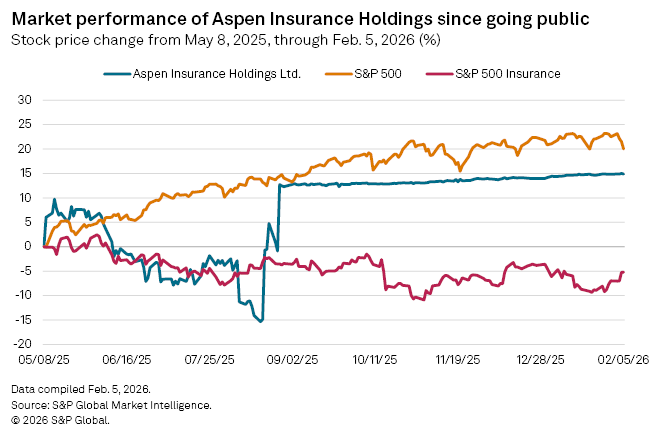
Seen as a test for the resilience of both the specialty insurance sector and the broader IPO market, Aspen announced in May that it sold 13.3 million class A ordinary shares at $30 per share in its upsized IPO, raising $397.5 million, and opened on May 8, 2025, at $33.25 a share.
But Aspen's owner, Apollo Global Management Inc., sold the company to Sompo Holdings Inc. in August. Under the deal, Sompo International Holdings Ltd., a subsidiary of Sompo, agreed to acquire 100% of Aspen for approximately $3.5 billion, or $37.50 per share. The deal was unanimously approved by the companies' boards and is expected to close in the first half of 2026.
While the sale has not yet closed, Aspen's shares have been stable since the sale was announced in August and were trading at $37.34 a share by the close of trading on Feb. 5. Prior to the sale, Aspen's value reached a low point of $27.51 a share, down 17.26% from its starting price.
A new mindset
Aspen's brief window between IPO and sale to Sompo stands out as an example of insurers' mindset, Schneider said.
"I think [Aspen's short public window] speaks to a trend that we've seen of reinsurers and insurers, shifting a bit more preferentially toward ownership by other companies rather than an IPO," Schneider said.
Some companies, such as Convex Group Ltd., which under different circumstances may have gone the IPO route, are instead choosing to sell, Schneider said. In October, American International Group Inc. announced it would acquire a 35% equity interest in Convex for approximately $2.1 billion.
"I think these types of companies feel like they are potentially getting better value going through the purchase acquisition, rather than the IPO market, although I'm sure they looked into the IPO market as well," Schneider said.
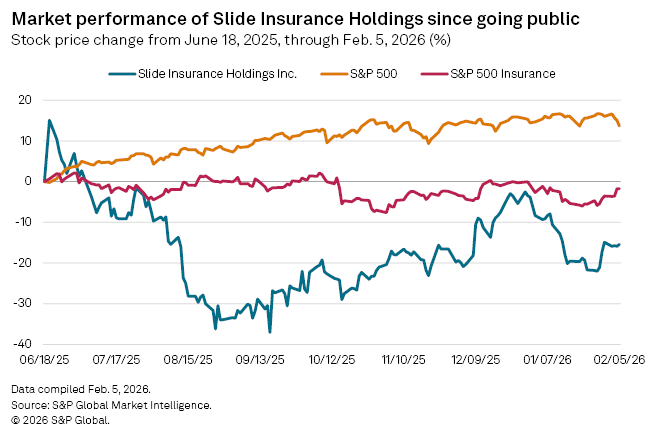
The decline of Ethos and Aspen largely matches the trends seen among insurers that launched IPO within the past year. Slide Insurance Holdings Inc. and Exzeo Group Inc. have both seen declines since launching, falling 18.43% and 16.67%, respectively.
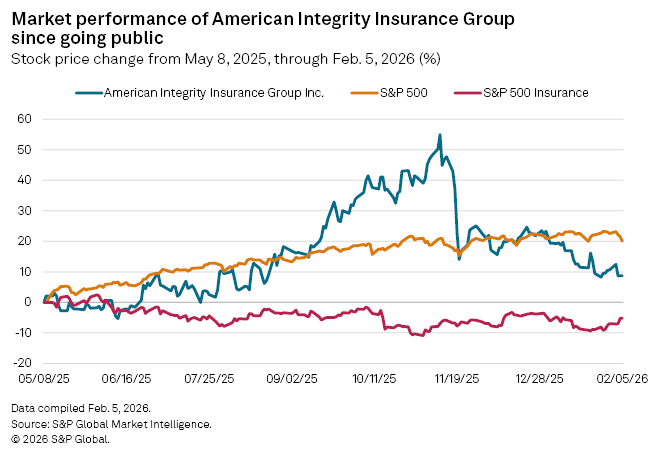
American Integrity Insurance Group Inc., which launched its IPO on the same day as Aspen May 2025, saw its stock ascend soon after, reaching a peak of $26.19 a share by Nov. 11.
However, American Integrity's stock soon dropped rapidly, around the time it released its third-quarter figures. The descent accelerated after American Integrity announced on Nov. 17 it was launching an underwritten secondary public offering of 3 million shares of its common stock — sold in this case by certain of its stockholders — for $20 a share, slightly higher than its launch price of $18.50.
American Integrity's stock closed 0.7% down from its launch price on Feb. 5.