12 Oct, 2026
US midterms add new risk to stock market beset by noise

By Nick Lazzaro
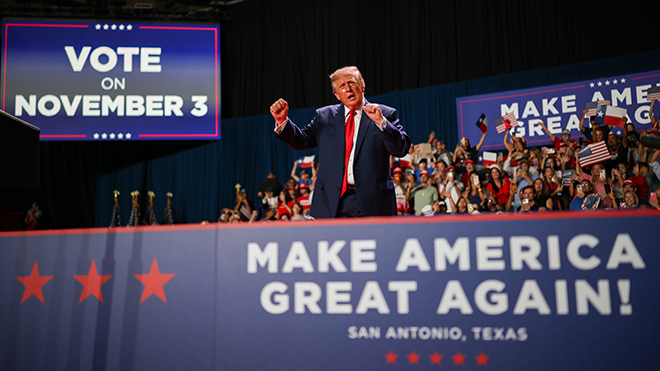
| US President Donald Trump appears at a rally in San Antonio on Oct. 7, 2026, to campaign for Republican candidates ahead of the US midterm elections. This year's elections will determine whether Republicans retain their congressional majorities or lose control of one or both chambers, potentially altering the policy outlook for investors. Source: Win McNamee/Getty Images News via Getty Images. |
The US midterm elections are adding another layer of risk to market sentiment amid a myriad of complications competing for investors' attention ahead of the November vote.
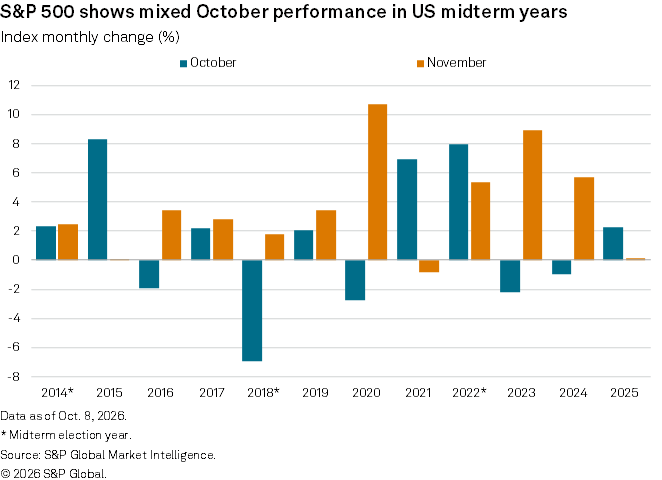
Recent history offers little consistent signal for how stocks perform in October ahead of midterm elections. In the last two cycles, the S&P 500 surged nearly 8% in October 2022 but slid nearly 7% in October 2018, according to S&P Global Market Intelligence data.
This year's elections will determine whether Republicans retain their congressional majorities or lose control of one or both chambers, potentially altering the policy outlook for investors. But the November vote is competing for investor attention with the war in the Middle East, inflation, rising interest rates and tariff policy.
"Political transitions often bring heightened market sensitivity, and US midterm elections are no exception," John Canally, head of portfolio strategy at TIAA Wealth Management, told Market Intelligence. "Uncertainty around policy, fiscal priorities and regulation has historically weighed on sentiment ahead of Election Day, though markets have consistently refocused on fundamentals once results are clear."
Regardless of the election outcome, Canally said structural checks such as presidential veto power and the Senate's 60-vote threshold for most legislation limit the extent to which the policy landscape could shift.
"Midterms are adding noise, not direction," Canally said.
If Democrats gain control of one or both chambers, the resulting divided government could temper major policy shifts and increase predictability. But, there is a small risk that the political reaction to such an outcome could challenge that expectation, Andrew Jackson, head of investments and head of fixed income boutique at Vontobel, said in an interview.
"We get more balanced attitudes and a reaction function that tends to bring down the noise rather than amplify the noise," Jackson said. "But there is a small possibility that this time is different because the tone of the administration is so different toward things that we thought were sacrosanct, and that might feed into concerns from external lenders to the US."
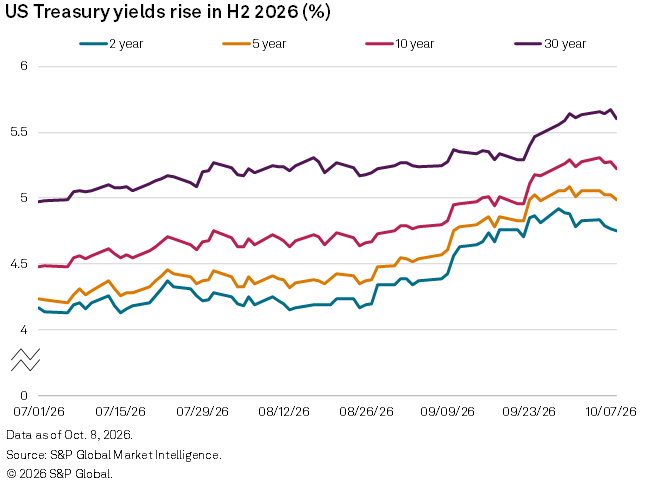
Jackson said the scenario is just another risk being monitored in Treasury markets, where investors are already scrutinizing challenges such as the inflation outlook and long-term debt sustainability.
AI trade faces regulatory questions
Midterms can introduce uncertainty for sectors sensitive to regulation, as changes in congressional control can bolster or impede a president's policy agenda.
"That's always a concern for markets, particularly as we've seen in the past for energy," Tracy Shuchart, senior economist at NinjaTrader, said in an interview. "That said, we are in a war right now, so that is the overriding concern for the oil market at this juncture."
Shuchart said AI represents another area where midterm-related regulatory questions could affect investor sentiment, with both parties supportive of AI development but potentially differing over the extent of regulation.
"Does that slow down the AI trade? That's a matter in question because AI has been leading the market," Shuchart said.
The regulatory uncertainty around AI could have broader implications for equities because of the outsized role large technology companies have played in driving major indexes higher, Shuchart said.
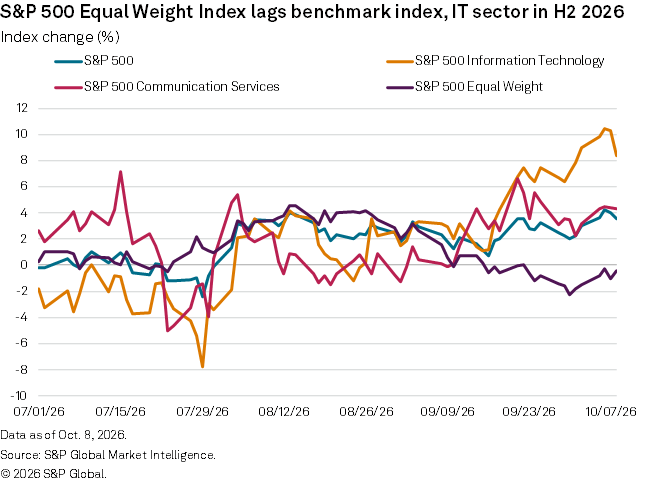
The equal-weighted version of the S&P 500 has posted a slight loss since the end of June, while the benchmark S&P 500 and its information technology sector have gained more than 3% and 8% respectively, according to Market Intelligence data as of Oct. 8. The equal-weight index reduces the influence of the market's largest companies by assigning the same weighting to each constituent.
|
Market crosswinds
Despite uncertainty over the outcome, the midterms have yet to command outsized investor attention amid the crowded market backdrop, Andrew Davis, head of investment strategy at Bryn Mawr Trust, said in an interview.
"It's competing with a lot on the macro calendar right now, so I think it has taken a little bit of a backseat," Davis said.
For market participants monitoring the election, Davis said the focus is concentrated on potential changes to taxes, government spending, trade and regulation.
"It's really about trying to identify what policy outcomes could be happening and whether that changes cash flow for businesses or discount rates," Davis said. "Political headlines, they're not going to be an investment thesis for us."