27 Oct, 2026
US elderly population to grow by nearly 8 million in 5 years

Recently released population forecasts by Claritas predict the US population will continue to age over the next five years. Owners of senior housing properties may see significant growth opportunities as the older adult population increases.
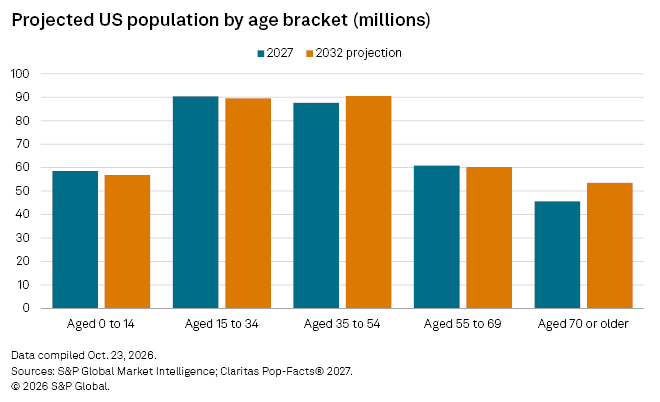
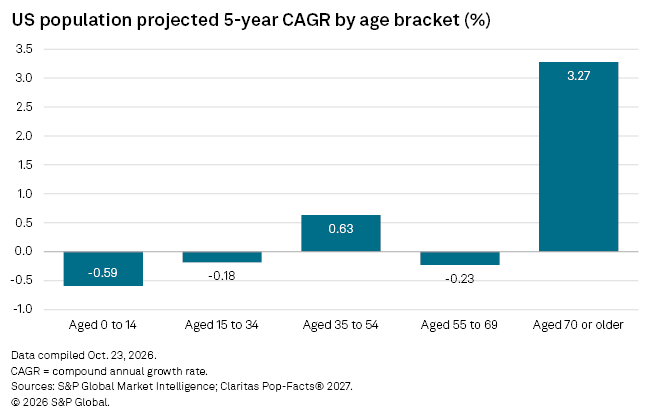
The elderly population, aged 70 years or older, is projected to grow by nearly 8 million over the next five years, the largest increase among age groups, with a compound annual growth rate of 3.27%.
High-growth counties
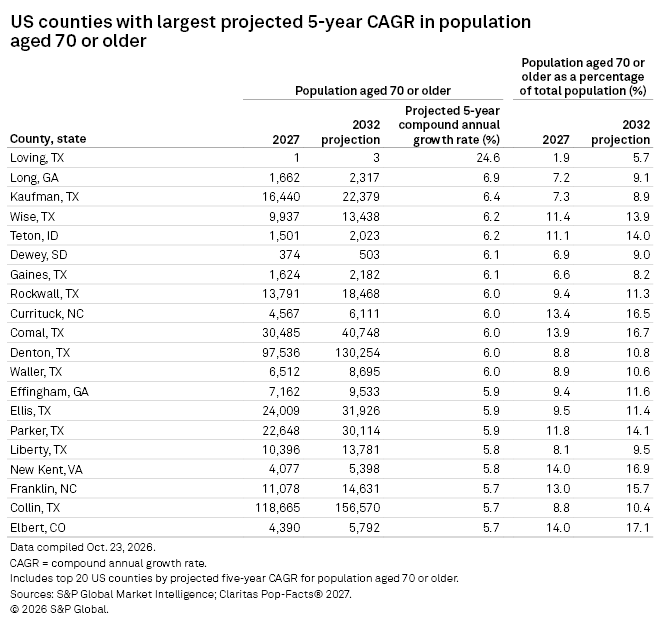
Excluding Loving County, Texas, which has a very small population, the elderly population in Long County, Georgia, is projected to have the largest relative growth over the next five years, rising to 2,317 in 2032 from 1,662 in 2027, representing a CAGR of 6.9%.
Twelve of the top 20 counties with the highest growth forecasts are in Texas. Kaufman County and Wise County ranked third and fourth overall with estimated CAGRs of 6.4% and 6.2%, respectively. Gaines County and Rockwall County ranked seventh and eighth, with estimated CAGRs of 6.1% and 6.0%, respectively. Other Texas counties in the top-20 are Comal County, Denton County, Waller County, Ellis County, Parker County, Liberty County and Collin County.
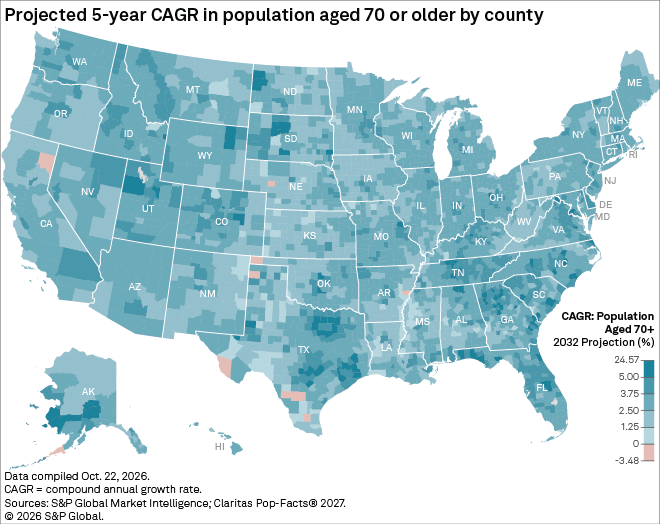
An S&P Global Market Intelligence analysis identified 56 senior housing properties owned by real estate investment trusts in US counties where the elderly population is projected to grow by more than 5% annually over the next five years. The analysis included independent living, assisted living and continuing care retirement properties reported individually in public filings by REITs that trade on the Nasdaq, NYSE or NYSE American.
Ventas Inc. owns 38 senior housing properties across these counties, representing roughly 5.3% of its US independent living, assisted living and continuing care retirement properties.
Diversified Healthcare Trust ranked second, with nine independent living, assisted living or continuing care retirement properties identified in high-growth counties, while Sabra Health Care REIT Inc. and American Healthcare REIT Inc. owned three and two senior housing properties, respectively.
Market Intelligence analysis also identified one property each owned by National Health Investors Inc., CareTrust REIT Inc., Omega Healthcare Investors Inc. and LTC Properties Inc. in these counties.
However, REITs likely have greater exposure to high-growth-rate counties than the analysis could identify. Due to differences in reporting, not all senior housing properties owned by REITs could be linked to a specific county. For example, Welltower Inc., the largest US health care REIT by market capitalization, reported most of its properties at the state level in recent filings.
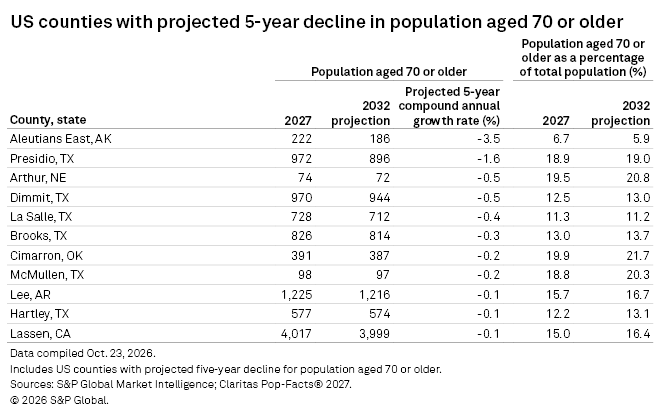
In contrast, Claritas' demographic estimates forecast a decline in the elderly population across 11 US counties due to overall population decline. Six of these counties are in Texas — Presidio County, Dimmit County, La Salle County, Brooks County, McMullen County and Hartley County — as well as Aleutians East County in Alaska, Arthur County in Nebraska, Cimarron County in Oklahoma, Lee County in Arkansas and Lassen County in California.
Market Intelligence did not find any independent living, assisted living and continuing care retirement properties owned by REITs in these counties.
|
Counties with the highest percentages of elderly population
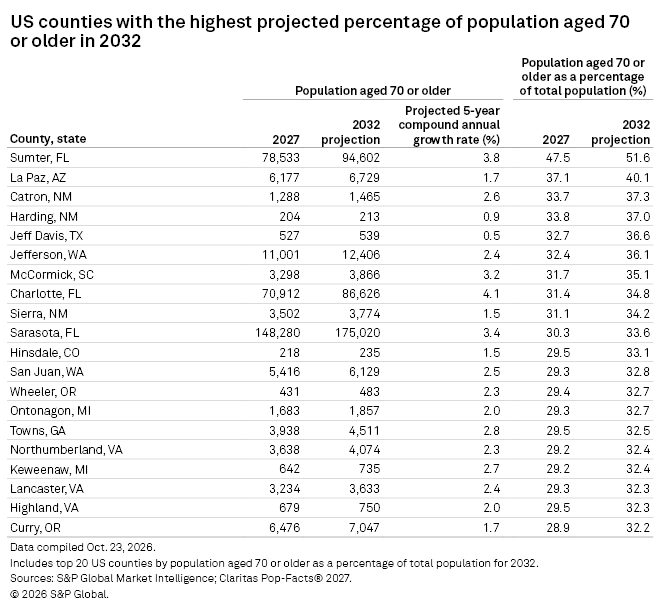
The elderly population is projected to grow to at least a quarter of the overall county-level population in 188 US counties by 2032.
The elderly population in Sumter County, Florida, is projected to surpass 50% of the county's overall population by 2032, the highest percentage among all US counties.
La Paz County in Arizona ranked second, with the elderly population projected to reach more than 40% of the county population by 2032.
Catron County and Harding County in New Mexico ranked next, with the elderly population projected to grow to 37.3% and 37.0%, respectively.