23 Oct, 2026
Brazil election offers contrasting visions for critical minerals development

|
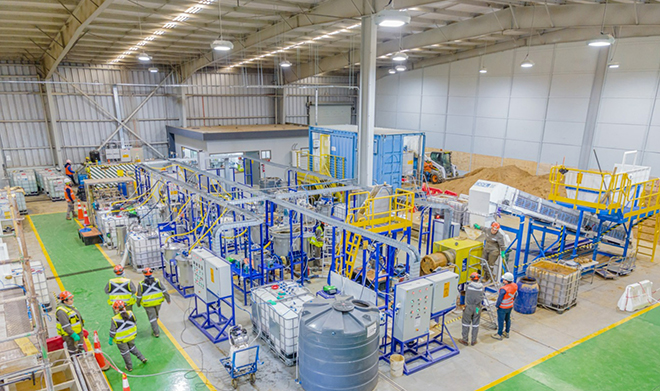
Both Brazilian presidential candidates would like to see more mineral processing, such as the rare earth pilot plant at Aclara Resources' Carina project, shown above. |
Brazilian presidential front-runner Flávio Bolsonaro, who narrowly led President Luiz Inácio Lula da Silva in the Oct. 4 first round ahead of the Oct. 25 runoff, plans to streamline mine permitting and align the country's mineral policies more closely with US interests, according to analysts and Bolsonaro's platform.
Lula, in contrast, is pushing for public investment, resource sovereignty and domestic processing of Brazil's raw ore.
Both candidates agree that mining is key to Brazil's future. The country holds the world's second-largest rare earth reserves, after China, and the seventh-largest lithium reserves, according to the US Geological Survey.
"Brazil has just approved a new framework for critical and strategic minerals with broad political support. That tells us this is a state policy that would be implemented and prioritized under either Lula or Bolsonaro," said Veronica Retamales Burford, a senior research analyst at S&P Global Market Intelligence covering political and security risks in Latin America.
Bolsonaro wants faster permitting, US access
Bolsonaro's platform frames critical minerals as a matter of competitiveness and investment. Dubbed "Brazil Grows," the program identifies lithium, niobium, graphite, copper, nickel, uranium and rare earths as strategic resources. It proposes accelerating mining approvals and reforming regulations to speed project development.
The program also proposes a more predictable permitting system, which when combined with foreign capital and technology partnerships would help Brazil become a leading mineral supplier.
A Bolsonaro victory could also bring Brazil's mining policy closer to the direction seen in other Latin American countries.
"What we could expect to see in Brazil is similar to what is happening in Chile, Peru and some other countries in the region: efforts to increase mineral extraction by simplifying processes and speeding up decision-making, while also creating incentives for producing companies," Juan Ignacio Guzmán, CEO of GEM Mining Consulting, told Platts, part of S&P Global Energy.
Bolsonaro hopes to move up the value chain by attracting foreign investment. "We will work to attract foreign capital and technology that already exist globally, applying here what other countries have already mastered and transferring that knowledge to Brazil," according to Bolsonaro's platform.
Bolsonaro has floated the idea of adding Brazil to the US-led Shield of the Americas initiative, which includes Argentina, Chile and Ecuador, among other countries, and prioritizing the supply chain for critical minerals and rare earths to help the US reduce its reliance on China.
Other observers see a Bolsonaro government as potentially providing the US with greater access to Brazil's resource base, while also raising questions about the effectiveness of Lula's existing critical minerals policy.
"From my point of view, Bolsonaro has already made clear his willingness to facilitate US access to Brazil's natural resources," Diógenes Breda from Universidade Federal de Uberlândia said during a debate organized by Clacso, an international nongovernmental organization.
Lula pushing for domestic processing
Lula's program emphasizes sovereignty, domestic industrialization and capturing more value within Brazil.
"We will not accept critical minerals and rare earths leaving the country in their raw state at derisory prices, repeating past mistakes," Lula said in a post on X after the critical minerals framework he championed was approved by the Senate.
The legislation created the National Council for the Industrialization of Critical and Strategic Minerals, or CIMCE, which coordinates implementation of the policy and defines and updates the country's list of critical and strategic minerals.
The council's role would likely diminish under Bolsonaro but remain stronger under Lula, Market Intelligence's Retamales said.
In Lula's government program, critical minerals are embedded in the New Industry Brazil policy and the broader Ecological Transformation Plan, which aim to promote reindustrialization, domestic value addition and low-carbon development.
The platform calls for a dedicated policy for critical minerals and rare earths, expanded domestic processing and the development of local supply chains to reduce exports of unprocessed raw materials.
The analysts expect that, under Lula's policy, Brazil would likely make greater progress in mineral processing and related technology projects over the next five years.
"If Lula wins, what the market ultimately expects is a continuation of public financing, industrial coordination and processing, with a focus on the domestic market," GEM Mining's Guzmán said.