


16 Jan, 2026
Supply limits, price risks deter critical minerals tariffs – analysts
By Rachel Looker and Liubov Georges
US President Donald Trump opted not to impose tariffs on critical minerals for fear that the lack of US processing capacity could lead to high prices under a restrictive trade policy, analysts told Platts Jan. 15.
Trump's Jan. 14 proclamation following a national security investigation on critical minerals imports fell short of implementing duties, instead instructing federal agencies to pursue critical mineral agreements through negotiations with trading partners. It raised the possibility of price floors to boost US production and left open the possibility of tariffs should negotiations fail.
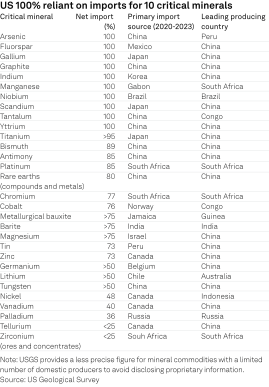
The Trump administration has made manufacturing and domestic critical mineral production a top priority in an effort to reduce reliance on foreign resources.
The announcement in April 2025 of a probe into US trade of nickel, cobalt, lithium, 17 rare earth elements and other minerals sent companies scrambling as they built up inventories ahead of a possible tariff. Earlier investigations into aluminum, steel and copper led to 50% tariffs, but Trump held off this time.
"There's a realization among administration officials that they can't unilaterally increase tariffs without addressing supply and expect there to be no consequences," said Nick Trickett, an associate director for research and analysis at S&P Global Horizons.
Trickett said metals affected by tariffs, like the 50% rate implemented on semi-finished copper products, fuel inflation. Strengthening domestic projects through tariffs weakens demand among industrial consumers, he said, adding that the threat of a tariff "can create a sustained premium for stocks flowing into US warehouses."
"Put simply, the White House balked because it feared stoking inflation ahead of this year's midterms and voters will likely visit their wrath on the party in power for it," Trickett said.
Markets face price volatility
As part of the investigation, the US Commerce Department determined the US is too reliant on foreign sources for the materials and lacks a secure and reliable supply chain.
The national security investigation found that critical minerals are being imported "in such quantities and under such circumstances as to threaten to impair the national security of the United States," according to the Jan. 14 proclamation.
It also found that the critical mineral market is experiencing unsustainable price volatility as well as weakened domestic manufacturing. Previous tariffs have caused prices to jump: The premium on primary aluminum in the US has quadrupled since tariffs went into effect, and the prospect of a copper tariff created high prices in the US as buyers stocked up. As of Jan. 14, the Platts assessed the spot 99.7% P1020 aluminum premium, delivered in the US Midwest with net 30-day payment terms, at 98.85 cents/lb on top of the London Metals Exchange cash price, up 315% year over year.
But despite the findings, Trump opted to prioritize negotiations before considering duties "depending on the outcome of such negotiations." He also left open the possibility of tariffs should talks collapse and that he may consider alternative remedies in the future, including minimum import prices for specific types of critical minerals.
A policy focused on working with allies to produce more key metals while punishing US adversaries closely resembles former President Joe Biden's approach of "friendshoring" critical minerals.
Chris Berry, an independent battery metals analyst and president of House Mountain Partners, said Jan. 15 that the lack of tariffs in the proclamation seems like a "detente with China," which dominates the global market for critical minerals and their processing. The country is the leading producer of 30 out of 44 critical minerals, according to Commerce's Bureau of Industry and Security.
The biggest takeaway from the proclamation is a potential price floor, which Trump instructed the commerce secretary and US trade representative to consider for critical minerals and other trade-restricting measures, Berry said.
"Determining floor prices for a host of commodities all of which are unique in market size and structure will take time to figure out and implement when demand is exploding for these commodities now — not in several years," the analyst said.
Congress looks to secure supply chains
A bipartisan group of lawmakers in both the House and the Senate introduced legislation on Jan. 15 in the wake of Trump's proclamation that aims to increase the domestic supply of critical minerals.
The lawmakers introduced the Securing Essential and Critical US Resources and Elements (SECURE) Minerals Act, which allocates $2.5 billion to establish a Strategic Resilience Reserve. The reserve would serve as an independent government corporation that aims strengthen critical minerals markets by supporting stable prices, domestic and allied production, mineral stockpiles and supply chains. The corporation will be governed by a seven-member board.
"Delivering much-needed stability to the market, providing targeted investments and stockpiling key inputs will help insulate the US from foreign threats and will provide a significant and cost-effective boost to the US economy," Senator Jeanne Shaheen, Democrat-New Hampshire, who introduced the bill alongside Senator Todd Young, Republican-Indiana, said in a statement.
Republican congressmen Rob Wittman of Virginia and John Moolenaar of Michigan introduced companion legislation in the House.
Also in the House, California representatives Ami Bera, a Democrat; and Young Kim, a Republican, introduced separate legislation on Jan. 13, dubbed the Developing Overseas Mineral Investments and New Allied Networks for Critical Energies (DOMINANCE) Act. H.R.7037 aims to build diversified critical minerals supply chains and reduce dependency on China for the materials.
Industry applauds executive action
Industry groups and producers commended Trump's proclamation and the administration's renewed focus on building critical mineral supply chains.
Price stability is "essential" for Western refining capacity to scale, KaLeigh Long, founder and CEO of Westin Elements, a nickel refiner in Oklahoma, said Jan. 15.
"The United States must work with allies to implement dynamic trade policies that include tariffs on FEOC-controlled (foreign entity of concern) products and address distorted markets such as nickel through coordinated production discipline and market stabilization measures," Long told Platts.
The National Mining Association also supports the Trump administration’s efforts to build more secure and resilient mineral supply chains.
"The administration’s continued support and recognition — reflected in this order — of the need to expand domestic mining to reduce our alarming overreliance on imports is very welcome," Conor Bernstein, NMA's vice president of communication, said in a statement to Platts.