Featured Topics
Featured Products
Events
S&P Global Offerings
Featured Topics
Featured Products
Events
S&P Global Offerings
Featured Topics
Featured Products
Events
S&P Global Offerings
Featured Topics
Featured Products
Events
Financial and Market intelligence
Fundamental & Alternative Datasets
Government & Defense
Professional Services
Banking & Capital Markets
Economy & Finance
Energy Transition & Sustainability
Technology & Innovation
Podcasts & Newsletters
Financial and Market intelligence
Fundamental & Alternative Datasets
Government & Defense
Professional Services
Banking & Capital Markets
Economy & Finance
Energy Transition & Sustainability
Technology & Innovation
Podcasts & Newsletters
27 Jan, 2026

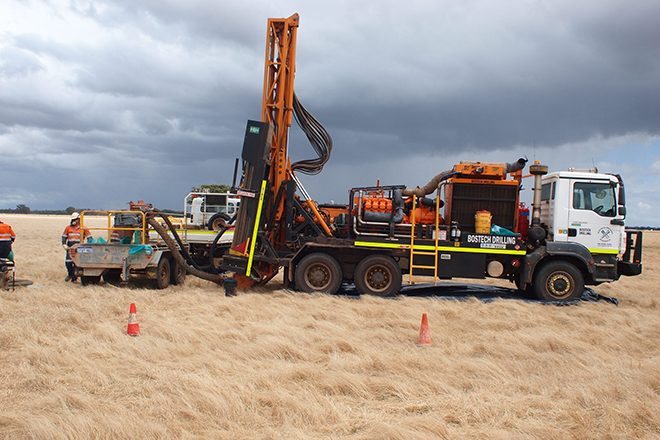
| The gold price has been rising fast, leading to more drilling, like that seen here at the Pyramid Hill gold project in Australia. Source: Falcon Metals Ltd. |
Gold prices blasted through a $5,000/ounce record on Jan. 26, a historic milestone driven by growing investor mistrust of government ability to maintain the rules-based global system, industry experts told Platts, a part of S&P Global Energy.
The London Bullion Market Association price of gold closed at $5,101.55/oz on Jan. 26, an all-time record for the yellow metal. Perceived breakdown of the US-led international order, coupled with concerns over macroeconomic and fiscal stability across major economies, has elevated gold to unprecedented levels at the start of 2026, smashing through previous forecasts from investment firms.
Analysts said that the gold rally is likely to persist through 2026 as both retail and institutional investors will seek to reduce exposure to US-denominated assets that are increasingly viewed as unstable.
The LBMA daily closing price hit seven new all-time highs in January before peaking on Jan. 26, notching an 18% gain year-to-date and a remarkable 179.7% surge since Jan. 2, 2023. Gold posted its best performance since 1979, when the precious metal rallied amid the Iranian hostage crisis and the Soviet invasion of Afghanistan, according to the World Gold Council, an industry group.

"We are now moving into a different level of uncertainty. It's above the corporate level, and it's at a sovereign level of risk," Ryan McIntyre, president at Sprott Asset Management, told Platts. "People are now less trustworthy of sovereigns and their ability to navigate things. This has not been thought about for a very long time."
The latest catalyst emerged from US tensions with world leaders over Greenland, exemplifying the broader shift away from multilateral cooperation toward America-first policies that have unsettled global markets.
Canadian Prime Minister Mark Carney, speaking at the World Economic Forum in Davos on Jan. 20, described the recent bout of US tensions as a "rupture” in the old world order and called on "middle powers" to unite.
Geopolitical premium
Gold's surge extends beyond traditional economic drivers, with geopolitical risk premiums now being priced in ways not seen since the Cold War era. The precious metal has effectively decoupled from typical correlations with real interest rates and inflation expectations, instead tracking global political stability concerns.
"Gold is essentially trading on geopolitics right now," Marlon Joaquin, an analyst at S&P Global CERA, told Platts. "The risk premium is doing the heavy lifting, and strong structural demand from central banks to record-[assets under management] gold ETFs keeps the floor firm."
Matthew Piggott, director of gold and silver at Metals Focus, emphasized that "it's not any single geopolitical instance but rather a gradual migration from a rules-based global system to a world where America is more focused on American interests" that has been gradually pushing gold prices higher.
Central banks are buyers
Central banks were the first to recognize uncertainty around US dollar asset holdings and began stockpiling gold accordingly, according to McIntyre, with most countries increasing their reserves despite elevated prices.
This shift has created sustained demand from institutional investors seeking portfolio diversification away from traditional government bonds and equities. Exchange-traded funds backed by physical gold holdings have seen record inflows, according to the World Gold Council, with assets under management reaching new peaks as fund managers allocate increasing portions of portfolios to precious metals.
"We expect this trend to continue in 2026 because several central banks already telegraphed that they are going to push up their target allocations for gold," Piggott told Platts.
The National Bank of Poland on Jan. 20 announced plans to purchase up to 150 additional metric tons of gold, raising holdings to a maximum of 700 metric tons, according to news reports. McIntyre said central banks across the emerging markets have now become a dominant buyer of gold.
The combination of some central banks reaching target allocations earlier than expected and higher valuations from the rally has created additional purchasing capacity.
"Central-bank gold buying still has room to run, and investment demand remains solid. The key watchpoint this year is whether that pace cools, because so far these buyers haven't been deterred by high prices. Demand has been very price-inelastic," Joaquin told Platts.
Limited room for the downside
Analysts see limited factors that could calm gold markets in 2026, with perceptions of an overheated US stock market concentrated in technology shares adding to safe-haven demand. While the US dollar maintains its entrenched reserve currency status, ongoing de-dollarization efforts by various nations continue supporting gold's appeal as an alternative store of value.
"When you start to think about all these factors, you quickly arrive at the fact that nothing is really going to change and calm the gold market down," Piggott said.
However, gold's evolution toward sovereign risk hedging could be a fundamental shift that would usher in a period of sustained higher prices, even if immediate geopolitical tensions ease.
"The problem with damaging the credibility, especially with what's been happening over the past year or two, is that it becomes difficult to restore that immediately," McIntyre noted.