


03 Dec, 2025
US wind developers rush to add 82 GW by end of 2030 to break through doldrums
By Nushin Huq and Susan Dlin
Slower US wind energy capacity additions in the third quarter of 2025 reflected the industry's ongoing downturn compared with several years ago.
Developers of large-scale wind projects added 728 MW of new capacity in the third quarter, a 183-MW drop from a year earlier and 44 MW less than in this year's second quarter, according to S&P Global Market Intelligence data. Wind capacity additions in the first nine months of 2025 totaled 3.1 GW, versus 3.4 GW in the same period of 2024.
The prolonged slump for the US wind industry comes as clean energy buyers continue to shift toward larger volumes of solar and battery storage. However, wind developers are planning to add record new volumes of capacity to the US grid over the next couple of years to take advantage of expiring federal tax credits.
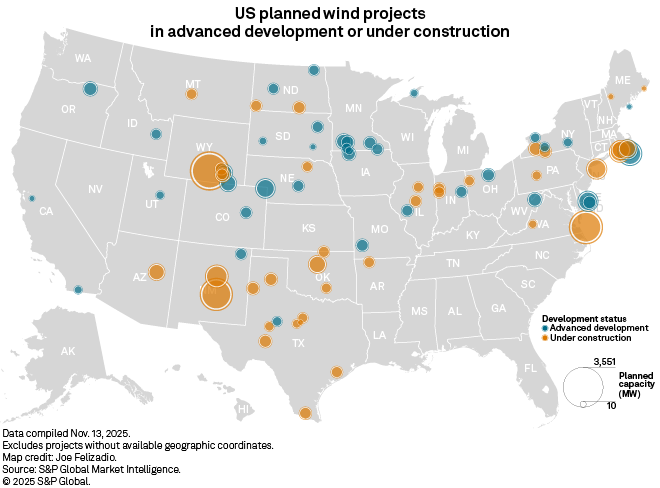
Developers plan to add approximately 82 GW of wind-generating capacity through 2030. That includes over 20 GW under construction, of which 3.6 GW is targeted for completion before the end of this year and nearly 10.9 GW is planned to come online in 2026. Another nearly 11 GW is in advanced development, while roughly 32 GW is in early development with intended completion dates through 2030, Market Intelligence data shows.
In 2026, developers are aiming to add 18.9 GW of wind to the grid and another 19 GW in 2027. If those plans come to fruition, it would surpass record annual wind capacity added in 2020, when developers completed over 16 GW of capacity.
Developers are navigating an accelerated tax credit phaseout enacted in July, under President Donald Trump's budget bill, though Trump administration actions targeting offshore wind in particular could delay construction schedules.
The biggest project vying for completion in 2026 is Dominion Energy Inc.'s 2,587-MW Coastal Virginia Offshore Wind.
"The project is now two-thirds complete and just a few months away from delivering much-needed electricity to our customers," Dominion Chair, President and CEO Robert Blue said on the company's third-quarter 2025 earnings call.
Coastal Virginia Offshore Wind is the largest of several major offshore wind projects under construction in federal waters off the East Coast.
Also under construction and planned for completion next year are the 2,426-MW SunZia Wind South and 1,089-MW SunZia Wind North projects in New Mexico. Pattern Energy Group LLC is developing the wind farms as part of a series of SunZia facilities and associated transmission.
The budget bill includes various deadlines for wind projects to capture tax credits over the next few years. Most immediately, facilities that begin construction before the end of this year can avoid new restrictions on investments linked to foreign entities of concern, though developers are still awaiting federal guidance on the rules.
Additional tariffs on imported equipment could create further headwinds.
US onshore equipment orders remain soft as customers face permitting delays and tariff uncertainty, GE Vernova Inc. executives said during their third-quarter earnings call.
But executives highlighted US wind farm repowering projects as a strength.
Vestas Wind Systems A/S reported stronger third-quarter 2025 order intake compared to the same quarter of 2024, driven in part by the US, company executives said during a third-quarter earnings call.
"We are having a well-covered order backlog in the US, and people are building out and planning for building out," said Vestas President and CEO Henrik Andersen, adding that US wind projects have "a very attractive levelized cost of energy."
Vestas likely would have had more orders if not for tariff uncertainty, Anderson added.
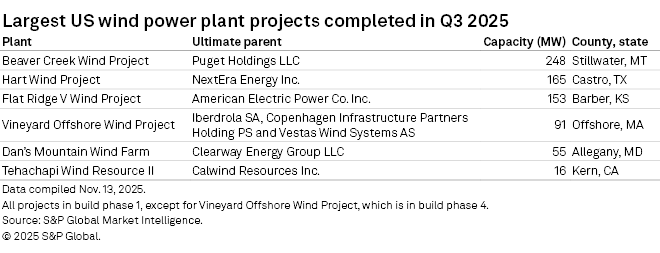
Puget Sound Energy Inc.'s 248-MW Beaver Creek Wind Project was the largest project to come online in the third quarter of 2025. The Montana wind farm will help Puget Sound comply with Washington state's clean energy law.
Despite challenges facing the offshore wind industry, Iberdrola SA subsidiary Avangrid Inc. brought online an additional 91 MW at the Vineyard Offshore Wind Project during the third quarter. Iberdrola owns 50% of the project off the coast of Massachusetts. Avangrid operates the facility, which has 227 MW in operation and another 585 MW under construction, according to Market Intelligence data.
American Electric Power Co. Inc. also completed its Flat Ridge V Wind Project in the third quarter, adding to its complex of Flat Ridge wind farms in Kansas.
Market Intelligence considers a project as announced when it has a listing in an interconnection queue with an accompanying public announcement or permitting action. A project is considered in early development after permitting begins. For a project to be considered advanced development, it must meet two out of five criteria: financing is in place, power purchase agreements are signed, equipment is secured, required permits are approved or a contractor has signed on to the project. A project is under construction when building activity begins; site preparation does not qualify a project for this status.