29 Dec, 2025
US renewables, battery sectors face new supply chain restrictions in 2026
By Kirsten Errick and Garrett Hering
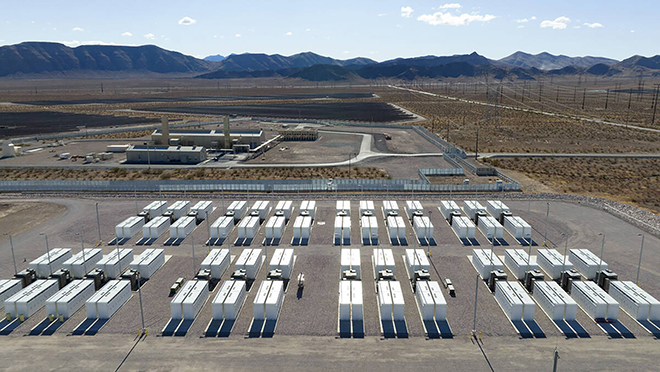
| Battery storage systems and a solar farm surround the natural gas-fired Harry Allen power plant in Las Vegas. Source: Bizuayehu Tesfaye/Las Vegas Review-Journal/Tribune News Service via Getty Images. |
US renewable energy and battery storage industries face a new challenge in 2026 when supply chains linked to certain foreign sources come under greater scrutiny.
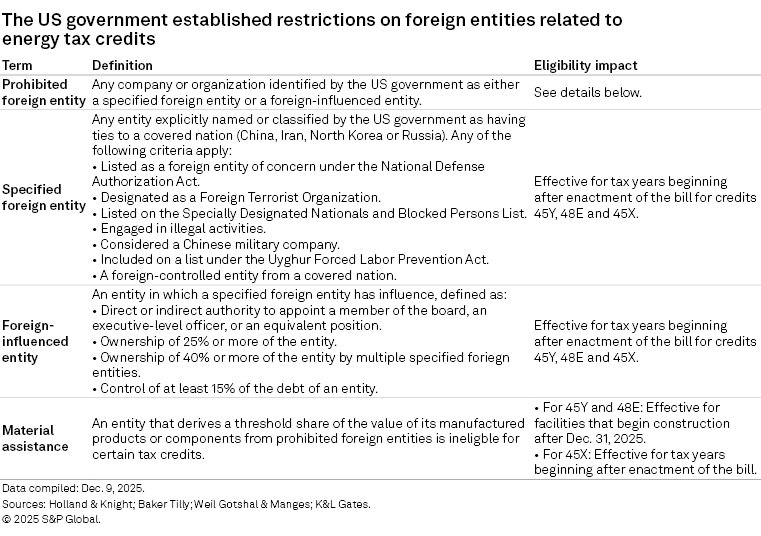
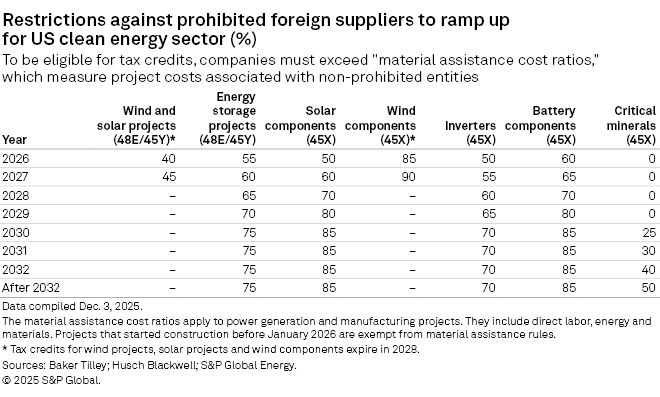
President Donald Trump's sweeping budget bill enacted in July added foreign entity of concern (FEOC) restrictions starting in 2026 to qualify for valuable federal clean energy incentives, including the Section 45Y production tax credit, 48E investment tax credit and 45Y advanced manufacturing production tax credit.
The FEOC restrictions, which become more onerous over time, limit material assistance from prohibited foreign entities linked to China — by far the world's largest cleantech manufacturer and a major exporter to the US — as well as Russia, North Korea and Iran. To offset their risks, US developers and manufacturers that rely on components, materials and investment from prohibited entities have safe-harbored significant inventory ahead of the new year, providing a multiyear runway to adapt to the new rules, according to some market participants and analysts.
Moreover, domestic and non-FEOC sources of solar panels, batteries, inverters and other clean energy equipment are ramping up to meet strong US clean energy demand.
But a delay in US Treasury Department guidance on FEOC requirements, exacerbated by the prolonged government shutdown in October and November, is adding to uncertainties as companies reconfigure their supply chains to include more US-made and other FEOC-compliant content.
"The prohibited foreign entity rules imposed as a result of the One Big Beautiful Bill add significant complexity to the tax code," Nicole Elliott, partner at Holland & Knight, told Platts, part of S&P Global Energy. For companies seeking to claim tax credits, "the challenge largely lies in the material assistance rules, requiring taxpayers to gather significant information about their suppliers," Elliott said.
A prohibited foreign entity is an umbrella term encompassing a specified foreign entity or a foreign-influenced entity, as defined by the law.
Others hope future guidance will help the domestic industry.
"We are all eager to see what the administration puts out in terms of guidance and are hopeful that it will help level the playing field for domestic manufacturers, and domestic manufacturers particularly that are not reliant on Chinese-linked supply chains," Solar Energy Manufacturers for America (SEMA) Coalition Chief Strategy Officer Yogin Kothari told Platts.
While there is a lot of specificity in the law's FEOC provision, "having additional clarity is always helpful just to make sure that they are reading what Congress's intent was in the right way," Kothari added.
Battery storage 'dicier'
"It looks like utility-scale solar itself should be okay," Osha told Platts. "The storage gets a little dicier. There is less inventory. And then also it's harder, given what the cell sourcing situation looks like, to necessarily get over that FEOC bar … I think there is some confidence that there are workarounds, but I'd say that the initial take is that storage is going to be more challenged than solar."
One such workaround was to start construction before Dec. 31, 2025, allowing developers to safe harbor projects under pre-FEOC rules.
It appears a large volume of projects were positioned to seize that window of opportunity. More than 100 GW of large-scale solar, wind and battery storage capacity was under construction or in advanced development as of Dec. 8, according to S&P Global Market Intelligence data.
A series of recently announced conversions of US electric vehicle battery plants to instead produce cells for battery storage has improved the outlook for the industry.
Ford Motor Co., for instance, on Dec. 15 said it would repurpose existing battery capacity at a factory in Glendale, Kentucky, as part of a new strategic push into energy storage, which includes investing roughly $2 billion over the next two years. South Korean suppliers LG Energy Solution Ltd., Samsung SDI Co. Ltd. and SK On Co. Ltd. are also converting US EV battery production lines to energy storage.
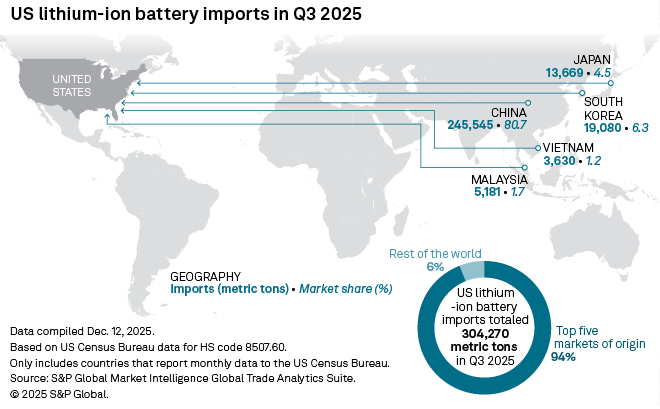
Such moves have given analysts more confidence in the battery storage industry's ability to adapt to the FEOC rules and move away from imports, which rose 15% in the first nine months of 2025 compared to the same period of 2024. In the third quarter, China accounted for roughly 80% of imported lithium-ion battery cell volumes.
"We have increased our outlook for [battery storage] in the US based on how quick manufacturers are able to transition their factories from EV production to [battery storage]," said John Murray, principal analyst at S&P Global Energy.
As of Dec. 12, that outlook included 58 GWh of demand in 2026 versus 37.25 GWh of annual US lithium-iron-phosphate (LFP) cell production capacity available for energy storage. Domestic LFP production capacity will expand to 95.25 GWh by 2028, surpassing the 71.85 GWh of demand forecast in that year, and reach nearly 150 GWh in 2030, according to the outlook.
Equity analysts at Jefferies expect 130 GWh of annual domestic LFP production capacity already by 2028, researchers said a Dec. 17 note to clients, citing Ford's plan to convert 20 GWh to energy storage in Kentucky by the end of 2027.
Some companies are taking action to address FEOC challenges over Chinese ownership.
For example, Canadian Solar Inc. on Dec. 1 announced that it created a joint venture, known as CS PowerTech, with its American shareholders and its China-headquartered manufacturing subsidiary CSI Solar Co. Ltd. to reduce supply chain risks. The joint venture will operate US-based manufacturing and sales of solar modules, solar cells and advanced energy storage systems, and Canadian Solar will have a 75.1% controlling stake in the joint venture.
The company said it will also acquire from CSI Solar a 75.1% ownership of "certain overseas facilities that support US operations."
Protecting industry
These FEOC restrictions align with broader US trade policy actions.
"It's another in a long series of measures that is designed to try and protect this market," said Guggenheim's Osha, pointing to tariffs and antidumping and countervailing duties.
"But it's coming at a price … you created this market here where the pricing is much higher," Osha said. "There can and should be some balance between an industry that's competitive and an industry that is able to support a manufacturing base."
Others added that guardrails are needed.
"When the government uses taxpayers' money … there should be due scrutiny on where the money goes," Jane Nakano, senior fellow in the energy security and climate change program at the Center for Strategic and International Studies, told Platts. "FEOC is [an] important sort of safeguarding mechanism or guardrail."
Nakano also called for balance.
"Having a national security test through FEOC is useful, but if that notion proliferates too much, I think the different segments within the US economy could simply become less competitive," Nakano said. "Particularly when in the current context of geopolitical competition between the US and China, I think it is warranted. But again, where [do] you draw the line?"