03 Dec, 2025
Unity Metals listing amid 'inflection point' for Cambodia mining – executive

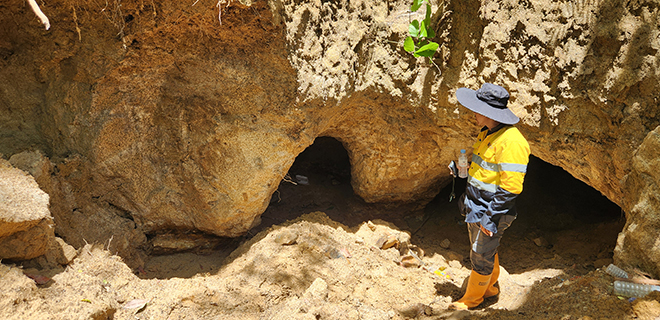
| New artisanal gold workings at Unity Metals' Ngot project in Cambodia, where the company is focused on intrusion-related mineralization |
➤ Unity Metals will list on the Australian Security Exchange on Dec. 19, focusing on gold and copper exploration in Cambodia and Thailand.
➤ Emerald Resources' Okvau mine represents an "inflection point" for Cambodia after decades of instability amid war and revolution.
➤ Unity Metals is seeing investor interest in its IPO from high net worth family office investors in Malaysia, Singapore, Hong Kong and Cambodia.
 |
| Craig Mackay, managing |
Unity Metals Ltd. is set to list on the ASX with a raise of up to A$10 million in the hopes of following in the footsteps of Emerald Resources NL, which runs Cambodia's first commercial gold mine, Okvau.
Before incorporating in July 2024 to facilitate the listing, Unity Metals started exploring in Myanmar in 2013 and secured permits for gold, base metals and thermal coal in 2019. The company started searching elsewhere in Southeast Asia after a coup in the country in 2021.
Craig Mackay, formerly managing director of West Africa-focused Golden Rim Resources Ltd. for 15 years, is no stranger to coups. The executive is confident about operating in Cambodia and Thailand, where Unity Metals has exploration licenses granted and pending across four projects.
Platts, part of S&P Global Energy, spoke to Mackay about the company's plans in light of the sovereign risk perceptions and realities in Southeast Asia. The following interview has been edited for clarity and length.
Platts: Explorers still talk about a tough equity market. How are you finding it leading up to this IPO?
Craig Mackay:
That said, demand is looking pretty good. What we've found with this raise is that we're obviously getting the demand out of Australia, but we're actually getting a lot of demand out of Southeast Asia for this one — Malaysia, Singapore, Hong Kong, and now starting to see some money out of Cambodia. Some are institutional investors but most of it is from high net worth family offices.
This IPO is quite unique. We haven't seen much in terms of an ASX IPO out of Southeast Asia in some time. This rarity stems from the fact that historically, some of the countries in Southeast Asia have been pretty difficult to operate in. In Cambodia, we've found that, since Emerald has been there, things look pretty attractive.
How would you describe Cambodia and Thailand as investment destinations?
Cambodia had a fairly unfortunate history. From the 1960s through to the early 2000s there was no real mining industry, no exploration, certainly by any Western companies. With Pol Pot, the Vietnam war and a military coup there was all sorts of trouble, so investors stayed away.
But it has the right geology, which is something people don't realize. Cambodia has this style of gold mineralization called intrusion-related gold, so it's gold related to a particular type of granite, which in Cambodia is a diorite. There are only a few places in the world where we find this. The best known examples are in Alaska where there are a bunch of deposits that are really sizable, like Fort Knox and Pogo, both with more than 10 million ounces. The most recent example in Australia is Hemi in the Pilbara, which is about 11 million ounces.
So Cambodia has the right rocks. Oxiana Ltd. — which became OZ Minerals Ltd. before being acquired by BHP Group Ltd. — first went there in 2006 and discovered Okvau in 2007, which over time became a deposit with over 1 million ounces of gold. Emerald arrived in Cambodia in 2016 and built that mine in 2021, and the inflection point is their success. Having started there as a junior, they are now worth about A$3.5 billion.
Okvau is now one of the lowest cost gold producers on the ASX with all-in sustaining costs of just over A$1,000 an ounce. Considering the current gold price of US$4,000 per ounce, that's an incredible margin. In some ways, we're following in the coat tails of their success. They put Cambodia on the map.
Then in Thailand, another Australian company called PanAust Ltd. found a deposit called PUT 1 and put together a large resource that is also associated with those diorites, which are magnetic there.
We've been able to pick up nearly 200 square kilometers of ground around PUT 1, and in that ground there are five similar big magnetic anomalies that have copper and gold occurrences with gossans on top that have never been explored. Our exploration licenses there will be granted in about February next year.
What is your perception of the sovereign risk in Cambodia and Thailand now?
There was a change in government in Thailand in 2023, so the current government is a lot more pro-mining than the previous group that caused problems with Kingsgate Consolidated Ltd., which had its Chatree mine shut down in 2016. Kingsgate commenced arbitration in 2017 against the government and the issue has been resolved, and from what we see, the current government is keen for us to get out and start some work.
Though Thailand is not quite as unexplored as Cambodia, we think that as an Australian explorer, you can get out and really make something of it.
Prior to Unity, I was in West Africa for 15 years as managing director of Golden Rim Resources, which certainly didn't have the same amount of support there that we would see in Southeast Asia.
Golden Rim had about 2 million ounces at the Kouri deposit in Burkina Faso, but then [a geologist was killed nearby and] we just couldn't work. What I like about Southeast Asia is you don't have a security problem. You can get out and about in the field and do your drilling without any issue. So it's a pleasant change.
Yes, Thailand previously had a military coup, but I've been through eight or nine of them now. I worry less about them.