30 Dec, 2025
Nonbanks dominate 2025 bank charter application surge
By Claire Lawson and Xylex Mangulabnan
This year's surge in bank charter applications is set to continue into 2026 as technology and digital asset-focused companies get a warm welcome from federal regulators.
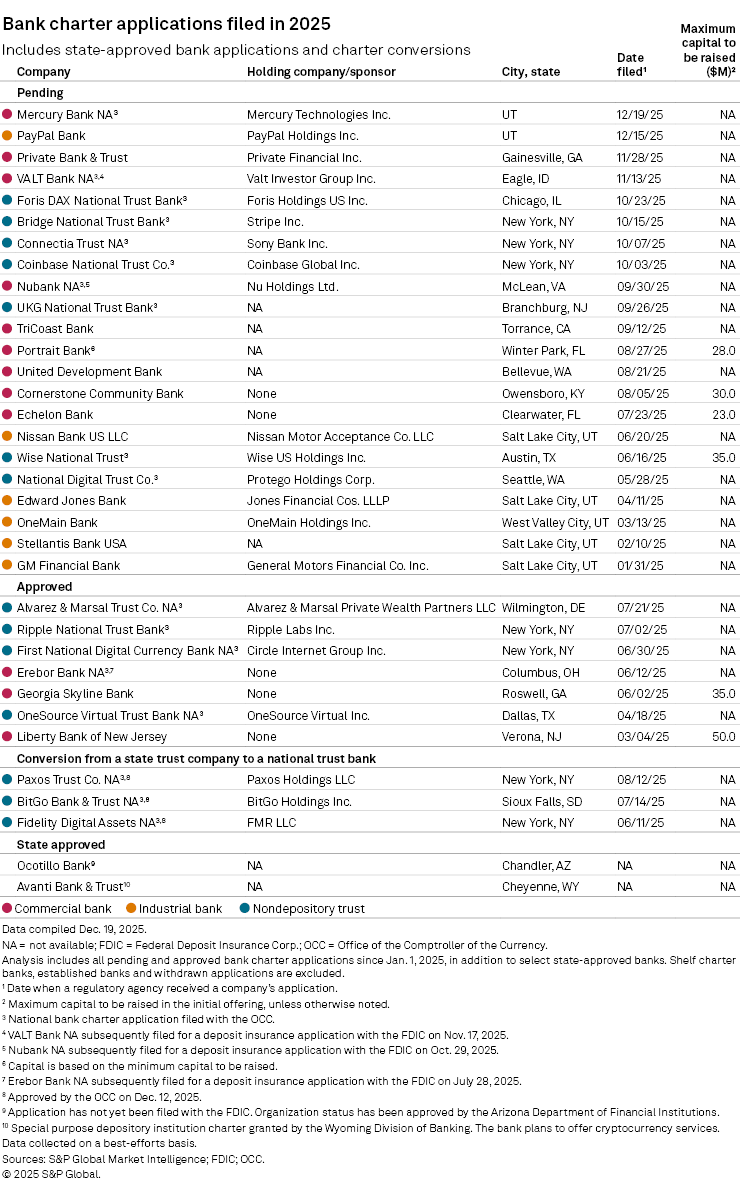
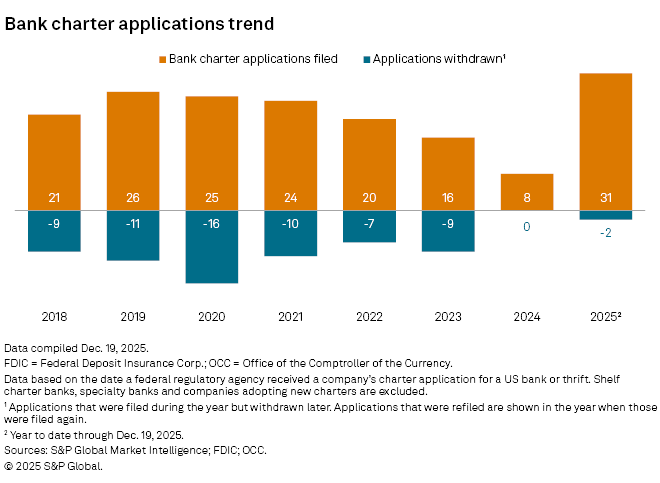
There were 31 US bank charter applications filed this year through Dec. 19, nearly four times 2024's total and the highest amount since at least 2018, according to S&P Global Market Intelligence data. The surge was largely led by nontraditional charters such as national trust bank charters and industrial loan companies (ILCs), as nonbank companies saw softening regulatory attitudes toward innovation in the bank space. Several digital-asset focused organizers even sought traditional commercial bank charters in 2025, and the trend is likely to continue, advisers said.
Nonbank applicants were "completely unwelcome" under the prior administration, but this year has brought a dramatic change with all business plans being welcome, said Troutman Pepper partner James Stevens. "Crypto people have a chance here. Before they really didn't have much of a chance to get past a filing. And so that has been a really monumental shift."
"It doesn't mean that everybody gets waved in and gets to get a bank charter. The standards continue to be very high and very rigorous. But I do think there is some openness to working through fintech, crypto or other nontraditional business plans," he added.
Nondepository trust applications
Among the 31 charter applications, 14 were nondepository trust bank applications with the Office of the Comptroller of the Currency. Nine of those were filed in the second half of 2025 after the Guiding and Establishing National Innovation for US Stablecoins Act's drafting and passage in July, which outlined that charter as a pathway to legal issuance of stablecoins.
The OCC has been explicit in welcoming these applications.
"It is important that we do not confine banks, including current national trust banks, to the technologies or businesses of the past. That's a recipe for irrelevance. Activities of national trust banks have evolved, as have activities of other banks across the country," Comptroller Jonathan Gould said during a Dec. 8 speech. During the same speech, he also pushed back on the bank industry's criticism of these charters.
"Some banks and their trade associations have raised concerns about pending applications. Among other things, they have asserted that approval of these applications would be contrary to OCC precedent because it would permit national trust banks to engage in nonfiduciary custody activities. What they fail to acknowledge is that the OCC has permitted national trust banks to engage in nonfiduciary custody activity for decades," he said.
Later that same week, the agency approved a slew of five national trust bank charter applications.
Those comments and approvals are a sign of the softer regulatory environment, and will motivate more digital asset-focused companies to seek this charter type in 2026, advisers told Market Intelligence.
"We do have now this clear regulatory window under this administration that exists," Matt Wolf, RSM US director of blockchain and digital assets, said in an interview. "And like anything, we don't stay in stasis forever. So it may not persist beyond 2028. So I believe the combination of all of those things are creating some urgency that we haven't seen."
Commercial bank applications
While nondepository trust charter applications padded the numbers, traditional commercial bank charters rose in tandem, with 12 such applications since the start of the year.
While the majority of those were traditional community banks, some digital asset-focused companies and organizers also sought this type of charter, such as Erebor Bank NA, which received preliminary approval for its national bank charter from the OCC in October and deposit insurance approval from the FDIC this month, and Mercury Bank NA, which filed a national bank charter application with the OCC this month.
Under a commercial bank charter, a company can take deposits and make loans, while nondepository trusts are limited to activities like managing assets and facilitating payments.
ILC applications
There were six
The most recent and notable ILC application was from payment platform PayPal Holdings Inc. The ILC charter type has also received a green light from regulators, including a request for information from the FDIC in July to simplify the application process.
Regulatory friendliness through both statements and actions has paved the way for the upswing of all charter types.
"We're now seeing the administration's priorities put into action," Mayer Brown partner Matt Bisanz said in an interview.