


11 Dec, 2025
Fed interest rate expectations fracture as tensions emerge into 2026

By Brian Scheid
Members of the US Federal Reserve's rate-setting Federal Open Market Committee are arguably more divided on the path for interest rates than they have been for decades.
The Fed cut rates by another 25 basis points on Dec. 10, taking the range for the benchmark federal funds rate down to 3.5% to 3.75%. While the cut was its third in as many meetings, it may be the last expected move on interest rates by the central bank for a while as officials appear split over whether to be more concerned about rising inflation or the softening jobs market.
Two of the 12 FOMC voting members dissented in favor of no cut and one voted for a 50 bps cut. But the Fed's quarterly economic projections — updated before the FOMC vote, but released after the meeting — show that six of the members wanted to hold rates instead of cutting.
The median view of FOMC members is for just one cut in 2026, the same as the median view in the last quarterly projections released in September. But interest rate expectations vary significantly, ranging from as high as 4% to as low as 2% by the end of next year.
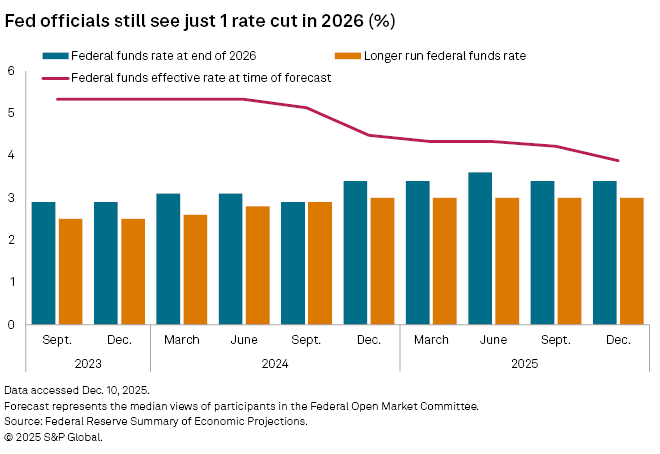
As the central bank enters into a new year, consensus on rates could prove difficult.
"
Fed Chairman Jerome Powell's tenure as head of the central bank is slated to end in May, though most Fed watchers expect him to stay on as a voting member until his term expires in 2028. At the same time, the Fed's independence has been tested by President Donald Trump, who is expected to continue to push for rate cuts.
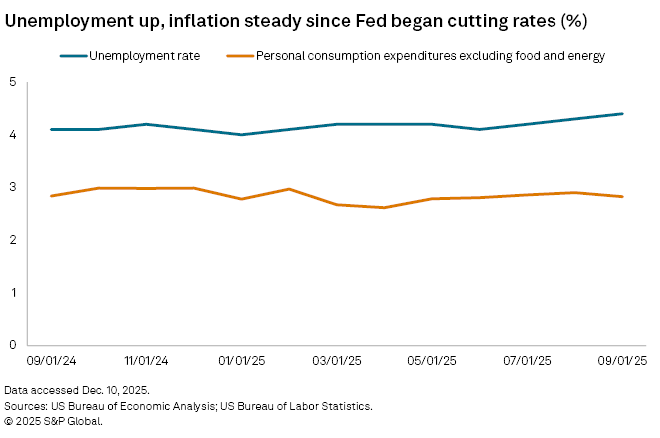
In addition, the Fed's policy actions are being challenged by limited inflation and jobs data, delayed or canceled by the recent federal government shutdown as Fed officials struggle to determine just how much inflation may be accelerating and how far the labor market is weakening, likely setting up a stretch of inaction on rates.
"In the current 'fog' it means any action might be deemed irresponsible," Wyett said. "To take action from here would take a clear and unambiguous break in unemployment higher or inflation [moving higher or lower] and none of those seem likely at present."
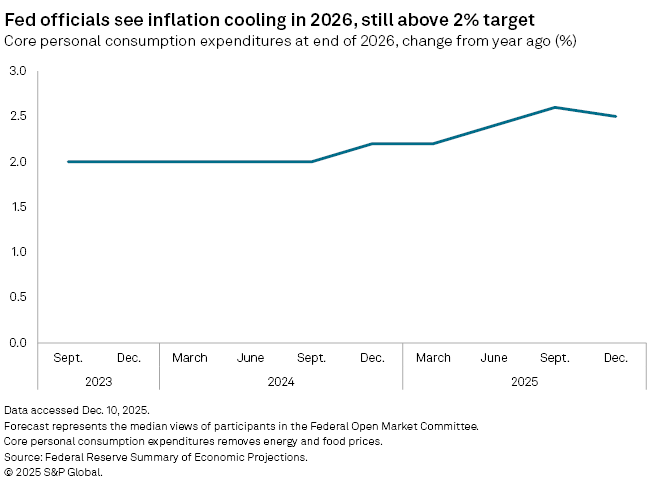
During his press conference following the Dec. 10 vote, Powell said there is a clear division between FOMC members who think inflation is too high, thus necessitating a pause in interest rate cuts, and those who feel the risk of further softening in the labor market calls for more rate cuts. The Fed's dual mandate calls for both price stability, returning annual inflation growth to a 2% target, and for maximum employment.
"Our two goals are a bit in tension," Powell said.
Still, Powell said that monetary policy is "within a range of plausible estimate of neutral," and that a further "normalization" of policy will help stabilize the jobs market and allow inflation to drift towards that 2% target. The Fed's expected neutral rate of interest is an equilibrium where monetary policy neither contracts nor expands the economy.
That neutral rate is widely assumed to be about 3% , which is within one more 25 bps cut, which the median view of Fed officials currently expects.
That one more cut would bring the central bank very close to neutral without tipping into a more accommodative stance, said Kathy Jones, managing director and chief fixed income strategist at the Schwab Center for Financial Research.
"That's appropriate if the inflation rate declines," Jones said. "I think the Fed wants to signal that they are willing to ease to support the labor market, but is keeping an eye on inflation."
Still, with expectations for rate moves in 2026 so diverse finding policy consensus will be a challenge, Jones said.
Before their next meeting at the end of January, Fed officials will have two more months of inflation and jobs data and further economic developments could make the path of rates more clear, said David Russell, global head of market strategy at TradeStation.
"There's plenty of time to adjust," Russell said.