


31 Dec, 2025
End of the line: Momentum builds to kill policy that supports gas system growth

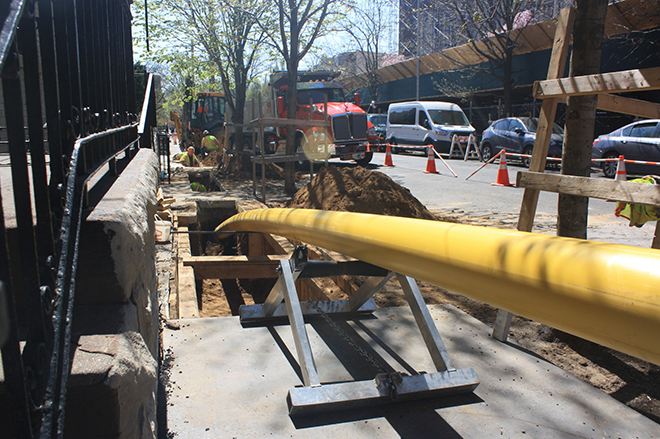
| New gas utility customers will shoulder the full cost of extending infrastructure to their property in a growing number of states that are ending line extension allowances. Source: S&P Global Energy. |
Efforts to roll back a long-standing policy that encourages new natural gas hookups gained momentum in 2025 — and the campaign appears poised to expand in the new year.
Policymakers in several states took action in 2025 toward phasing out gas line extension allowances, following the early example of utility regulators and lawmakers in California, Colorado and the Pacific Northwest. The change makes connecting to the gas grid more expensive by requiring new customers to shoulder the full cost of extending pipelines to their home or business.
By contrast, line extension allowances spread the cost of new utility connections among the existing customer base. The rationale is that revenues from new ratepayers spread the cost of maintaining infrastructure across a larger customer base, lowering the cost per ratepayer.
However, utility commissioners, ratepayer advocates and environmental groups have begun to reconsider the policy in recent years, often on the view that incentivizing gas use does not align with greenhouse gas emission reduction goals.
The change also reflected concerns about rising utility bills, according to Kristin George Bagdanov, senior policy research manager at the Building Decarbonization Coalition. Ending line extension allowances is one area where utility regulators typically have latitude to address the practice of shifting costs from new to existing customers, she said.
"The fact that we saw so much rapid movement after kind of that slow rollout a few years prior from a couple leader states means that tending to that cost shift, tending to that affordability — especially on the gas side — is going to be really important this year and continuing into next year," she told Platts, part of S&P Global Energy.
Future of gas proceedings provide venue
The California Public Utilities Commission was the first regulator to end gas line extension allowances, issuing the 2022 order in its building decarbonization proceeding (R. 19-01-011). Since then, many regulators have considered the change within future of gas proceedings, which aim to align future gas system planning with state climate policy.
In Maryland, the Public Service Commission's decision in June to end line extension allowances actually preceded the official launch of its future of gas proceeding (Case No. 9707). Commissioners concluded that the policy was not compatible with the state's legal requirement to achieve net-zero emissions by 2045.
The Massachusetts Department of Public Utilities released a proposal to end gas line extension allowances in February, after long signaling the change during its future of gas proceeding (Docket 20-80). In August, commissioners issued a final proposal and ordered gas utilities to submit draft changes to their customer tariffs. The parties are still litigating the issue in climate compliance plan proceedings (Dockets 25-40 through 25-45).
The Maine Public Utilities Commission has not yet considered specific changes to gas line extension allowances but will explore the topic in its future of gas proceeding, a spokesperson told Platts. The commission launched the proceeding in May and will hold workshops on individual topics in 2026 (Docket 2025-00145).
The Minnesota Public Utilities Commission sought comments on modifying gas line extension policies in May and took stakeholder feedback through September in its future of gas proceeding (Docket 21-565). However, the commission previously took limited action on revising the policy.
Some regulators make change through rate cases
In recent rate cases, Minnesota gas utilities operated by CenterPoint Energy Inc. and Xcel Energy Inc. agreed to modify their gas main extension allowances. The Minnesota PUC approved the settlements, which reduced the amount of main line that qualifies for free extension. Commissioners resolved to explore additional changes in the future of gas proceeding.
Other utility regulators have taken that approach, phasing out the policy over time.
The Washington Utilities and Transportation Commission (UTC) in 2022 approved settlements in Avista Corp. and Puget Sound Energy Inc. rate cases, which ended their line extension allowances by January 2025. Cascade Natural Gas Corp. will eliminate its allowance by March 1, 2027, under a rate case settlement approved by the UTC in 2024.
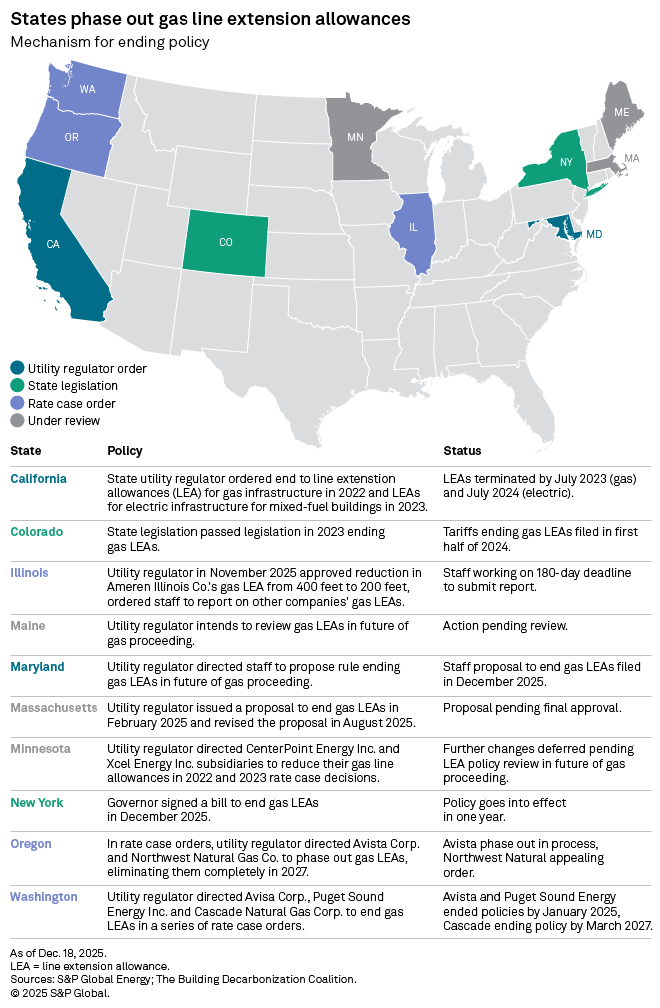
In neighboring Oregon, Avista in 2023 agreed to phase out its allowance by 2027, and the Oregon Public Utility Commission last year directed Northwest Natural Gas Co. to also wind down its residential allowance by November 2027. Cascade, an MDU Resources Group Inc. subsidiary, has proposed changes to its allowance in its current rate case.
Most recently, the Illinois Commerce Commission approved a proposal by Ameren Illinois Co. on Nov. 19 to halve its maximum line extension allowance to 200 feet. Commissioners also directed ICC staff to report on state gas utilities' line extension policies within 180 days. Shortly after, as the ICC began fielding policy suggestions through its future of gas workshops, some stakeholders proposed ending the allowances.
"The energy landscape is rapidly evolving, and the existing line extension policy may no longer provide a balanced benefit to ratepayers in the state," the ICC said in final rate case orders for Ameren and Northern Illinois Gas Co.
Legislation provides another path
Taking a different route, the New York legislature in June voted to end the state's line extension allowance policy, known as the 100-foot rule. In 2024, lawmakers declined to adopt the policy in a larger package of energy reforms, prompting the New York Public Service Commission to propose rule changes to water down the 100-foot policy.
New York Gov. Kathy Hochul, who has faced pressure to scale back building decarbonization policies, signed the bill into law on Dec. 19 amid a slew of end-of-year approvals.
Colorado followed a similar path. Atmos Energy Corp., Black Hills Corp. and Xcel Energy subsidiaries filed tariffs to end their extension allowances between March and May of 2024, responding to 2023 legislation that ended the policy.
Lawmakers in Illinois and Massachusetts have also introduced legislation to end line extension allowances.
Gas utilities push back on policy change
Gas utilities have not simply accepted the changes. NW Natural has appealed the Oregon PUC's order to phase out extension allowances in state court.
In regulatory proceedings, some gas utilities have argued that commissioners have pushed through the policy change without adequate review. Some have warned that ending line extension allowances would actually shift benefits from new customers to existing customers, known as cross-subsidization.
The Massachusetts DPS proposal would "result in cross-subsidization that the existing line extension policy avoids and could have unintended consequences, including increases in housing costs, negative impacts on economic development, and increased greenhouse gas … emissions," subsidiaries of Eversource Energy, National Grid USA, Avangrid Inc., Algonquin Power & Utilities Corp. and Unitil Corp. said in an October filing.