02 Dec, 2025
Egypt launches new mining exploration incentives after forum 'opened our eyes'

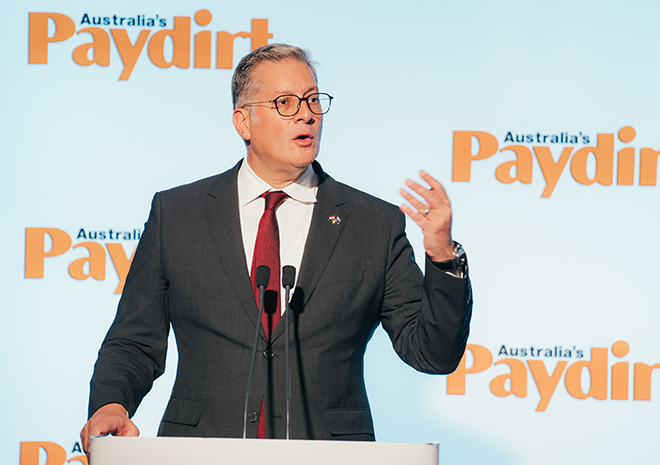
| Karim Badawi, Egypt's minister of petroleum and minerals resources, attends an industry conference in September in Perth, Australia. He returned in late November to reveal new exploration incentives. |
Egypt has launched a new mineral exploration incentive package, Karim Badawi, minister of petroleum and mineral resources, said at a Nov. 28 forum in Perth, Australia.
Egypt is moving to reduce its reliance on oil for domestic wealth and is following Saudi Arabia's lead by assessing and exploring its metal reserves. During September's Africa Down Under conference in Perth, Badawi laid out a government goal to boost mining's GDP contribution to 6% by 2030 from less than 1% currently.
Doug Horak, CEO of Australia-Africa Minerals and Energy Group (AAMEG), a trade group representing companies exploring for resources in Africa, told Platts that his group led a delegation of consultants and mining executives who met Badawi and other ministry officials in Cairo on Oct. 22 to discuss what industry needed. Platts is part of S&P Global Energy.
Badawi's ministry signed agreements with Barrick Mining Corp. and AngloGold Ashanti PLC in July that were considered a model for future investment in Egypt. However, Badawi said his government still required "a shift in the mindset of traditional legacy oil and gas in terms of exploration" toward "understanding what is a junior company" in the mining context.
In understanding the structure and financial capabilities of mineral explorers, "we realized that we had to do something around incentives for junior companies to make it easier for [them] to be able to strive" for success and thus attract others to Egypt, Badawi told the Nov. 28 Perth forum.
"This is where I'm very, very appreciative of the Africa Down Under conference because it really opened our eyes," Badawi said.
Into the 21st century
"The major challenge Egypt has is that it hasn't really been open to [mineral] exploration in the past," Sherif Andrawes, global natural resources and energy leader for tax adviser BDO Australia who attended the Cairo briefings, told Platts. "Egypt is very much oil and gas [focused] where the majors do the exploration and find, build and operate the assets, and only when [the project] gets smaller do the juniors come in."
"We explained [in Cairo] that in mining, juniors tend to do the exploration. They'll find the ground ... then at some point sell on or get taken over by the majors who then operate assets. Then that flip [in Egyptian officials' understanding] was sudden, like the light bulb went on," Andrawes added.
 |
| Doug Horak, CEO of AAMEG. and Energy Group. |
While Egypt's officials did not adopt everything industry suggested during the Cairo briefing, there are a number of "dramatic changes" to the regulations the ministry had originally drafted, AAMEG's Horak said.
"We think this brings it into a 21st century because companies want to know that they have secure tenure," Howard Golden, a nonexecutive director of Marvel Gold Ltd., told Platts of the new incentives. The company is now considering applying for a gold exploration block in Egypt, Golden said.
Gold projects will be required to contribute a minimum 15% of net taxable income to the government once in production, plus royalties for training and community development, according to Badawi's presentation.
For the mining sector more broadly, Egypt has reduced exploration rental fees from $100 per square kilometer to $40/sq km. A newly created Mineral Resources and Mining Industries Authority (MRMIA), which Badawi described as a "one stop shop" agency, will handle environmental permits, security clearances, expat approvals and export procedures.
Long-term tenure
The country will offer a 30-year exploitation agreement for mining, with all mining operations including exploration, development, logistics, production and processing exempt from value-added tax (VAT), customs duties, taxes and import-related fees. All assets, equipment and infrastructure will remain the miners' property for the full concession period.
Under the exploitation agreement, all entitlements remain valid and unchanged for the 30-year term regardless of any new laws or regulations issued later. The government will also provide a security regiment for exploration and production sites.
Exploration blocks are also available year-round with no need for bid rounds previously used for Egypt's oil and gas sector, while the mandatory relinquishment of blocks seen in the previous version of the reforms has also been removed, so long as technical and financial commitments have been fulfilled.
"The only time there's going to be any delay on being issued an exploration license is if there's someone else also interested, but if you're the only person on that block you'll get that within a month," Horak told Platts.
Egypt is also undertaking a nationwide airborne geophysical survey with high-resolution magnetic radiometric and gravity data across the Eastern Desert. A new, simplified nine-month reconnaissance license allows companies to evaluate targets before committing to full exploration.
Badawi and geologist Yasser Ramadan, chairman of the MRMIA, met executives from over a dozen Australian miners while in Perth in November, "reaffirming Egypt's commitment to reducing investment risks for junior and mid-tier mining companies," according to a Nov. 29 ministry post on LinkedIn.
The Egyptian officials also met four Australian mining-focused corporate advisories while in Perth, according to Horak.