


08 Dec, 2025
Coal plant retirements slow as demand, policy boost near-term prospects
Efforts by the Trump administration to provide a lifeline for coal-fired power plants and coal producers, coupled with surging electricity demand, may be providing a short-term uplift for the fuel.
Despite an expected surge
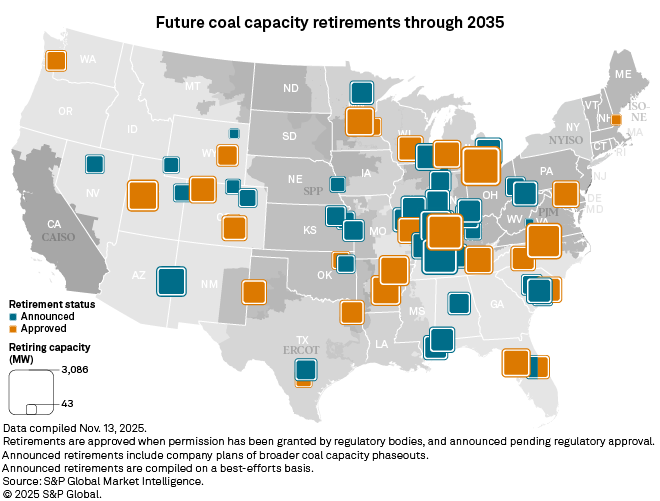
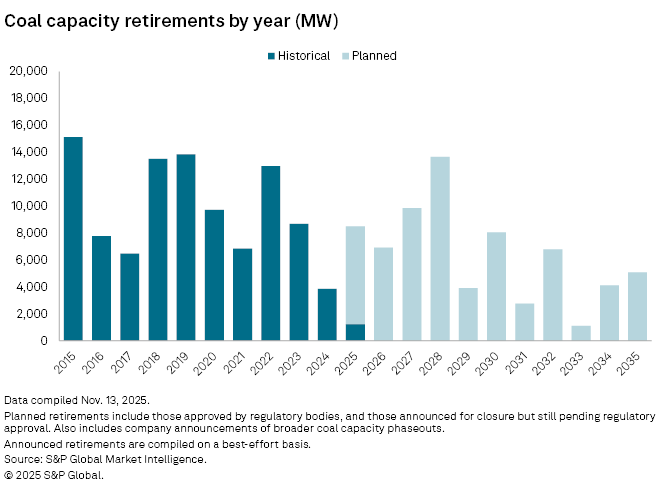
Data from earlier this year predicted companies would retire nearly 14 GW of coal capacity in 2025, but the most recent analysis shows this number falling to about 8.5 GW. This number will drop even further after a Nov. 18 federal order requiring CMS Energy Corp. subsidiary Consumers Energy Co. to continue operating its 1,410-MW coal-fired J.H. Campbell plant at least into early 2026.
The slowdown in retirements and delays to planned closures come as President Donald Trump implements policies to revive the sector. The president declared a national energy emergency in one of his first official actions after being sworn in in January, citing a "precariously inadequate and intermittent energy supply and an increasingly unreliable grid."
Increased demand from data centers for electricity also creates more opportunities for coal-produced power.
"The numbers track with what we're seeing, sort of an incremental back down of retirement plans that reflect a more supportive environment for coal," Steve Piper, director of North America power and renewables research with S&P Global Energy CERA, said in a Dec. 1 interview with Platts, part of S&P Global Energy.
Delaying the inevitable?
While coal plant retirements are still increasing, Piper said models showing retirements plateauing are a sign that coal may be needed to meet short-term energy needs.
"There's still kind of a secular decline in steam coal in our outlook, but the floor is a little bit higher now than it used to be," Piper said.
This near-term boost, however, may not be enough to stop the trend of declining capacity.
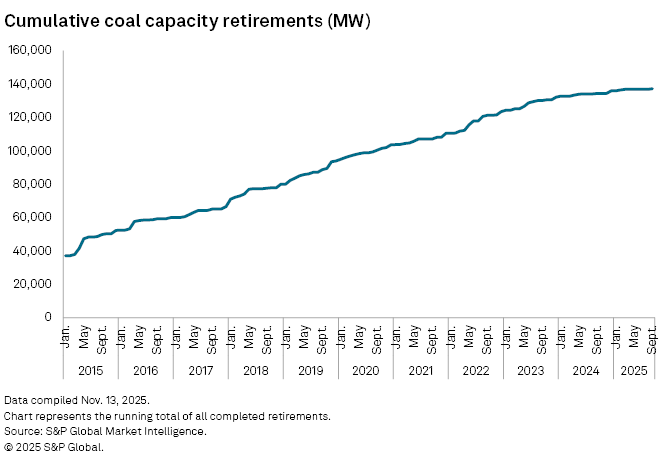
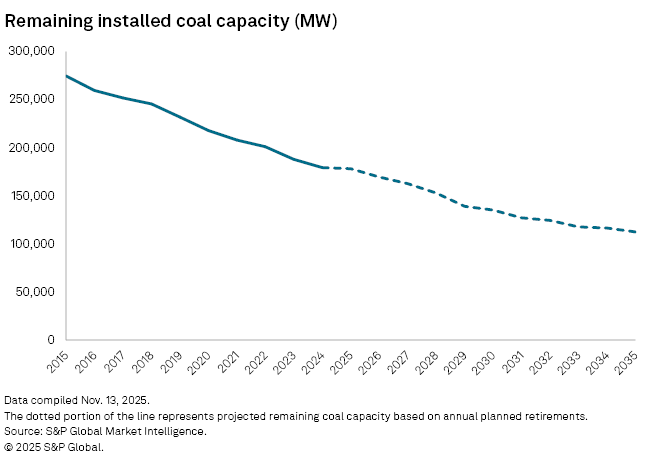
At the beginning of 2015, the US had about 275 GW of coal-fired capacity online, the analysis shows. This number is expected to decline to about 112 GW by 2035.
Accounting only for power plants with announced retirement dates, 64.2% of the coal-fired generation that existed prior to 2015 will be offline by 2035.
Coal plant retirements are expected to reach a peak in 2028, with 13.7 GW coming offline that year, according to Market Intelligence data. Earlier this year, that number was closer to 18 GW.
Piper said a combination of a supportive federal policy environment and lengthening timelines to deploy new gas-fired resources contribute to the increased amount of coal capacity remaining online.
Operators of dozens of coal plants have delayed planned closures to meet electricity demand. Colorado regulators on Dec. 3 allowed Xcel Energy Inc. to delay the planned retirement of unit 2 of its Comanche plant to maintain reliable service while the companion Comanche 3 unit is out of service. The Colorado Public Utilities Commission said allowing Comanche 2 to operate an additional year, through the end of 2026, would be more cost-effective than depending on spot market purchases while Comanche 3, which has been out of service since August, undergoes repairs that are expected to take until June 2026.
'Significant shift'
Increased demand for electricity from data centers is giving a lift to coal-fired resources, according to coal sector stakeholders.
"The energy challenge that is at our door thanks to AI and data center-driven demand requires the unassailable reliability offered by coal," the National Mining Association (NMA), a trade group representing the mining industry, said in a statement to Platts.
Data center power demand in the US is expected to rise 22% by the end of this year compared to the end of 2024, before nearly tripling in 2030, according to the latest forecast from 451 Research, part of S&P Global Market Intelligence.
Power provided to hyperscale, leased and crypto-mining data centers will rise to 61.8 GW in 2025, an increase of 11.3 GW, 451 Research said in its Datacenter Services & Infrastructure Market Monitor & Forecast, released in September.
US data center power demand will further rise to 75.8 GW in 2026, 108 GW in 2028 and 134.4 GW in 2030, according to the outlook.
The capacity factor for coal-fired plants, a measure of how frequently the units are run, has jumped with the increased power demand and rising natural gas prices, the NMA said, adding that it expects the importance of the coal fleet to continue to grow and that more retirement delays are expected.
Spot natural gas prices at the Henry Hub averaged about $3.47/MMBtu for the year through September, more than a dollar higher than the same nine-month period in 2024, according to data from Platts. That lifted coal's share of average monthly power generation to its highest level in three years and led to the share of gas declining 3% year over year. Monthly gas contracts for the winter months were running above $4/MMBtu.
Pennsylvania-based miner Core Natural Resources Inc. reported on its third-quarter earnings call that power demand remained robust through September, attributing the increase to data centers.
"This data center demand boom has caused many electric utilities to look at their long-term lower capacities, which has driven a significant shift in how they think about contracting future energy supply," Core CFO and President Miteshkumar Thakkar said during the call, held Nov. 6. "We have seen a noticeable shift to longer-term deals for our thermal products."
While there are no new coal-fired power plants planned in the US, existing coal capacity remains available and will be used to meet demand even as the generation declines, Tanya Peevey, a senior principal analyst with S&P Global Energy, told Platts.
"They're not going to run as often, but they're still, for reliability reasons, needed," Peevey said.
But economics are still drivers for the trends, she said, adding, "It would be hard for policy to de-risk the uncertainty and the demand growth."
Back orders for gas
Another factor keeping coal around a bit longer is "the lengthening timelines to deploy new gas [capacity]," Piper said, pointing to a backlog of gas turbine orders and an escalation in costs for baseload combined-cycle facilities that compete with coal-fired generation.
"It's taking longer than people expected to deploy these against the expected growth in data center demand," Piper said. "The very logical response to this is to delay turning down what you plan to turn down to keep those megawatts on the ground while you're working through the process of getting your new generation deployed."
Turbine-maker GE Vernova Inc. said in July that it had orders for delivery out to 2031 and slot reservation agreements for 55 GW. Manufacturer Siemens Energy AG said in November that its typical delivery period is four years.
The US government is also keeping some coal-fired resources available. The J.H. Campbell plant in Michigan was scheduled to shut down May 31, but US Energy Secretary Chris Wright on May 23 issued an emergency order under Section 202(c) of the Federal Power Act to keep the plant running another 90 days. Wright said the plant was needed to provide stability to the Midcontinent ISO market and prevent outages during the hot summer months.
The order has been extended twice already, with more extensions expected.
"I think where the DOE sees opportunity to issue orders for old plants in critical areas, they're going to do it," Piper said.
Transition continues
While the data center demand and supply chain issues can be beneficial for coal, investor-owned utilities are still moving forward with energy transition strategies that call for phasing out the resource.
NiSource Inc. still plans to shut down its 722-MW coal-fired R.M. Schahfer plant at the end of this year, followed by the retirement of the 455-MW Michigan City plant by the end of 2028. Both are in Indiana.
"That is still the plan online for us, and that is still the plan we're actioning," NiSource Executive Vice President and CFO Shawn Anderson said in a Nov. 21 interview with Platts. "That's why we've invested greatly in renewable assets over the last few years to ensure that we have adequate power available and capacity for our region when these retirements then next advance."
"With that said, we've obviously watched the change in the policy landscape since we started this transition back in 2018," Anderson said. "Certainly, that policy landscape has, at least in Michigan in certain situations, extended the utilization of some of these coal assets."
NiSource has taken steps to understand and prepare for receiving similar orders from an operational standpoint but has not received any sort of notification yet, the CFO said.
"We're being thoughtful and diligent, and responsive. And obviously, we'll do what's lawfully required of us," Anderson said.