


04 Nov, 2025
Trump tariffs add momentum to US metals, mining investments
By Rachel Looker and Fernanda Pintle
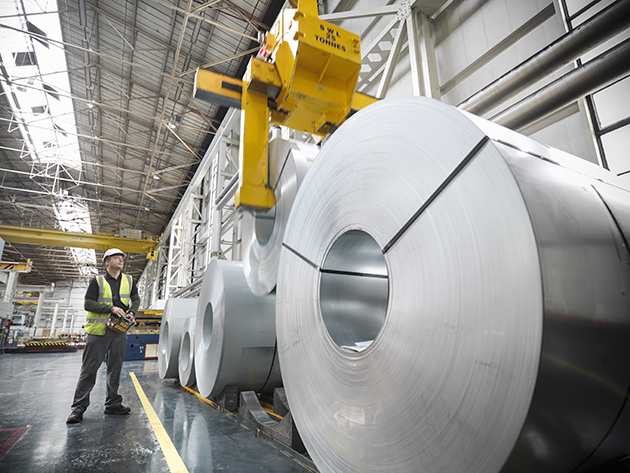
| US President Donald Trump's tariffs have amplified metals and mining companies' investments in the US. |
This is the second in a three-part series examining how US tariffs have affected economies and reshaped trade relationships. Click here to read part one of the series and click here to read part three.
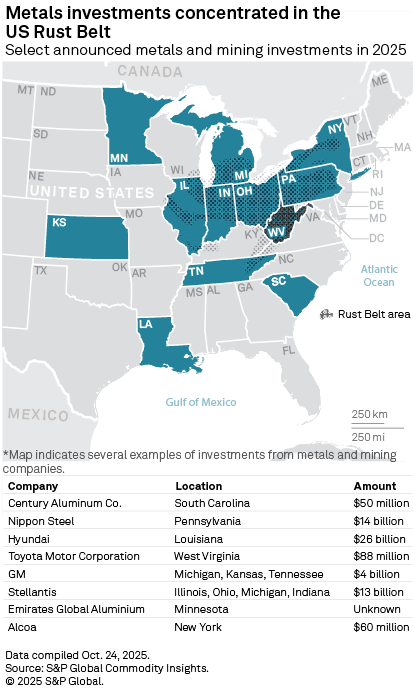
Metals and mining companies, as well as automakers, have announced nearly $57.2 billion in investments in the wake of US President Donald Trump's sweeping tariffs in 2025.
The tariffs, in conjunction with changes to the US tax code, have provided a strong government signal that is fueling a more favorable investment environment for metals companies and carmakers, metals experts and companies told Platts, part of S&P Global Commodity Insights.
Some companies are expanding US operations and relocating investments from overseas, while others report difficulty planning long-term investments due to changing trade policies.
"When we think about US investment and companies' decisions to place manufacturing, it really is a dynamic choice, and it's a long-term choice," Eric Oak, a senior supply chain intelligence analyst with S&P Global Market Intelligence, told Platts. "Right now, what we're seeing is companies taking tactical actions to reduce the impact of duties on their bottom line."
During Trump's current term, he has doubled steel and aluminum tariffs from 25% to 50% and added a 50% tariff on copper imports and a 25% tariff on cars and automobile parts. Trump also imposed country-specific tariffs on dozens of US trading partners, though the executive orders exempted most metals and critical minerals.
Tariff impacts amplified
Trump implemented steel and aluminum tariffs during his first term in 2018, citing national security concerns and the need to reduce reliance on imported metals. Former President Joe Biden preserved the 25% tariff on steel and 10% tariff on aluminum.
"Having a clear policy signal from the government that they're not going to allow the flood of global overcapacity to come washing in and undermine investments in the US has created a much more positive investment environment that's encouraged lots of folks to invest in steel production in the US," Kevin Dempsey, president and CEO of the American Iron and Steel Institute trade association, told Platts.
The 2018 tariffs, which Trump strengthened earlier in 2025 by eliminating exemptions in March, help bolster investments alongside the 50% tariffs imposed in June, Dempsey said.
Automotive companies, facing reduced profit margins due to tariffs and supply disruptions, have increased US-based investments in the wake of the aluminum and steel tariffs and a 25% car parts duty. The companies have been working to onshore supply chains to lower tariff costs.
General Motors Co., Hyundai Motor Co. and Stellantis NV have all announced billion-dollar investments in US steel mills and plants.
Toyota Motor Corp. is investing $88 million in West Virginia to establish a new line of hybrid transaxles, a component commonly used for front-wheel-drive vehicles. And Volvo Car AB (publ.) moved the production of one of its models from Sweden to a plant in South Carolina, executives said on a July 17 earnings call.
Automakers respond quickly when identifying trends and finding ways to optimize supply chains, Oak said. "If they decide to invest in the US, that's generally a sign that they feel that their cost structures are changing and they want to kind of make those long-term moves."
Taxes boost tariff impact
While tariffs represent "a major factor in promoting investment," Dempsey also pointed to tax legislation that Trump signed in July that restores a provision from the 2017 Tax Cuts and Jobs Act allowing companies to fully expense the cost of equipment purchases.
"I think the tax law combined with the strong tariff policies will encourage additional, significant investment in the steel industry in the US," Dempsey said.
US policy appears to have influenced some mining companies' investment decisions. Century Aluminum Co. is spending millions to restart and expand a South Carolina smelter, while copper producer Grupo México SAB de CV outlined up to $6.2 billion in potential US-based investments to increase production in Arizona and Texas.
These projects "align with the new mining and industrial policies of President's Trump's administration," Grupo Mexico said in a July 28 quarterly report. The company did not respond to a request for comment.
Companies that want to be resilient to external factors — whether natural or political — need to spend more money to restructure and diversify supply chains, Oak said. Recent tariffs have only accelerated these trends.
"The decision to reshore either in the US or somewhere else really comes down to the company's individual characteristics, up to cost structure," Oak said, adding that "money and resilience" are consideration.
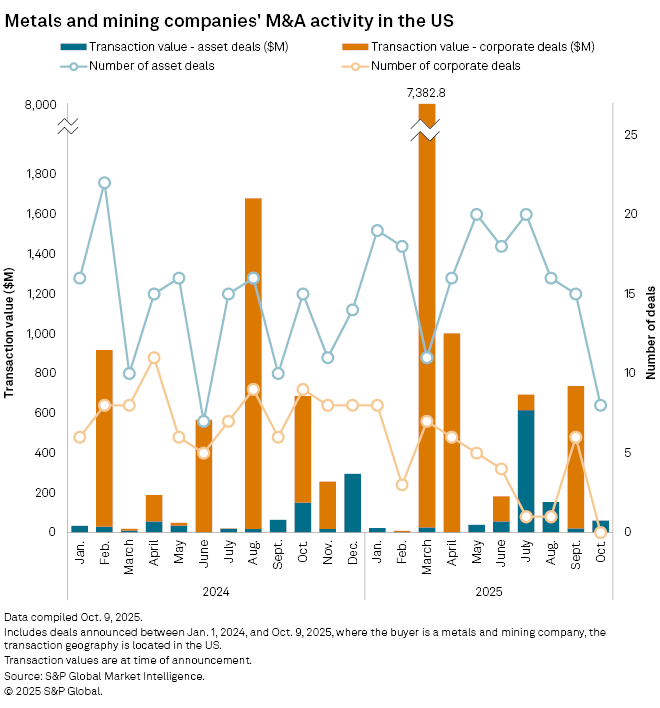
Though metals and carmakers have enjoyed a burst of investment announcements, gold has driven most US M&A activity as the precious metal has set multiple price records over the course of 2025.
Companies reassess plans
Trump's shifting trade policies have left some companies uncertain about what to do.
The zigzagging announcements have declared country-specific tariffs on almost all US trading partners, going on to delay implementation dates before reversing tariff deadlines or even rescinding tariff plans.
The uncertainty raises questions over the permanency of the new trade environment, said Tom Brady, a professor at the Colorado School of Mines' Division of Economics and Business.
"In what's traditionally called AAA-rated countries ... you really didn't have this kind of uncertainty in the past," Brady said. "Under all that was free trade, open markets, and it's just a radically different environment."
Some companies have been reconsidering investment decisions, some of which might have benefited the US.
Gerdau SA, Brazil's largest steelmaker, canceled an investment in the range of $500 million to $600 million for a special steels plant in Mexico that would have supplied the North American auto market.
"This has been officially canceled in terms of our possible investments in the coming years, not due to the current administration in the US but mostly due to everything we have experienced in terms of this global defense," CEO Gustavo Werneck Da Cunha said on an April 29 earnings call.
Werneck Da Cunha pointed to "a very deep reconfiguration of the automotive platform in the next few years" and questioned whether Mexico would remain a top supplier of auto parts to the US, given the tariffs.
The tariffs hit hard for Canadian steelmaker Algoma Steel Group Inc., making the operation of its blast furnace and coke ovens unsustainable, the company said.
"The ongoing imposition of a 50% tariff on Canadian steel has closed the US market to Canadian steelmakers," CEO Michael Garcia said in a Sept. 29 news release.
The US Supreme Court will hear arguments Nov. 5 about whether the International Emergency Economic Powers Act provides sufficient authority for Trump's country-specific tariffs. However, most of the metals tariffs were imposed under a different law that was upheld by US courts during Trump's first term.
"Supply chain decision-makers will get a degree of clarity in the policy outlook during the fourth quarter, though tariffs will remain volatile through 2026," Market Intelligence analysts said in an Oct. 10 report.