03 Nov, 2025
Manganese producers see stability amid tight market during Q3 2025

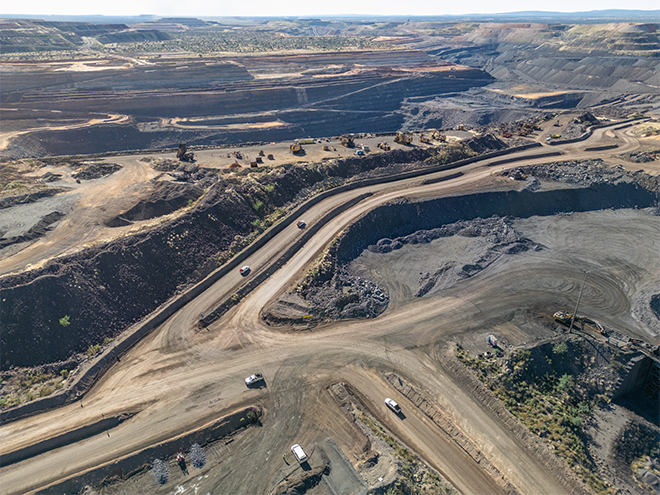
| Haul roads and stockpile at the Tshipi manganese project in South Africa, and the mine pit in the background. |
The world's top manganese producers saw a stable but tight market in the third quarter after the return of a major supplier in May, but planned expansions could put pressure on recovering prices.
South32 Ltd., the world's largest manganese producer in 2024 according to S&P Global Market Intelligence data, resumed export sales in May at its 60%-owned Groote Eylandt Mining Co. Pty Ltd. (GEMCO) unit in Australia's Northern Territory. GEMCO was suspended in March 2024 due to significant cyclone damage. Manganese is a key ingredient in the production of stainless steel.
 |
| Brad Rogers, CEO and |
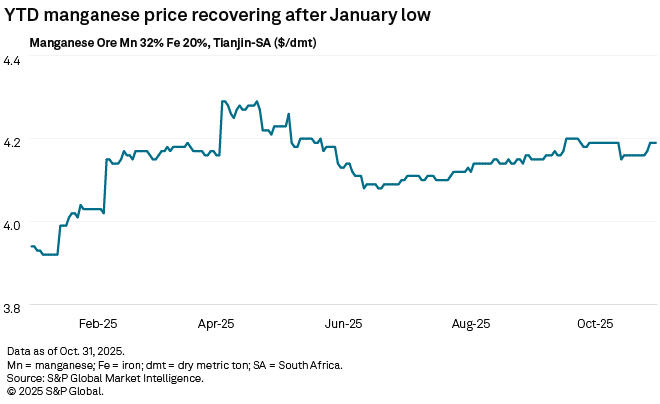
The manganese price was up 6% year-to-date at $4.18 per dry metric ton unit on Oct. 31, compared to $4.11/dmtu a year prior, according to Market Intelligence.
"Through this [September] quarter we saw a slight strengthening in manganese prices and pretty good downstream demand from a manganese alloy perspective," Brad Rogers, managing director and CEO of Jupiter Mines Ltd., said during an Oct. 31 earnings call.
"Relatively strong supply, including GEMCO reentering the market and good volumes out of South Africa, were consumed by the market, and prices reflect that," Rogers said. "So we're in a stable market right now. Prices have been range trading within a relatively narrow range for the last few months."
On the day of the call, manganese prices were "sitting just above four-year average levels," Rogers said.
Tight surplus
"The global [manganese] ore supply/demand balance remained in slight surplus" during the period, Eramet SA's Oct. 30 quarterly report said.
Chinese port ore inventories stood at 4.6 million metric tons by the end of September versus 4.5 MMt at the end of June, "equivalent to around eight weeks of consumption," according to Eramet.
Global manganese ore production fell 1% year-on-year to 5.3 MMt for the quarter as output from South Africa — which still accounts for nearly half of seaborne production — dropped 2% but "remains at a high level," Eramet said.
In Gabon — which in June banned crude manganese exports starting Jan. 1, 2029 — production fell 29% during the September quarter. This reflects "the decline in volumes at Comilog [in France] and other producers," while Australian volumes normalized after GEMCO resumed exports, Eramet said.
Overall, global manganese ore consumption rose 8% year on year to 5.2 MMt for the quarter amid "sustained manganese alloys production, particularly in China. This has led to an increase in manganese alloy inventories among Chinese producers since the beginning of the year, in a local context of flat to slightly declining steel production," Eramet said.
Production of carbon steel, manganese's main end-product, was 454 MMt for the quarter globally, which was "relatively stable" from a year prior, Eramet said.
"Chinese production, which still accounts for more than half of global steel output, was stable compared to a particularly low Q3 2024 performance," while India's production rose 12% and North America's was up 4%, the latter of which Eramet attributed to "trade measures."
However, steel production fell 6% in Europe which is "faced with steadily declining demand and sustained pressure from imports," Eramet said.
Price warning
Ricardo Jose, COO-Australia of Consolidated Minerals Ltd., also said the market has stabilized but warned that it may not stay that way for long given his company's plans to expand in coming years, along with others in the market.
Jose pointed to the potential for Eramet to increase production from Comilog "if they manage to unlock their logistics capacity," while Consolidated Minerals will lift production from Woodie Woodie in Western Australia from 1.3 MMt in 2024 to 1.5 MMt in 2025.
Jose said Consolidated Minerals plans to boost output to 1.8 MMt in 2026. Then, through the development of two additional Pilbara mines in Balfour South and Utah, production is set to reach 5 MMt by 2030, to meet demand from parent company Ningxia Tianyuan Manganese Industry Co. Ltd. (TMI).
Manganese production in Ghana, where TMI also operates the Nsuta mine, is expected to rise 60% from 2024 to 8 MMt in 2025, the Ghana Chamber of Mines confirmed in June.
This planned growth in production by Consolidated Minerals and others "can only lead to an oversupply, leading to a reduction in price, and somebody will have to drop off or revise their cost structures," Jose said.
"Demand of manganese in the battery market and clean energy markets has not translated into a price increase ... [but] there's likely to be an increase in steel requirements from China and from Central Europe with the race towards producing more weapons, unfortunately," Jose told Platts, part of S&P Global Commodity Insights.