


10 Oct, 2025
Rising sovereign yields strain debt sustainability in Europe, Japan

By Nick Lazzaro

|
Sebastien Lecornu announces his resignation as France's prime minister on Oct. 6, 2025, less than one month after assuming the role from Francois Bayrou, who also resigned following a failed budget proposal and a lost vote of confidence among the country's government. France is facing political instability while trying to establish new leadership and tackle debt challenges, similar to other governments in Europe and Japan facing rising debt risks. |
Governments in Europe and Japan with high debt levels face rising risks to debt sustainability as sovereign bond yields rise.
Yields on 30-year sovereign bonds in Japan and major European countries climbed by more than 100 basis points in the three years to early October, according to S&P Global Market Intelligence data. Similarly, the yield on 30-year US Treasurys was up by 93 bps.
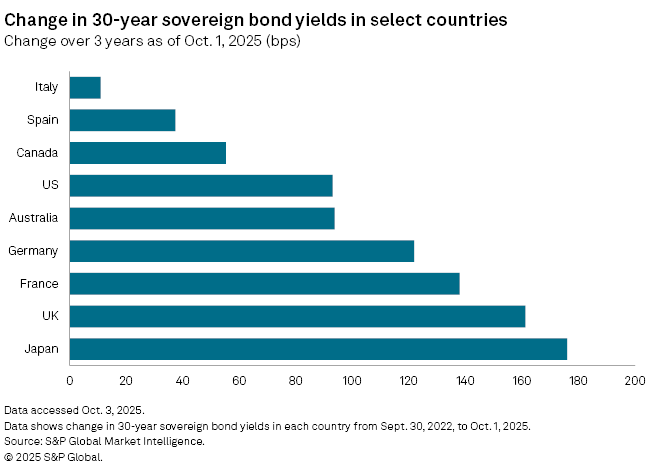
Global economies are adjusting following the distortions caused by the COVID-19 pandemic in 2020 and 2021. The pandemic led to a surge in government borrowing at ultralow interest rates to support stimulus spending. Elevated spending and borrowing persist as interest rates have since rebounded and remain elevated, increasing debt payments and straining government budgets.
"The greatest risks fall on economies with high public debt where rising long yields quickly inflate interest bills and narrow fiscal space," Tomas Williams, associate professor of economics and international affairs and director of the Center for Economic Research at George Washington University, told Market Intelligence. "The danger is amplified if investors already question debt sustainability or if fiscal policy credibility is weak."
Global debt reached a record $338 trillion in the first half of 2025, according to the Institute of International Finance.
The underlying risks stemming from debt sustainability concerns have prompted investors to demand a higher yield premium for longer-dated bonds, a dynamic that maintains upward pressure on interest rates and government debt payments.
Debt, GDP metrics
In many countries, government debt has outpaced economic growth and represents an increasing share of national GDP, highlighting the strain that debt can place on national economies.
When considering debt as a percentage of GDP, debt sustainability appears particularly vulnerable in the US, France, Japan and the UK, Niladri Mukherjee, chief investment officer at TIAA Wealth Management, told Market Intelligence. The debt-to-GDP percentage in each of these markets rose by more than 10 percentage points from 2018 to 2024.
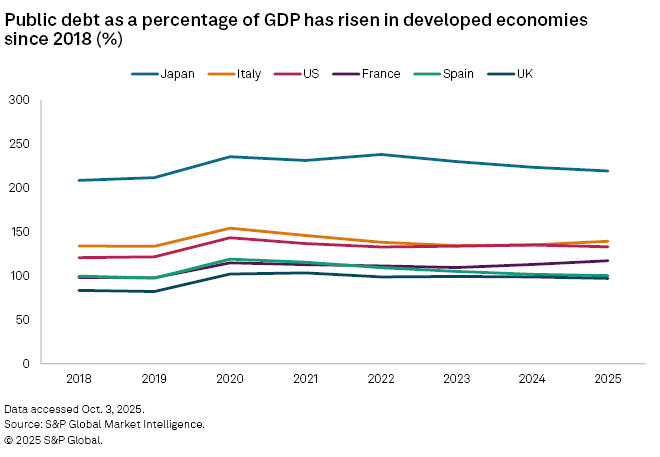
The difference between nominal GDP growth rates and bond yields is another key driver of fiscal sustainability.
"When the average yield on total government debt rises above the trend rate of economic growth, risks of a debt spiral increase," Mukherjee said. "From this standpoint, France and the UK appear more vulnerable than the US."
Political risk
Political instability has emerged as a key risk driver for rising sovereign bond yields in Japan and France. Both countries are facing leadership changes that could cloud policy outlook and fiscal spending plans.
"Investors are increasingly demanding higher term premiums to hold long-dated government debt in jurisdictions where political uncertainty threatens to derail fiscal discipline and economic stability," said Kristian Kerr, head of macro strategy for LPL Financial, in a September commentary.
Japan's Prime Minister Shigeru Ishiba resigned in early September, prompting the Liberal Democratic Party to begin the process of electing a new leader, securing majority approvals and forming new coalitions. Failure to form a stable government could increase political uncertainty and undermine investor confidence in Japanese government bonds, Kerr said. Sanae Takaichi is set to be sworn in as prime minister.
Japan's debt has eased since peaking in 2022 but still represented 238.3% of GDP in 2024, the highest among developed economies, according to Harumi Taguchi, principal economist at Market Intelligence. An incoming coalition government under Takaichi will likely face pressure to incorporate opposition proposals into legislation, potentially undermining fiscal discipline, Taguchi said.
"In addition, the election of Takaichi as leader of the ruling Liberal Democratic Party has raised concerns about rising debt risks, as Takaichi's economic policy is likely to focus on fiscal expansion," Taguchi said in an email. "Her key policies include increasing basic income tax deductions combined with refundable tax credits and the abolition of provisional taxes on gasoline to lower household costs."
Similarly, France has experienced increasing political strain since September, when then-Prime Minister Francois Bayrou lost a confidence vote and resigned after an austerity budget did not gain sufficient support from the country's National Assembly. His successor, Sebastien Lecornu, also resigned Oct. 6, less than a month after taking office.
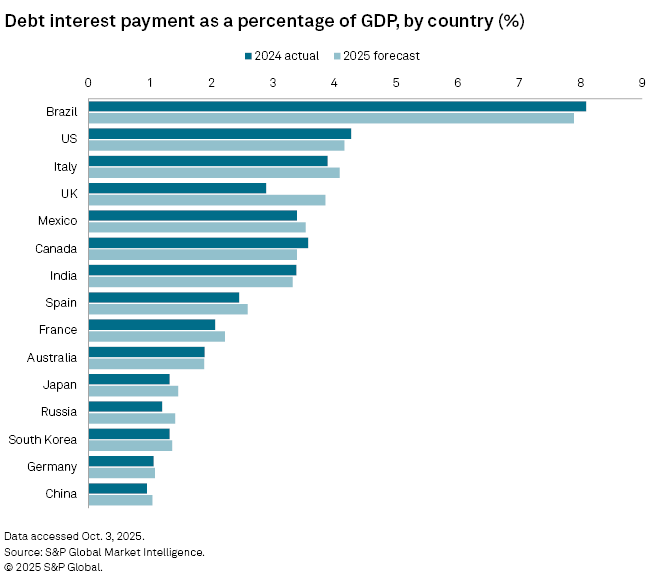
France has a debt burden of over €3 trillion and rising debt interest costs. The country's interest payments are projected to reach 2.22% of GDP in 2025, up from 2.06% in 2024, according to Market Intelligence data.
"Should markets begin to perceive that political dysfunction is impeding necessary reforms, the risk of a sovereign credit rating downgrade becomes very real, potentially exacerbating the sell-off in French government bonds," Kerr said.