01 Oct, 2025
Low prices hit Queensland met coal miners as costs level out
By Anthony Barich and Susan Dlin
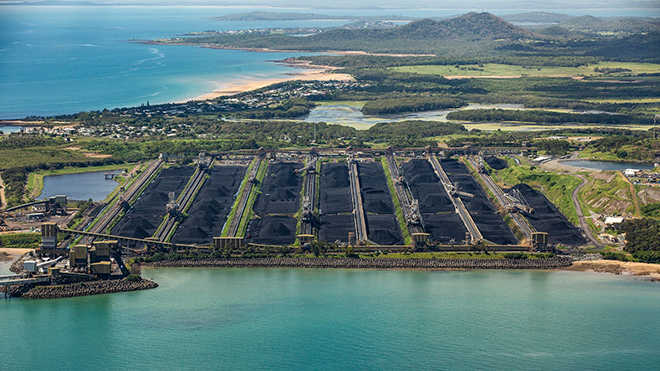
| The Dalrymple Bay Coal Terminal in Queensland, Australia. The state is the world's biggest exporter of met coal but its producers are struggling due to low prices as well as increased costs and royalties. |
Low prices appear to be a primary cause of metallurgical coal mines closing in Queensland, Australia, as costs have remained relatively flat since state royalties increased in 2022, according to an analysis of S&P Global Market Intelligence data.
BHP Group Ltd., Anglo American PLC and QCoal Pty Ltd. all announced job cuts at their respective Queensland metallurgical coal businesses in September. QCoal plans to shutter one of two underground units at the Cook Colliery, and BHP will close the Saraji South mine. All three companies cited high production costs and low coal prices, and BHP and QCoal both lamented Queensland's burdensome royalty regime.
Queensland, which is largely responsible for Australia's standing as the world's biggest exporter of met coal, hiked coal royalties in mid-2022.
Platts assessed the Premium Hard Coking Coal FOB Australia price at $190.20 per metric ton on Sept. 30, decreasing from $204.75/t a year prior and still well down from a multiyear high of $670/t in March 2022.
Market Intelligence data shows Queensland coal miners' consolidated total FOB cash costs spiked from $105.61 per wet metric ton in 2021 to $138.38/wmt in 2023. Costs are expected to level out at about $118/wmt through 2029 after falling to $126.11/wmt in 2024.
Labor, energy and other on-site and off-site costs all rose from 2021 to 2024. These metrics are all expected to contract by 2029 except off-site costs, which are forecast to edge up.
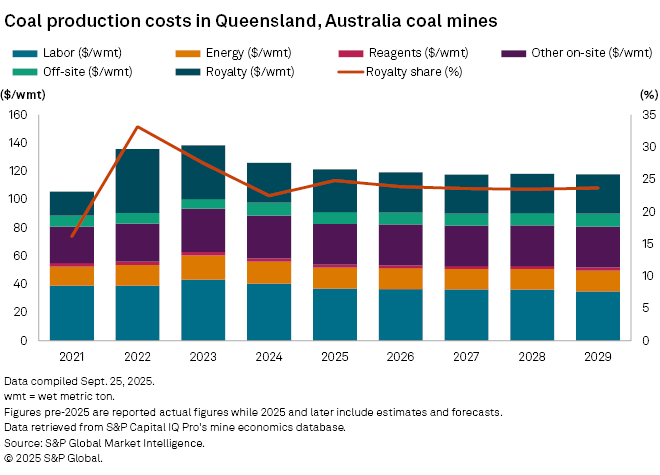
Royalties accounted for 16.2% of Queensland miners' costs in 2021, doubling to a 33.2% share of costs in 2022 before falling to 22.5% in 2024. Royalties' share of costs is forecast to level out after rising to 24.8% in 2025. Meanwhile, royalty costs soared from $17.06/wmt in 2021 to $45.03/wmt in 2022, and are also expected to level off around the $28/wmt level after reaching $30.15/wmt in 2025.
Consolidated production from Queensland coal miners totaled 145.3 million wmt in 2024, decreasing alongside prices from 169.1 million wmt in 2021. Output is expected to recover to 163.6 million wmt in 2029.
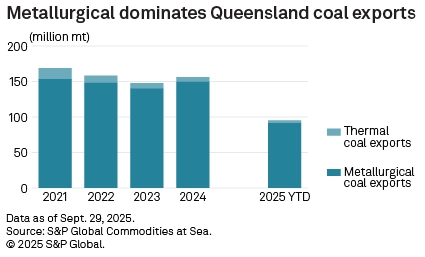
The Market Intelligence data covers both thermal and met coal production, and the latter accounts for the vast majority of the state's coal exports, according to S&P Global Commodities at Sea data.
Consistent warnings
Industry group Coal Australia has "consistently warned of job and investment losses as a result of Queensland's unsustainable royalties regime," CEO Stuart Bocking told Platts, part of S&P Global Commodity Insights. "This has seen some coal miners paying tens of millions of dollars to the government, despite never having made a profit."
"The combination of lower coal prices, surging production costs, and the world's most punitive coal royalties regime has created a dire conjunction of circumstances for Queensland miner," Bocking said. "Over the past three years, coal unit costs for steelmaking coal production have increased by an average 47%, while for thermal coal producers, costs are up by 50%."
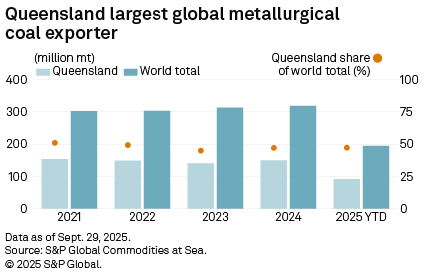
Coal Australia's warning comes as Queensland's share of global met coal exports has also decreased, from 50.9% in 2021 to 47.0% in 2024, according to Commodities at Sea data. The state's share of global met coal exports accounts for 47.1% year-to-date as of Sept. 28.
Queensland met coal exports decreased from 153.5 MMt in 2021 to 149.6 MMt in 2024, while global exports increased from 301.7 MMt to 318.4 MMt.
Other factors at play
However, the Institute for Energy Economics and Financial Analysis (IEEFA) believes royalties are not necessarily "sending coal miners broke" in Queensland.
"The margins of major coal companies remain strong by historical coal mining standards," IEEFA, a US-based nonprofit, said in a Sept. 24 report. Miners reported margins in the range of 15% to 25% for the six-month period ended June 30.
Higher royalty rates have contributed to Queensland met coal miners' unit costs increasing by up to 50% from 2018 to 2025, IEEFA said. However, contractor labor costs, rising strip ratios and costs incurred for coal mine emissions under the federal government's Safeguard Mechanism are other factors that are starting to have an impact.
It was "no surprise" that the Cook Colliery and Saraji South operations went under, given both were previously mothballed, according to the IEEFA report. The Bluff, Millennium and Wilkie Creek met and thermal coal mines were also closed again in fiscal 2024 after being restarted.
The Bluff mine is owned by Bowen Coking Coal Ltd., which appointed voluntary administrators in late July. The company cited "the current challenging environment for the coal industry in Queensland from higher costs, lower global coal prices and higher royalty rates."
However, coal miners' profit margins have been pressured by stubbornly high costs for some time. Unit costs remain high while prices have returned to historical levels, IEEFA said.
The Queensland Resources Council and miners met with Queensland Premier David Crisafulli on Sept. 26, but details were not provided.
Janette Hewson, CEO of the Queensland Resources Council, confirmed the meeting to Platts but did not elaborate on what was discussed beyond "industry issues." The government did not immediately respond to requests for comment.