


07 Oct, 2025
IEA cuts 2030 renewables forecast by 5% on US, China policy changes

|
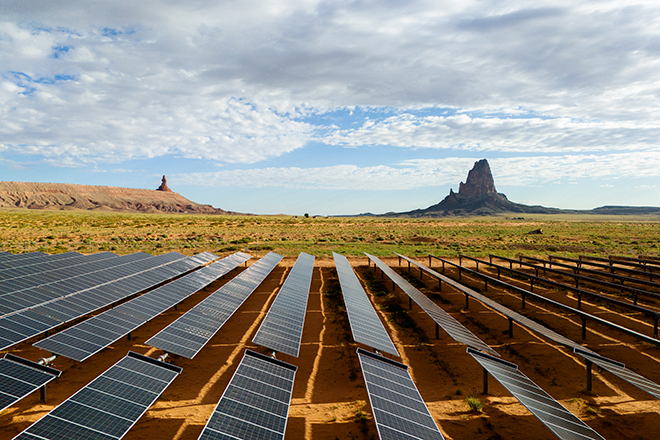
A solar farm in Arizona. The IEA downgraded its forecast for renewable energy growth in the US by almost 50% after a series of policy reversals by the Trump administration. |
The International Energy Agency on Oct. 7 downgraded its six-year forecast for global renewable energy installations by 5% due to the Trump administration's sweeping rollback of pro-wind and solar policies in the US and the effect of policy changes in China.
The organization now sees 4,600 GW of new renewables installations between this year and 2030, some 248 GW less than it forecast a year ago, the IEA said in its Renewables 2025 report.
Solar accounts for more than 70% of the absolute reduction, mainly utility-scale projects, while offshore wind has the largest relative decline in growth over the forecast period, decreasing 27%.
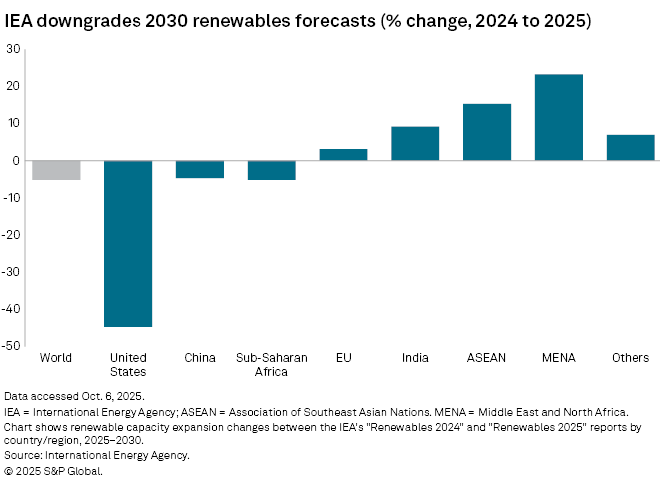
Regionally, the US accounts for the largest discrepancy, with the IEA downgrading its forecast by almost 50% compared to last year after a series of policy reversals by President Donald Trump.
Already this year, the Trump administration has accelerated the phaseout of key federal tax credits for wind and solar, suspended offshore wind leasing and restricted the development of renewables on federal lands. Meanwhile, previous challenges around grid connection backlogs, interconnection delays and tariffs continue to persist in the US, the IEA said.
The organization's updated renewables forecast for the US amounts to 250 GW of new capacity by 2030, with 140 GW of solar and 57 GW of wind removed from its assumptions.
After the US, China accounts for the second-largest absolute cut in forecast capacity, though the 129-GW reduction represents a downward revision of just 5%.
The IEA expects China's renewables capacity to grow nearly 2,660 GW between 2025 and 2030, doubling the previous five-year expansion.
However, growth could be impeded by renewables policy changes announced over the last year, with the country shifting from fixed tariffs to competitive auctions as part of broader electricity sector reforms.
The end of China's previous policy of guaranteed revenues for renewables led to a surge in project completions in the first five months of 2025, with nearly 200 GW of solar and 47 GW of wind installed before activity dropped off sharply.
The shift to auctions represents a "key uncertainty" for renewables growth in China and is "impacting project economics," the IEA said.
2025 set for record
The downward revisions in the US and China are partly offset by what the IEA described as "buoyancy" in other global regions.
Its forecast for Europe is slightly more optimistic than last year, led by utility-scale solar installations in Germany, Spain, Italy and Poland, but offset by a 24% downgrade in offshore wind capacity.
The IEA sees 630 GW of new additions in Europe by 2030, adding that widespread permitting and grid integration challenges continue to hamper faster expansion in certain markets.
Meanwhile, the organization's forecast for India is up 10% while the Middle East and North Africa is up 23%.
A record 685 GW of renewables were installed globally in 2024, and this year is set to be another record year, with the IEA forecasting between 750 GW and 840 GW of new capacity. Annual installations are set to grow to almost 890 GW by 2030.
Solar is set to account for around 80% of the growth between now and 2030, driven by low costs, faster permitting and broad social acceptance, the IEA said.
Overall, global renewable power capacity is expected to reach 2.6 times its 2022 level by 2030, falling short of a pledge set at COP28 to triple capacity to 11,500 GW.
The IEA's main case, which assumes recent cost trends and current policies, sees renewables capacity reaching 9,530 GW in 2030. Under the accelerated case, in which governments address key policy, grid integration, financing and permitting challenges, capacity reaches more than 10,400 GW.