


11 Aug, 2022
Singapore banks' fee income to bounce back once capital markets improve
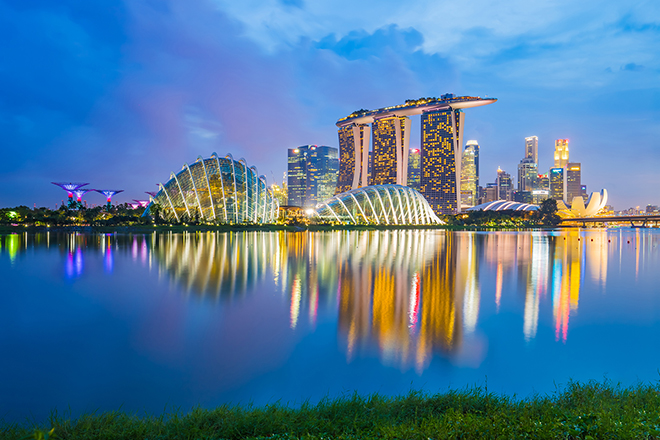 |
| Singapore skyline. The island nation's banks may see their fee income bounce back as markets recover. Source: iStock by Getty Images |
Singapore banks' efforts to boost recurring revenue from fees have taken a temporary hit in the market lull, although analysts expect an improvement once capital markets recover.
Singapore's three largest banks by assets — DBS Group Holdings Ltd., Oversea-Chinese Banking Corp. Ltd. and United Overseas Bank Ltd. — reported year-over-year drops in fee income of as much as 15% in the June quarter amid a decline in stock prices and a reduction in wealth management and investment banking fees since January, according to their recently announced results. Singapore's lenders have grown their income from wealth management and investment banking recently, tapping growing wealth in Asia. Net fee and commission income at all three lenders increased their share in total operating income by nearly 3 percentage points between 2019 and 2021.
"Fee income was a weak point for the Singapore banks, but that's more cyclical and due to capital market conditions, which resulted in weakness in wealth management, fund sales and brokerage," said Michael Wu, senior equity analyst at Morningstar. "There is no change in our view that fee income will continue to increase in the medium term on regional growth."
The S&P 500 index is down about 12% year-to-date as surging prices of raw materials and the spillover effects of the war in Ukraine hurt global economic prospects. The COVID-19 pandemic lingered in several parts of China, with lockdowns further hurting activity. But global equities markets have recovered somewhat on the expectation that sharp monetary tightening by global central banks and steps taken by governments to control prices would bring inflation under control. The bellwether index for global stocks closed at 4,210.24 on Aug. 10, bouncing from a 52-week low of 3,666.77 on June 16.

For the three Singapore banks, wealth management contributes to a material proportion of fees, Thilan Wickramasinghe, Maybank Investment Banking Group's head of research Singapore and head of regional financials, said.
"Wealth management is likely to remain muted with customers staying on the sidelines given current market conditions," Wickramasinghe said. "However, we observe [assets under management] have still grown or remained constant, implying that when market conditions improve, there could be a turnaround in client activity and, thus, wealth management fees."
DBS, which bought Citigroup Inc.'s Taiwanese consumer banking operations in January, and United Overseas Bank, which in the same month bought Citigroup's consumer franchise in four Southeast Asian markets, will also see a fee income boost after the acquisitions are due to close next year, Morningstar's Wu said.
Stable asset quality
Asset quality overall moved in mixed directions year over year for the April-to-June quarter. The nonperforming loan ratio at DBS and Oversea-Chinese Banking dropped to 1.30% from 1.50% in the prior-year quarter, while United Overseas Bank's ratio increased to 1.70% from 1.50%.
"We think asset quality should be a key risk to watch as funding costs to customers rise," Wickramasinghe said. "We think it would be unlikely that any more provisions taken during COVID be written back as banks preserve buffers for uncertainty ahead."
Singapore's banks piled on provisions to endure economic uncertainty during the pandemic, although the banks wrote back some of them in 2021. Current allowance coverage levels are at around 100% across all three banks.
"All three banks have sufficient provisions to ride through most market conditions, and we do not expect them to be hit badly," said Glenn Thum, research analyst, Phillip Securities Research.
Dividends to rise
All three banks reported higher net interest margins and healthy loan growth for the quarter, leading to growth in net interest income, said Ralph Chen, senior research analyst, APAC dividend forecasting at S&P Global Market Intelligence.
"We expect the momentum to continue in the second half of the financial year, and supporting a potentially higher [full-year 2022] final dividend," Chen said.
Banks have declared dividends to be at least the same or higher for the first half compared with the prior-year period. Chen expects DBS' final full-year dividends to be S$1.44 per share, United Overseas Bank's to be S$1.29 per share, and Oversea-Chinese Banking's to be S$0.60 per share.
As of August 10, US$1 was equivalent to S$1.37.