


29 December 2025
DRAM makers prioritize AI data center demand, sparking automotive semiconductor shortage
By Jeremie Bouchaud and Hrishikesh S
Article Summary
Understand the short, medium and long-term impacts of the upcoming DRAM shortage, plus what automakers need to do to build a more resilient supply chain.
As we approach 2026, the automotive industry is bracing for yet another potential crisis: a shortage of dynamic random access memory (DRAM) chips.
This anticipated shortage will not be quite as dramatic as the 2021 crisis—which prevented more than 10 million cars from being built that year—but could potentially be more disruptive and long-lasting than the 2025 Nexperia incident.
The automotive semiconductor shortage and DRAM vulnerability
DRAM is found in the compute-heavy systems in cars, namely in cockpit and in ADAS/Autonomy systems. However, major DRAM manufacturers are increasingly reallocating their wafer capacity toward high-bandwidth memory (HBM) for AI data centers.
The profitability and demand for HBM far exceed those of traditional automotive applications, leaving automakers increasingly vulnerable to an automotive supply chain crunch that could rival the previous shortages.
The perfect storm brewing
.When did this shift begin and why? Here is an overview of the key developments:
The AI boom: The explosion of AI usage following the launch of ChatGPT has accelerated demand for data centers. These data centers rely heavily on GPUs (Graphic Processing Units), with Nvidia becoming a market leader.
Increased DRAM consumption: Each GPU module requires a special type of DRAM called HBM, consuming more wafer area than standard DRAM chips used in vehicles. This shift means that as demand for AI applications grows, the supply for automotive applications diminishes.
Manufacturing challenges: DRAM manufacturers did not foresee this explosion in demand, and there is now a deficit of capacity for DRAM wafer fabrication. While new investments in capacity have surged since 2023, is still takes years to build a new wafer fab.
Profit margins: The margins for DRAM in data centers are significantly higher than those for automotive applications. This has led the top three DRAM makers—Samsung Electronics, SK Hynix, and Micron Technology—to prioritize their resources for data centers over automotive needs.
Phasing out older technologies: Additionally, these manufacturers are phasing out older technologies like DDR4 and LPDDR4, which are still widely used in automotive applications. This shift has already sparked panic among OEMs and tier 1 suppliers, reminiscent of the rush to secure components during the 2021 crisis.

The impact on the automotive industry
Vehicles are increasingly reliant on DRAM chips. While entry-level segments may use relatively modest memory footprints, high-end vehicles with advanced cockpit experiences and greater autonomy features require significantly more DRAM to support rich infotainment systems, continuous sensor processing, and over-the-air updates. This trend applies across both electric and internal-combustion platforms, with premium segments driving the need for higher-density DRAM modules.
However, the production choices made by DRAM manufacturers are creating a potential chokepoint in automotive electronics. The previous shortages primarily involved analog components and microcontrollers, but the looming DRAM shortage could disproportionately affect premium vehicles, where DRAM value per vehicle can range from less than $10 in basic models to over $100 in high-tech vehicles.
Navigating the upcoming shortage
In this environment, supply chain resilience is crucial. OEMs and tier 1 suppliers may wish to build buffer inventory as DRAM makers pivot to data center applications, but this strategy offers limited long-term relief.
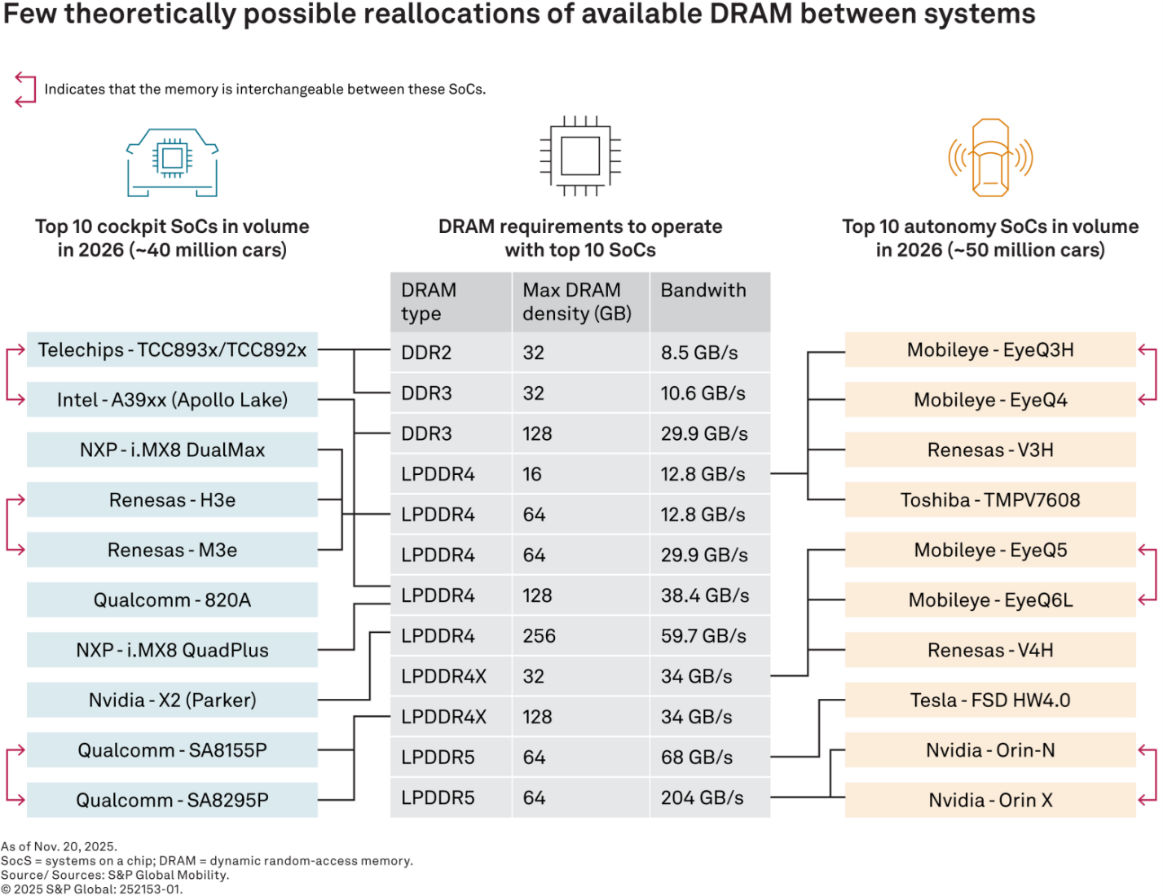
The variety of DRAM types used in modern vehicles complicates the situation further. Unlike analog or microcontroller components, memory chips are not easily interchangeable across vehicle systems. As a result, while inventory buffers may delay the impact of the shortage, they cannot resolve the structural supply imbalance created by the shift toward HBM production.
Strategic decisions ahead
Automakers face tough decisions as they navigate this landscape. We anticipate the main impacts of this crisis to arrive in two phases.
2026-2027: Price-elastic supply, anecdotal shortages
DRAM suppliers have clarified that the retirement of DDR4 and LPDDR4 is for consumer products, however it will still be in production for automotive for a few years (S&P estimates through end of 2027).
In 2026 and 2027, DRAM capacity will be constrained but elastic. If automotive clients are ready to pay more to match the wafer value DRAM makers would get from other industries, then they will get the volume they need.
For new contracts, this means that DRAM prices could rise between 70% and 100% in 2026 compared to 2025 prices. This a significant increase for premium cars with advanced cockpit and autonomy feature which already had north of $150 of DRAM in 2025. The average DRAM value in 2025 in an A segment vehicle is around $24.
While the additional chip cost is eroding the margin of OEMs, car makers will be able to stomach it as we saw with higher cost increase triggered by US tariffs in 2026. We don’t expect that the DRAM price increase will impact the Light Vehicle production.
We could also see some anecdotal disruption to car production triggered mostly by panic buying however. Indeed the DRAM shelves are currently being emptied and an artificial shortage may occur.
2028 and beyond: Automakers will need to redesign their cockpit and autonomy/ADAS systems
Beginning in 2028 and beyond, the supply of older generation DRAM for automotive will rapidly dry, no matter how much automakers are willing to pay.
The majority of cars currently planned for production in 2028 have cockpit and ADAS designs using old gen DRDR4 and LPDDR4, which will no longer be available. The top 10 cockpit designs, and 8 of the top 10 ADAS designs in 2028 are forecast to use DDR4 and LPDDR4.
Therefore, the industry has two years to change its designs and migrate to newer generation LPDDR5, which will still be in production by 2028. While two years is enough time to make this transition, all stakeholders—processor suppliers, cockpit and autonomy/ ADAS Tier 1 suppliers, and OEMs—must rapidly act.
Looking ahead: The future of DRAM in automotive
The automotive sector must prepare for longer-lasting structural constraints on supply as the landscape continues to evolve. While the top three DRAM makers currently account for 88% of automotive DRAM supply, there is no quick fix to the capacity issue. The industry must remain vigilant, adapting to the challenges posed by the booming AI data center market while ensuring that the needs of automotive applications are not sidelined.
As the industry grapples with the implications of the upcoming DRAM shortage, strategic planning, timely action, and collaboration across the supply chain will be crucial in navigating this complex landscape.
OEMs and suppliers must prioritize their strategies, focusing on securing DRAM supply while also investing in new technologies that will define the future of mobility. The shift towards AI and advanced electronics is not just a trend; it is the future of the industry. By understanding the dynamics at play and being proactive, the automotive sector can mitigate the risks of the upcoming DRAM shortage and emerge stronger.
Stay ahead of the DRAM semiconductor market
S&P Global Mobility’s E/E and Semiconductor Service provides clients with timely, accurate data and intelligence on the automotive semiconductor industry as well as other key technologies affecting vehicle electronics and electrical architectures.
Clients can quickly gain insights into market developments, place events and technology trends in context, dive into granular forecasts, and seamlessly drive analytics to support challenging decision making.
Planners and strategists use our E/E & Semiconductor Service to:
- Assess and forecast new E/E and semiconductor technology growth
- Analyze competition and understand OEM purchasing strategies
- Evaluate customer technology adoption paths
This article was published by S&P Global Mobility and not by S&P Global Ratings, which is a separately managed division of S&P Global.