













































Executive Summary
Principal protected products that provide a stream of income, support accumulation or facilitate wealth transfer and legacy planning are playing an increasingly significant role within the global wealth management landscape. Because of this, index-linked annuity and life products have seen strong growth in recent years.
The S&P 500® has long been at the forefront of the indexed insurance market. However, market and interest rate volatility can create uncertainty in crediting rates within these products, thus creating a need for indices that employ volatility-control mechanisms that may offer more rate stability.
This paper will explore:
- The growth of volatility-controlled indices (VCIs) in tandem with the growth in the U.S. fixed indexed annuity (FIA) market—as well as the more recent growth of the APAC indexed universal life (IUL) market;
- How and why VCIs have performed across various market environments and navigated market volatility; and
How VCI technology has evolved to meet the needs of modern markets.
Growth of the U.S. FIA Market and Rise of VCIs
The U.S. FIA market has seen meaningful growth. From 2014 to 2025, U.S. FIA sales grew from USD 47.8 billion to USD 128.2 billion—a compound annual growth rate of 9.4%—with 2025 marking the fifth consecutive year of annual sales growth. LIMRA has forecast FIA sales to reach all-time highs of USD 132.7 billion by 2028.
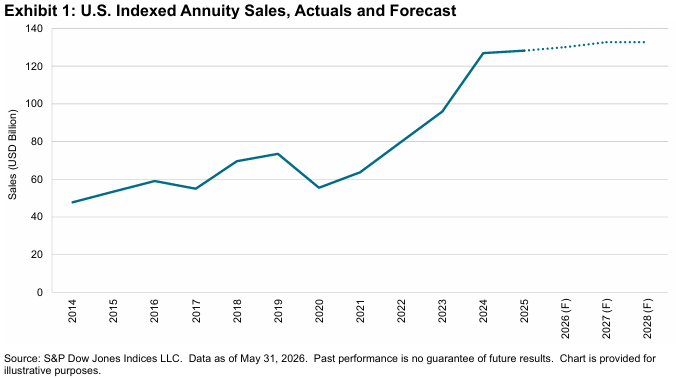
As the market for indexed annuities has grown meaningfully since the introduction of the FIA (in 1995)—which offered crediting based on the S&P 500—so too has the volume and complexity of the indices used within these products. Today, more than 200 VCIs are actively offered in the U.S. FIA market.
VCIs—also referred to as risk-controlled indices—are a category of indices that target a specified level of volatility by dynamically adjusting exposure between one or more risky assets (such as equities or gold) and a volatility dampener (such as cash or Treasuries). Unlike traditional benchmark indices that can be sensitive to market volatility, VCIs aim to deliver a smoother volatility profile over time. This stability may facilitate hedge efficiencies in principal protected insurance products, thus giving rise to VCIs’ popularity in the U.S. FIA and IUL market. S&P Dow Jones Indices (S&P DJI) pioneered the first VCIs in 2009, in the wake of the 2007-2008 Global Financial Crisis in response to the extreme volatility experienced during that time. The S&P 500 continues to be the world’s most widely referenced equity index, serving as the foundation for many VCI strategies used in both the U.S. and international insurance markets. There is more than USD 35 billion in assets tied to S&P DJI VCIs in indexed insurance products, with FIAs driving most of that figure. Examples of S&P DJI indices that are widely used in insurance products include the following.
