












































Celebrating 25 Years of iBoxx Indices and the Evolution of the ETF Ecosystem
Introduction: From Niche Exposure to Market Infrastructure
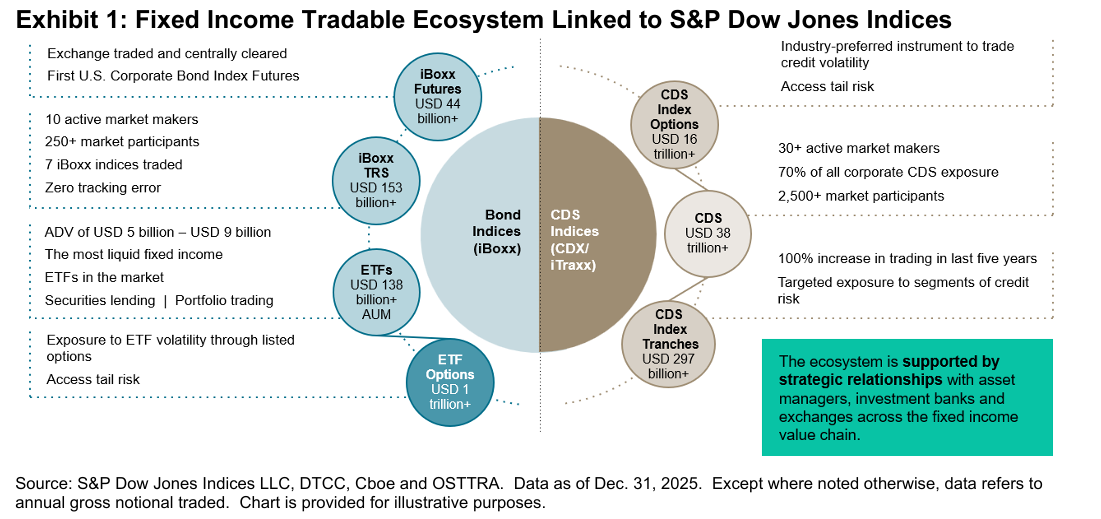
Corporate bond markets are no longer a collection of isolated products. They operate as a connected chain: transparent index rules standardize a fragmented, over-the-counter universe; ETFs convert those benchmarks into exchange-traded exposures; the ETF primary market links shares back to cash bond baskets; portfolio trading transmits that demand into the underlying securities; and a widening derivatives complex allows the same standardized exposure to be hedged, financed and transferred. Each link makes the next one more efficient.
This framing applies across the credit spectrum. In investment grade (IG), scale and breadth make standardization a tool for core allocation, duration positioning and transition management. In high yield (HY), where bond-level trading is more episodic, standardization is what makes diversified exposure investable at all. Over 25 years, iBoxx indices have not just built a benchmark series, they have built market infrastructure.
That transformation is most visible in high yield. Once considered a relatively illiquid and operationally intensive asset class, high yield has evolved into a core allocation for many investors, supported by the rapid growth of ETFs. But the same forces have reshaped investment grade, where scale, electronification and standardized index exposure have made benchmark-based implementation central to core allocation, duration management and transition management. The two markets differ in starting point but not in outcome: transparent index rules make credit exposure tradable at scale.
At the center of this evolution is the interplay between transparent index design, advances in portfolio management and the development of a robust capital markets ecosystem. Together, these elements have enabled fixed income ETFs to scale, providing investors with efficient, liquid and cost-effective access to markets that remain fragmented at the individual security level.
Just as importantly, the ETF story is not simply an asset growth story. It reflects a broader shift in how credit exposure is defined, transferred and implemented. What was once primarily a bond-by-bond market has increasingly developed around standardized, index-based units of exposure that can be used in multiple wrappers. In that context, the index does more than measure the market: it creates a common reference point for investors, portfolio managers, liquidity providers and derivatives markets. That common reference point is a tool that helps allow credit risk to move more efficiently across the ecosystem.
S&P DJI has played a foundational role in this development. Over 25 years, our indices have evolved alongside the market, supporting innovation, ensuring relevance and enabling implementation at scale.