










































Launched in March 1957, the S&P 500 is widely regarded as the best single gauge of large-cap U.S. equities and is one of the most quoted indices by financial media and social finfluencers. The U.S. equity barometer has come to serve as the basis for a multitude of investment products around the world, with over USD 20 trillion estimated to be indexed or benchmarked to The 500® at the end of 2024.
Reinforcing The 500’s status as the gold standard U.S. equity benchmark, the U.S. Treasury recently announced that, at launch, all contributions to Trump Accounts will be invested in an S&P 500-based product.
In light of this decision, market participants may be curious to learn more about the S&P 500, and so this paper:
- Provides a brief overview of the S&P 500; and
- Shows the hypothetical growth of S&P 500-based allocations.
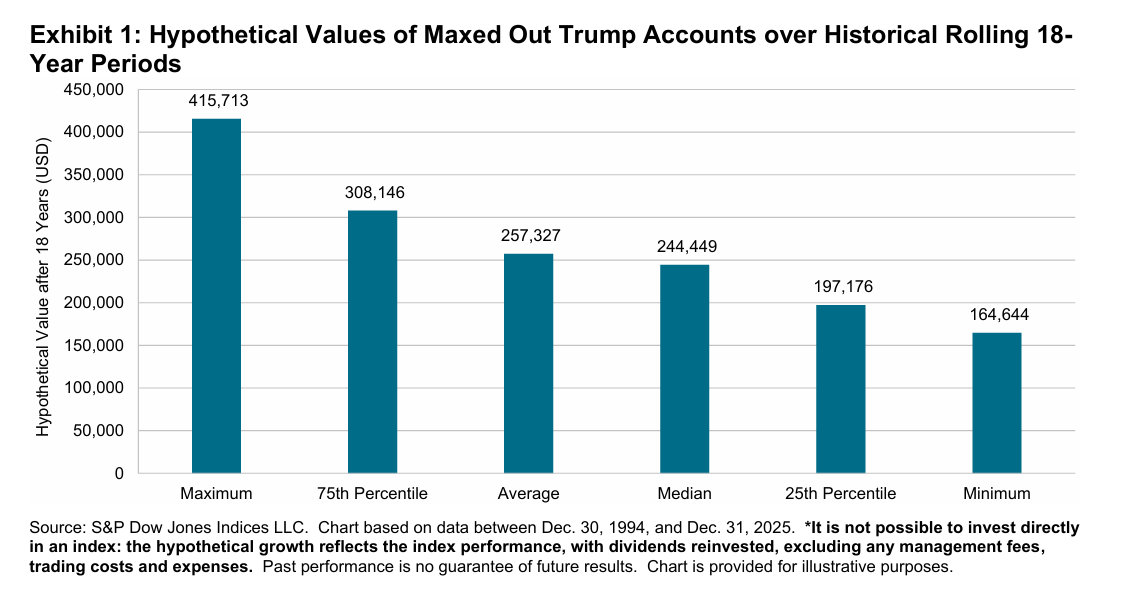
Exhibit 1 provides summary statistics for the hypothetical growth for maxed out Trump Accounts allocated entirely to the S&P 500 across rolling 18-year periods. Considering historical index performance, with dividends reinvested, and excluding any management fees, trading costs and expenses, the average hypothetical value was more than USD 250,000 under various stylized assumptions.
Introducing the S&P 500
The S&P 500 is designed to measure the performance of the large-cap U.S. equity segment and is widely regarded as the best single gauge of large-cap U.S. equity performance. The 500 companies in the index accounted for approximately 90% of the entire U.S. equity market capitalization at the end of 2025.
Crucially, the S&P 500 does not necessarily include the largest 500 U.S.-domiciled companies: companies must first meet various criteria before they are eligible to be considered for addition to the index. For example, firms must have a history of positive earnings and must meet certain liquidity and size thresholds. Exhibit 2 summarizes the S&P 500 addition criteria outlined in the publicly available S&P U.S. Indices Methodology.
Satisfying the addition criteria does not guarantee S&P 500 inclusion: the Index Committee that maintains the index according to the publicly available methodology also considers sector balance when considering constituent changes. Also, the addition criteria are not used for determining continued S&P 500 membership for existing constituents because the Index Committee seeks to avoid index turnover when possible. This means that existing S&P 500 stocks that may no longer satisfy one or more of the addition criteria are not automatically deleted from the index.
